Whether a Shar Pei’s Eyes Limit Its Peripheral Vision
It's a common sight for Shar Pei owners: your dog turns its entire head to look at something, rather than just shifting its gaze like many other breeds. You might wonder if they're just being particular, or if there's more to it. The truth is, that distinctive head shape and those wonderful wrinkles that make our Shar Pei so unique also create a real-world limitation when it comes to their peripheral vision. This guide will delve into why their eyesight is structured this way and, more importantly, how understanding this helps you create a safer, happier environment for your beloved companion.
Understanding the Unique Visual World of a Shar Pei
Our Shar Pei are truly one-of-a-kind, and much of what makes them distinct also influences how they perceive the world around them. While we often focus on their intelligence and sometimes their stubborn streak, their physical attributes play a huge role in their day-to-day experience, especially when it comes to sight. Their deep-set eyes and abundant facial folds aren't just cosmetic; they significantly impact what your Shar Pei can and cannot see without moving their entire head.
The Anatomy Behind Restricted Sight
The most obvious factor contributing to a Shar Pei's limited peripheral vision is, of course, their famous wrinkles. Imagine trying to see out of the corner of your eye if you had a soft curtain draped just inches from your temples. That's a bit like what it's like for a Shar Pei, especially those with particularly prominent facial folds. These loose folds of skin, a hallmark of the breed, can physically obstruct the dog's side view. It's not just the wrinkles, though. The way their eyes are set deeper within their skull, combined with the compact nature of their head, further limits their field of vision compared to breeds with more protruding eyes or leaner faces.
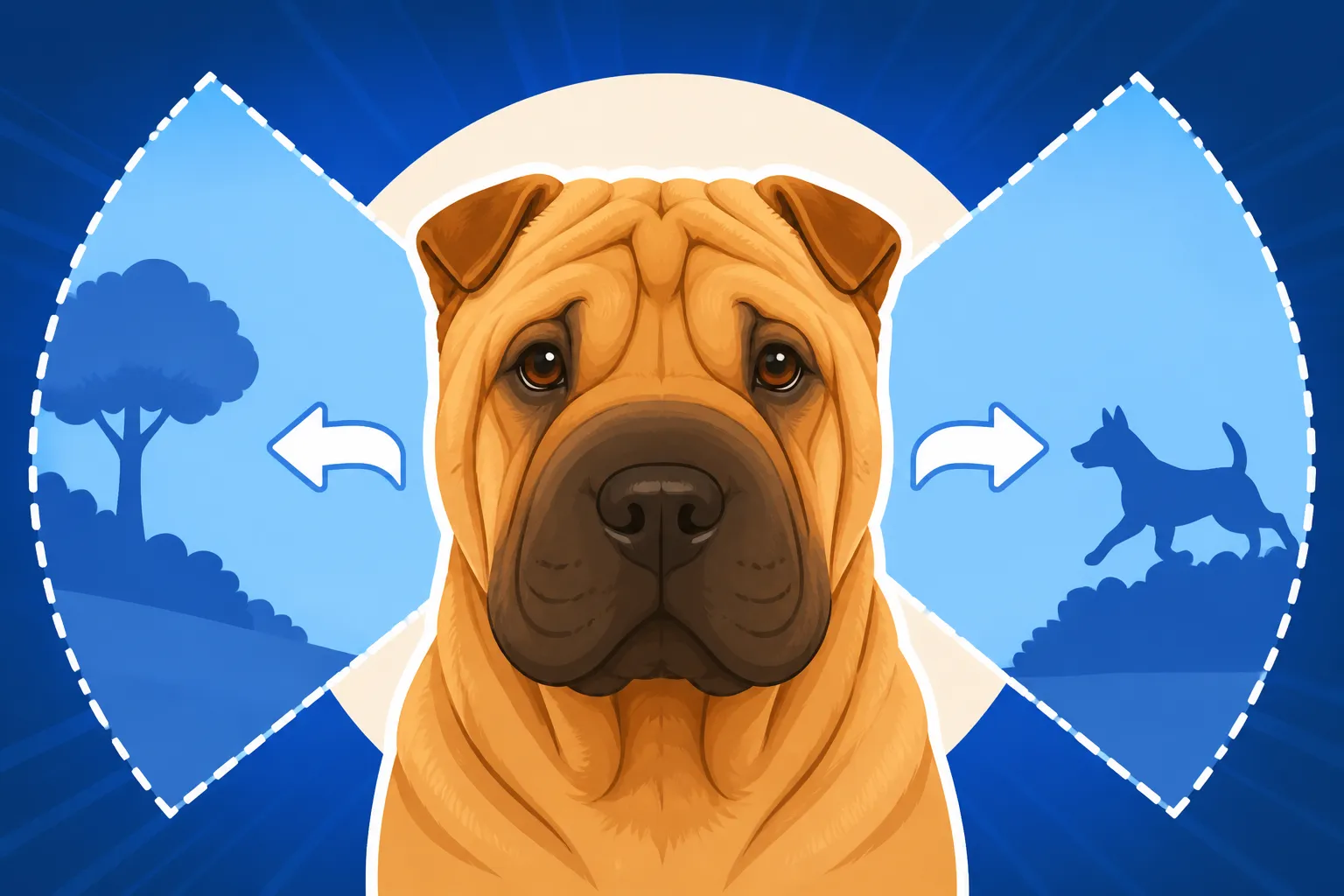
This anatomical setup means a Shar Pei has a significantly narrower arc of vision to its sides than, say, a Labrador Retriever or a Greyhound. Where many dogs have a visual field that can extend up to 240 degrees or more, allowing them to detect movement quite far to their left or right without turning their head, a Shar Pei's field is considerably reduced. This isn't a defect, but a characteristic of the breed's unique conformation. Owners must understand that this isn't a sign of inattention or disobedience; it's a physical limitation that shapes how your dog interacts with its surroundings.
For some Shar Pei, particularly puppies or individuals with excessive wrinkling, this can be exacerbated by conditions like entropion, where the eyelid rolls inward, causing eyelashes to rub against the cornea. While entropion is a medical issue that needs immediate attention, even without it, the sheer volume of skin can create visual blind spots. Whether a Shar Pei's Eyes Limit Its Peripheral Vision is a fundamental question, and the answer is a resounding yes, purely due to their fascinating physical design.
Beyond the Wrinkles: Eye Placement and Field of View
Beyond the skin folds, the actual placement of a Shar Pei's eyes on its skull contributes to its unique visual experience. Their eyes are set relatively forward, giving them good binocular vision (depth perception straight ahead), which is useful for tracking objects directly in front of them. However, this forward placement often comes at the expense of wider peripheral vision. It's a trade-off in canine anatomy – breeds with eyes set more to the sides tend to have broader peripheral vision but less depth perception directly in front.
Think about the difference between a predator's eyes (like a cat, or even us) that are forward-facing for hunting, and a prey animal's eyes (like a rabbit) that are set far to the sides to detect danger from any angle. While Shar Pei aren't strictly predators in the wild, their eye placement leans more towards that forward-focused perspective. The characteristic "squinty" appearance isn't just because of the wrinkles; it also relates to the deeper set of their eyes, further narrowing their effective field of view to the sides. This means that a stimulus that might barely register as a flicker in another dog's side vision would be completely invisible to your Shar Pei without a full head turn. Why a Shar Pei Turns Its Whole Head to Look becomes less of a quirky habit and more of a necessary adaptation to their visual limitations.
This also means that the world appears less "open" to a Shar Pei. They process visual information in a more focused, tunnel-like way. This can make them seem highly observant when looking directly at something but surprisingly oblivious to things happening just slightly outside that direct line of sight. Understanding this is crucial for preventing unexpected reactions and ensuring their comfort and safety in various environments.
Navigating the World: Practical Impacts of Narrow Vision
The impact of limited peripheral vision extends far beyond a simple head turn; it fundamentally shapes how your Shar Pei experiences and reacts to the world. It can influence everything from their social interactions with other dogs and people to their safety in busy environments. As responsible owners, recognizing these implications allows us to anticipate potential issues and adjust our interactions accordingly.
Startle Reflex and Social Interactions
One of the most significant consequences of a Shar Pei's restricted side vision is an increased likelihood of being startled. Imagine walking along, focused straight ahead, and suddenly someone or something appears right next to you, seemingly out of nowhere. Your natural reaction would be a jump, a gasp, or a sudden defensive posture. This is precisely what can happen to a Shar Pei. A person approaching from the side, another dog appearing unexpectedly, or a sudden movement just outside their direct line of sight can trigger a strong startle response. This isn't aggression; it's a natural reaction to a perceived sudden threat when they simply didn't see it coming. How a Shar Pei Shows Affection or even How a Shar Pei Warns Before It Reacts might be misinterpreted if you don't account for their visual limitations.
This heightened startle reflex can, unfortunately, be mistaken for reactivity or aggression, especially towards other dogs. If your Shar Pei is engrossed in sniffing a lamp post and another dog approaches from its side, the sudden appearance could lead to a quick, defensive snap or growl. This isn't because your dog is inherently unfriendly, but because it felt surprised and potentially cornered. It's vital for owners to be proactive in managing these situations. For instance, when meeting new people or other dogs, always ensure the approach is frontal and slow, allowing your Shar Pei to see them clearly from a distance. Consider positive reinforcement training that encourages your dog to regularly check in with you, keeping their focus forward and reducing the chance of being caught off guard. BAXTER & Bella, for example, offers excellent online programs that emphasize these foundational skills.
In a multi-dog household, this can also be a factor. While many Shar Pei can live peacefully with other dogs, understanding their visual blind spots is key. Another dog nudging them from the side could lead to an unexpected reaction, even if they're usually tolerant. Teaching children to approach the Shar Pei gently and from the front is also paramount to prevent unintended startling. How to Teach Children to Approach a Shar Pei is an important read, as kids often move quickly and unpredictably, which can be particularly unsettling for a Shar Pei with narrow vision.
Environmental Awareness and Safety Considerations
Beyond social interactions, limited peripheral vision can pose real safety challenges for your Shar Pei, especially in busy or unpredictable environments. Walking near roads, in crowded parks, or navigating obstacles can become more hazardous. A car pulling out of a driveway to the side, a cyclist approaching, or a child darting into their path might not be registered until they are almost directly in front of the dog. This makes them more reliant on their other senses, like hearing and smell, but these don't offer the same immediate warning as direct visual input.
Consider a walk in your neighborhood. While you might scan traffic from left to right, your Shar Pei primarily focuses on what's directly ahead. This means you, as the handler, become their "eyes" for peripheral threats. It requires a much more attentive approach to leash handling and environmental scanning on your part. Using a sturdy, non-restrictive harness and a reliable leash can help you guide your dog safely. Products found on Amazon, for example, offer a wide range of reflective harnesses that can improve visibility in low light, adding another layer of safety, and some are designed to keep your dog closer to your side, allowing for better management.
Furthermore, this visual limitation can affect their ability to navigate unfamiliar spaces or detect subtle environmental cues that other dogs might pick up on. For example, a sudden drop-off to the side of a path, or a low-hanging branch, might not be noticed until they are right upon it. Therefore, maintaining a watchful eye on their environment, offering clear verbal cues, and keeping them on a shorter lead in complex areas become even more important for Shar Pei owners.
Here's a quick comparison of general canine vision versus the Shar Pei's visual characteristics:
| Feature | General Canine Vision (Average) | Shar Pei Vision (Approximate) | Impact of Shar Pei Vision |
|---|---|---|---|
| Field of View | 240-270 degrees | 180-200 degrees (or less) | Significant blind spots to the sides. |
| Binocular Vision | 30-60 degrees | Good, focused straight ahead | Good depth perception directly in front. |
| Peripheral Vision | Strong | Limited, obstructed by folds | Prone to startling from side approaches. |
| Eye Placement | Varies, often semi-lateral | Deep-set, forward-leaning | Enhances frontal focus, reduces side view. |
| Wrinkles/Facial Folds | Minimal or none | Prominent | Physical obstruction of visual field. |
| Head Movement | Can shift gaze easily | Often turns entire head | Necessary to compensate for narrow vision. |
Empowering Your Shar Pei: Strategies for Owners
Understanding your Shar Pei's visual limitations is the first step, but empowering them to live a full, confident, and safe life in spite of it is where the real work and joy comes in. By making conscious adjustments to our routines and interactions, we can help our beloved companions thrive. It's about building trust, clear communication, and creating an environment where they feel secure.
Enhancing Communication and Attention
Because your Shar Pei can't always see what's happening to their sides, verbal communication becomes even more critical. Think of yourself as providing a running commentary on the world. Using consistent verbal cues for approaching people, dogs, or changes in direction can significantly reduce startling. Simple cues like "car," "person," or "watch it" can alert your Shar Pei before something enters their narrow field of vision, giving them time to process and react calmly rather than defensively. This proactive communication builds a stronger bond and increases their confidence in you as their guide.
Training for attention is paramount. Teaching a solid "watch me" or "look" command can redirect your Shar Pei's focus to you, helping them disregard peripheral distractions or potential surprises. Practice this in various environments, starting in quiet, low-distraction areas and gradually increasing the challenge. Positive reinforcement, using high-value treats and enthusiastic praise, will make these exercises fun and rewarding for your dog. Online dog training resources, like those offered by BAXTER & Bella, can provide structured programs and support for building these essential communication and attention skills, which are particularly valuable for a breed with specific visual needs. Consistency is key here; make it a daily habit to engage your Shar Pei's attention, turning what might be a limitation into an opportunity for deeper connection.
It's also crucial to remember that your body language plays a huge role. Approaching your Shar Pei from the front, speaking to them softly as you near, and giving them a moment to acknowledge you before reaching out can prevent unnecessary startle responses. How a Shar Pei Feels About Being Petted often depends on their comfort level and whether they felt surprised by the approach. Always give them a chance to register your presence visually and verbally.
Creating a Safe and Predictable Environment
Making adjustments to your home and walking routines can go a long way in ensuring your Shar Pei feels secure. Indoors, try to avoid placing their bed or crate in high-traffic areas where people or other pets might constantly pass by their blind spots, which can lead to stress or repeated startling. A quiet corner where they can see who is approaching them head-on will make them feel much more at ease. Pay attention to how they navigate corners or narrow spaces in your home, and ensure paths are clear.
When out and about, consider the timing and location of your walks. Avoiding peak hours in crowded parks or bustling sidewalks can reduce the number of sudden, unexpected encounters. Opt for quieter routes or times of day when there's less unpredictable movement. If you're walking in an area with potential hazards (like a busy street or a dog park with off-leash dogs), keeping your Shar Pei on a shorter leash, such as those available on Amazon with comfortable handles and reflective stitching for visibility, allows for quicker reactions and better control on your part. How Far a Shar Pei Should Walk Daily needs to be balanced with their ability to safely navigate the environment, especially on warmer days when overheating is a concern.
Finally, always be an advocate for your Shar Pei. Politely inform strangers or well-meaning dog owners about your dog's limited vision. A simple "Please approach from the front, he can't see well from the side" can prevent many awkward or potentially reactive situations. Regular veterinary check-ups are also important, especially given that conditions like entropion can worsen vision. Whether a Shar Pei's Eyes Should Be Checked Yearly is a good question for your vet, ensuring any treatable conditions that might further impair sight are caught early. By being proactive and understanding, you can help your Shar Pei confidently navigate their unique visual world.
Disclaimer
This article is for general informational purposes only and does not constitute professional advice. Laws, prices and regulations vary by location and change over time. Consult a qualified professional for guidance on your specific situation.