Whether the Shar Pei Herded
A Shar Pei’s history is often described in broad terms: farm dog, guard dog, hunter, or working dog. That can make it sound as though the breed was a livestock herder, too. The evidence is less clear. This guide separates what is reasonably known about the Shar Pei’s traditional work from assumptions based on the jobs other rural dogs performed.
Was the Shar Pei traditionally used for herding?
The short answer is not as a specialist herding breed
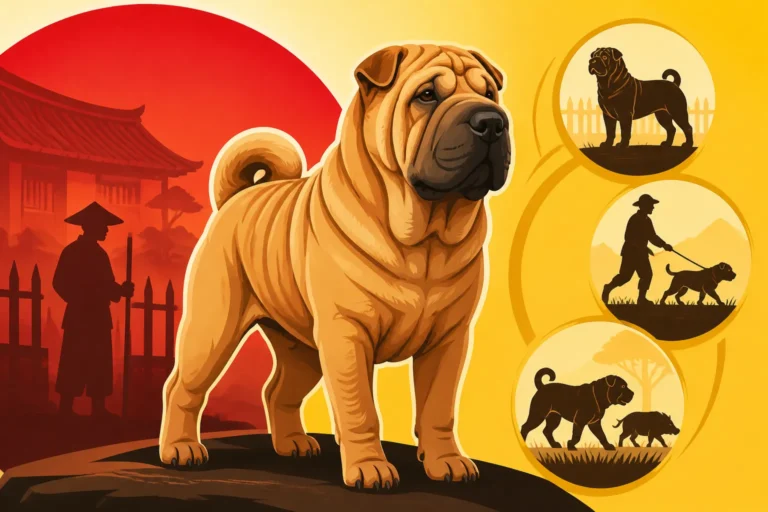
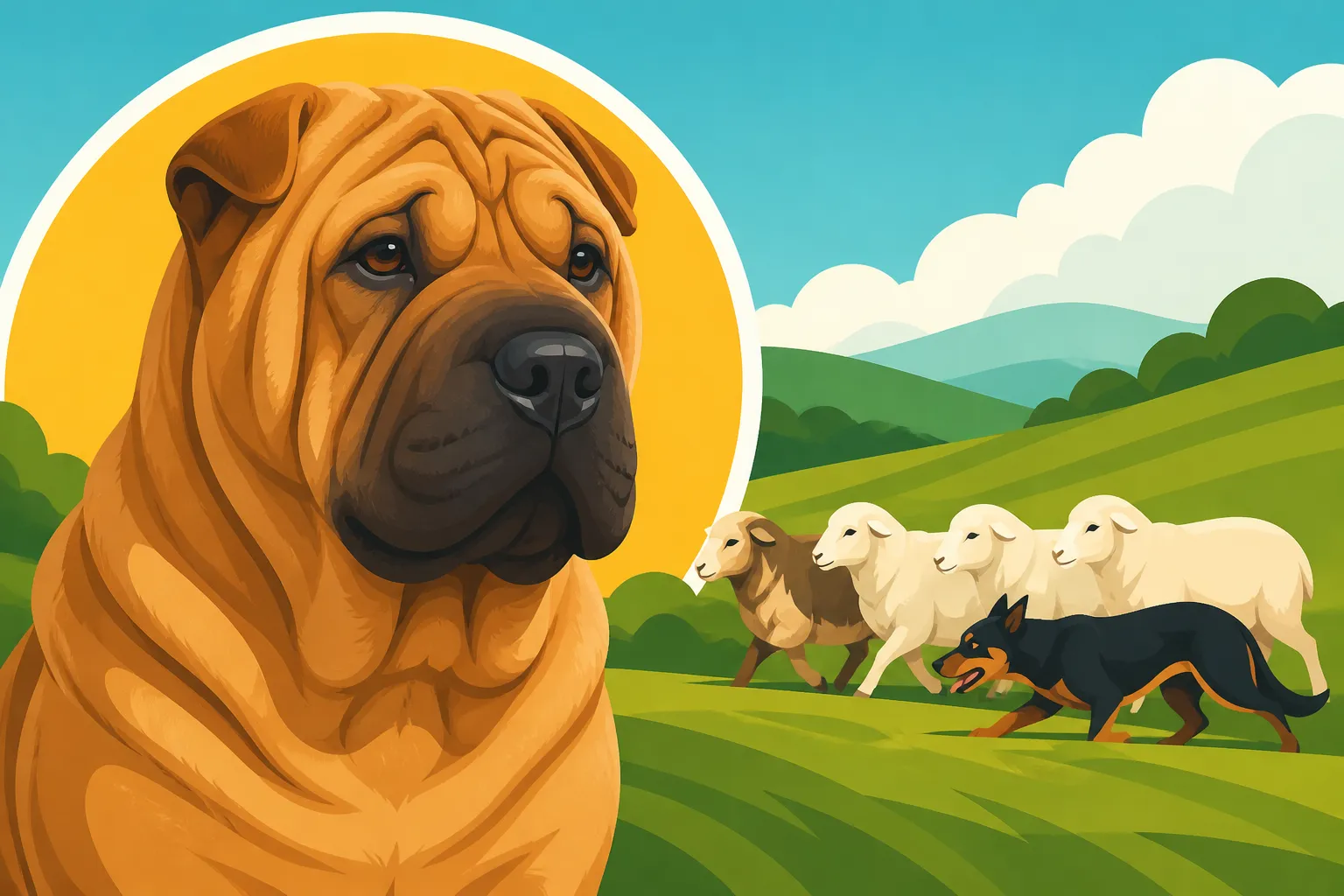
The Shar Pei is not generally described as a traditional herding specialist in the way breeds developed to gather, drive, or control livestock are. Its historical reputation is more closely associated with guarding property and families, hunting, and taking on a range of practical jobs in rural communities. Those roles could overlap on a farm, but overlap is not proof that a dog was bred specifically to herd.
There is an important distinction here. A dog can live around livestock, alert people when animals move, or help protect a farm without being a herding dog. Herding involves guiding or controlling the movement of animals, often through selected behavior and training. Guarding involves deterring threats and staying watchful. A dog might perform more than one task, but the terms do not mean the same thing.
Historical records about the breed’s exact working duties are limited, so it is sensible to avoid confident claims that every Shar Pei herded livestock—or that none ever did. The more careful answer is that herding is not one of the breed’s best-established defining jobs. For a broader overview of the breed’s traditional roles, see What the Shar Pei Was Used for in China.
Rural work could be varied
Dogs in rural settings did not always have one neat job description. A household dog might guard a home, accompany someone outdoors, hunt small game, and live near farm animals. That does not mean it had the specialized instincts or training associated with a dedicated herding breed. It does mean that an individual dog’s day-to-day work could depend on its household and local conditions.
This distinction matters because people sometimes read “farm dog” as shorthand for “herding dog.” But a farm needs more than livestock management. A dog might warn of strangers, discourage predators, or simply be a companion around the property. Those jobs can be valuable without involving the deliberate movement of sheep, cattle, or other animals.
The Shar Pei’s history is also discussed through several different working roles, and accounts do not always agree about the details. It is more reliable to say the breed had a broad working background than to assign it a precise job where the evidence is uncertain. What Job the Shar Pei Held in Rural China explores that wider context.
Why the herding claim can be hard to pin down
Many familiar descriptions of old breeds were written down or popularized long after the dogs were doing their original work. Details can be repeated without a clear record of where they came from. Over time, “used on farms” may become “herded livestock,” even when the original account meant guarding or general farm work.
A similar issue comes up when people compare the Shar Pei with breeds known for controlling livestock. A shared rural setting does not establish a shared function. Herding breeds are often selected for traits that help them respond to movement and direct animals; a guardian may instead be expected to assess a situation independently and hold its ground. Those tendencies can look quite different in everyday life.
It is also possible for an individual Shar Pei to chase, circle, or try to control the movement of another animal. A behavior that resembles herding does not prove the breed was historically developed for that purpose. Dogs can develop movement-related habits through play, excitement, training, or their individual temperament.
What work is the Shar Pei better known for?
Guarding and watchfulness
The Shar Pei is commonly described as a watchful, independent dog with a background that included guarding. A guardian’s task is not to move livestock from one place to another; it is to notice changes, assess what is happening, and respond to a possible threat. That history helps explain why a Shar Pei may be reserved around unfamiliar people rather than naturally eager to greet everyone.
This does not mean every Shar Pei will guard in the same way, or that every dog will be suspicious. Temperament, early experiences, socialization, and training all matter. But an owner who expects a dog with a guardian background to behave like an outgoing herding breed may misread normal caution as disobedience or a lack of friendliness.
For new owners, it helps to learn how the breed’s guarding history can shape its behavior today. A Shar Pei Was Bred to Guard, Not to Greet looks more closely at that contrast, while Why a Shar Pei Is Aloof With Strangers covers what reserve can look like in ordinary situations.
Hunting and general utility
Hunting is another role often associated with the Shar Pei’s working background. As with many historical breed accounts, the exact details of how frequently or in what circumstances dogs were used can be difficult to establish. Still, hunting and general utility fit more naturally into the breed’s commonly described history than specialized livestock herding.
A dog used for practical work may also have needed to make decisions without constant direction. That is different from assuming it would automatically respond to repeated commands or enjoy a long, repetitive training session. A Shar Pei can learn, but its independent nature may mean that clear rewards, patient practice, and short sessions work better than expecting instant, automatic compliance.
That independence can also create confusion when an owner sees a Shar Pei watching or following another animal. Observation is not necessarily herding. Chasing is not necessarily herding. If a dog is fixating on livestock, cats, or smaller dogs, the priority is safe management and training—not guessing at an ancestral job. What a Shar Pei Was Originally Bred to Do provides more context on the mix of roles linked with the breed.
A farm setting is not a job title
A Shar Pei that lived on a farm might have encountered animals regularly. It may have guarded a yard or accompanied people through the property. That still does not tell us that the dog was trained to gather animals or guide them through gates and pastures.
This is true of many working dogs. “Farm dog” describes a setting, while “herding dog” describes a specific type of work. A dog can be useful on a farm without doing every job associated with farm life. The same applies to guarding: living near livestock does not necessarily mean a dog was responsible for protecting them from predators.
| Description | What it generally means | Does it establish that a Shar Pei herded? |
|---|---|---|
| Farm dog | A dog that lived or worked around a farm | No |
| Guard dog | A dog used to watch or protect people, property, or animals | No |
| Hunting dog | A dog involved in finding or pursuing game | No |
| Herding dog | A dog used to direct or control livestock movement | Yes, if there is evidence it performed that role |
| Individual dog that circles or chases | A behavior observed in one dog | No, not by itself |
Can a modern Shar Pei show herding behavior?
Individual behavior is not breed history
A modern Shar Pei may chase a moving animal, run alongside a bicycle, or circle another dog during play. These behaviors can look like herding, but they can have several causes. A fast-moving object can trigger excitement or pursuit; rough play can involve circling; and a dog may repeat a behavior because it has been rewarded with attention or movement.
Watch the full pattern rather than labeling one action. Is the dog responding to livestock movement, or is it simply chasing anything that runs? Can it disengage when called? Does it become tense, bark, nip, or try to block an animal’s path? These details help determine whether the behavior is playful, overexcited, or a safety concern.
If your Shar Pei is showing strong interest in livestock, do not test whether it can “herd” by letting it loose around animals. Livestock can be frightened or injured, and a dog can be kicked, trampled, or chased. Keep a secure barrier or leash between the dog and animals while you work out a safe management plan.
How to handle chasing around animals
Start by preventing opportunities to rehearse the behavior. Use a secure fence, leash, or long line where appropriate, and keep enough distance that your dog can notice livestock without lunging or becoming unable to respond. If your dog is already fixated, calling repeatedly from close range may not be enough to bring its attention back.
Reward calm choices early. For example, when your Shar Pei glances at a sheep and then turns back toward you, mark that moment with a calm cue and a suitable reward. Practise at a distance where the dog can still think. Gradually work closer only if the dog remains responsive and the setting is safe. If you are using treats or toys, a familiar reward from home—or a suitable option picked up from a local shop or a retailer such as Chewy—can help make practice more consistent.
Do not punish a dog for noticing an animal or rely on harsh corrections to stop chasing. Those approaches can increase stress without teaching the dog what to do instead. If there is lunging, snapping, a history of contact with livestock, or a dog that cannot disengage, ask a qualified trainer or veterinary behavior professional to help you make a safe plan. For everyday interactions with unfamiliar dogs and other animals, How a Shar Pei Behaves Toward Other Dogs offers related guidance.
Give the dog useful outlets
A dog with energy or a strong interest in movement needs appropriate activities, whether or not that interest has anything to do with herding. Sniffing walks, food-search games, short training sessions, and puzzle activities can provide mental work without putting livestock or wildlife at risk. Keep activities suited to the individual dog, its health, and the weather.
For example, you might scatter part of your dog’s meal in a safe patch of grass and let it search, or teach a simple “look at me” cue in a quiet area before practising around more distractions. A puzzle feeder or other enrichment item can be useful indoors; Chewy is one place owners may look for everyday pet supplies, but the important part is choosing something safe and appropriate for the dog. Supervise new toys, especially if your dog tends to chew or swallow pieces.
Enrichment is not a substitute for management around animals. A dog that has rehearsed chasing may still chase after a long sniffing walk. Keep barriers and leash rules in place, and treat training as one part of a broader safety routine. If the dog’s behavior is escalating, get professional guidance rather than waiting for it to resolve on its own.
How to think about the Shar Pei’s working history
Separate what is known from what is assumed
When you read about an old breed, look for whether a claim describes a documented, specialized role or uses a broad phrase such as “worked on farms.” Those statements are not interchangeable. If a source says the Shar Pei was around livestock, that alone does not prove it gathered or drove animals.
It is also helpful to distinguish breed tendencies from the behavior of one dog. A Shar Pei that chases chickens may need careful supervision and training, but that does not make herding a defining trait of the breed. A Shar Pei that ignores livestock is not somehow failing to perform an ancestral duty.
This measured approach avoids two common mistakes: assuming a Shar Pei should naturally herd because it has a rural working background, and assuming an individual dog can safely interact with livestock because it belongs to a particular breed. In both cases, the dog’s actual behavior and the safety of the animals matter more than a broad label.
Set expectations for the dog in front of you
If you are choosing a Shar Pei, focus on the temperament and history of the individual dog. Ask about its experience around livestock and other animals, and observe how it responds to movement at a safe distance. A breeder, rescue group, or previous owner may be able to describe the dog’s behavior, but no description replaces careful supervision.
If you already have a Shar Pei, you do not need to make it a herding dog to provide a satisfying life. Training, calm exploration, and suitable enrichment are more useful goals than trying to recreate a historical job that is not well established for the breed. Some owners use everyday supplies such as a sturdy lead, treats, or a puzzle feeder; Chewy may be one convenient retailer to browse, alongside local pet shops and other options.
The simplest answer remains the most accurate: the Shar Pei is not generally recognized as a traditional specialist herding breed. It is better understood as a versatile working dog with a history more often associated with guarding, hunting, and general rural duties. A modern Shar Pei may still chase or circle animals, but that behavior should be assessed and managed on its own merits—not treated as proof of the breed’s historical role.
Disclaimer
This article is for general informational purposes only and does not constitute professional advice. Laws, prices and regulations vary by location and change over time. Consult a qualified professional for guidance on your specific situation.