Whether a Shar Pei Learns From Another Dog
It’s a common heartwarming scene: an older, wiser dog patiently showing a new puppy the ropes, whether it's where to potty, how to play, or even how to "ask" for a treat. Many of us hope that if we bring a well-behaved canine companion into our home, our new dog will simply absorb all those good manners through osmosis. But with a Shar Pei, whose independent spirit and unique breed traits shape so much of their behavior, the idea of them "learning from another dog" isn't quite as straightforward as it might seem. This guide will explore the nuances of peer learning for our beloved wrinkly friends, delving into how they observe, what truly influences them, and how we, as their dedicated humans, can best support their learning journey in a multi-dog household.
The Shar Pei's Unique Learning Style
When we talk about dogs learning from each other, we often picture highly biddable breeds, eager to please and quick to mimic. However, the Shar Pei, with its distinct history and personality, approaches the world, and indeed learning, through a different lens. Their heritage wasn't about cooperative hunting or flock management, but rather a more self-reliant existence.
Innate Independence vs. Observational Learning
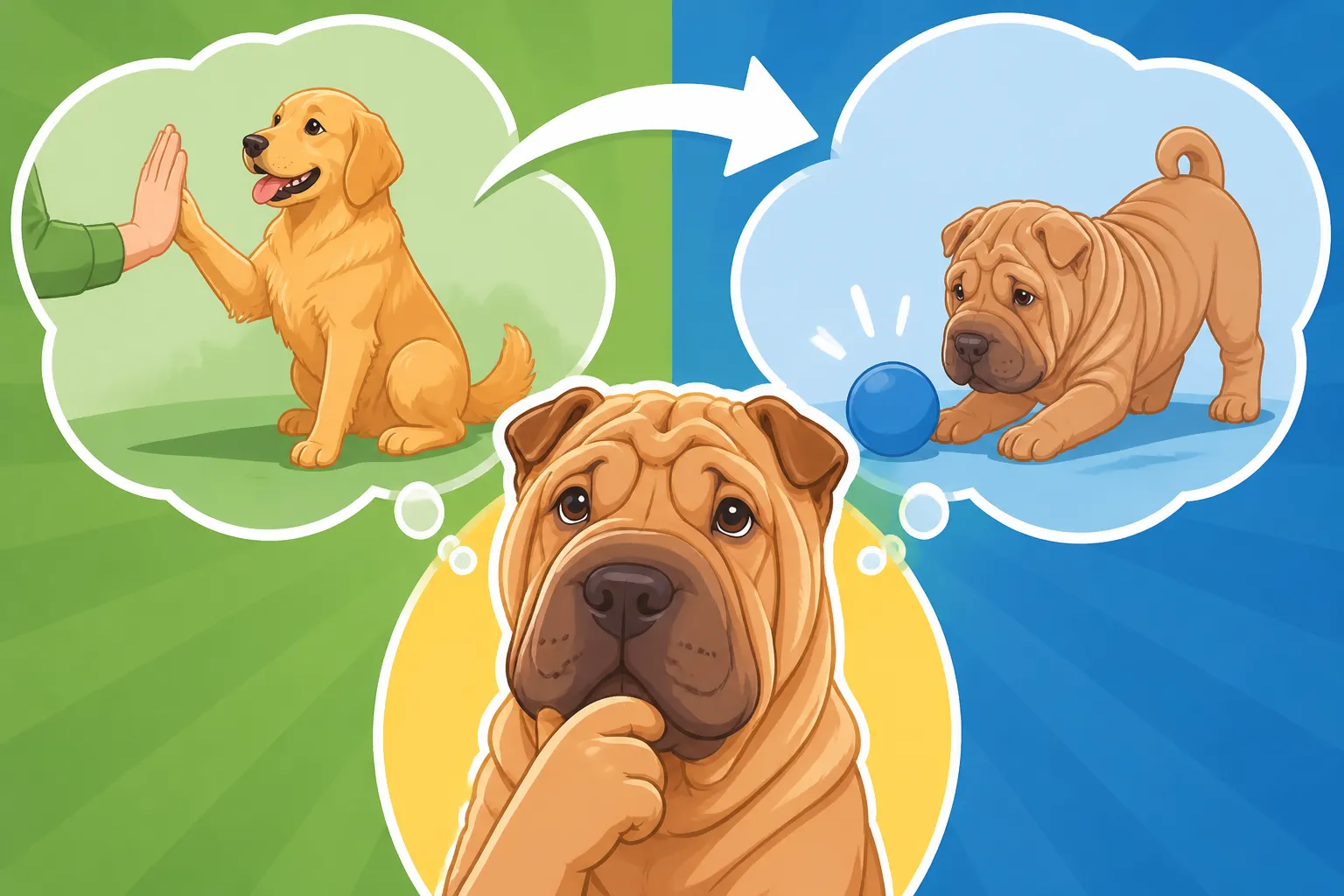
Shar Pei were historically valued for their guarding instincts and self-sufficiency, often working alongside peasants or protecting property. This translates into an innate independence that can sometimes be mistaken for stubbornness. They are thinkers, certainly, but they often think for themselves rather than defaulting to mimicking others. While a Golden Retriever might watch another dog perform a trick and try to emulate it to earn praise, a Shar Pei is more likely to assess the situation for its own benefit. "What's in it for me?" is often their unspoken question. This isn't to say they can't learn by observation, but their motivation to act on that observation is often deeply rooted in their own perceived self-interest or a strong bond with their primary human.
Furthermore, a Shar Pei's physical characteristics can impact their observational learning. Their deep-set eyes and wrinkled brows often restrict their peripheral vision, meaning they literally cannot see as much of the world around them as many other breeds. This can make subtle body language cues from other dogs harder to pick up. If they miss these crucial signals, their ability to fully understand and replicate a behavior might be hindered. This limited field of vision is also why a Shar Pei might startle easily if approached unexpectedly, which is an important consideration when evaluating their interactions with other animals. Why a Shar Pei Startles: It Cannot See You Coming
Selective Mimicry: What They Choose to Learn
Because of this inherent independence, a Shar Pei tends to be a selective mimic. They aren't going to learn everything from another dog, but they might pick up on specific behaviors that they find advantageous or deeply ingrained in the household routine. For instance, if you have an older, house-trained dog who reliably signals to go outside, a Shar Pei puppy might quickly learn to mimic that signal, not necessarily because they want to "be like" the older dog, but because they quickly grasp that this action leads to relief and avoids trouble. It's a pragmatic approach to learning.
Similarly, if the resident dog barks at every squirrel, mailman, or passing car, a Shar Pei might quickly adopt this alert barking behavior. This aligns with their natural guarding instincts, making it a behavior that resonates with their genetic predisposition. They might learn that barking is an effective way to communicate perceived threats or territorial claims. Why a Shar Pei Guards Its Food and Its Doorway However, if the older dog has a boundless enthusiasm for retrieving toys, a Shar Pei might observe it but not necessarily participate, unless a strong play drive or specific reward system is put in place for them. Their motivation has to be intrinsic or directly tied to a reward they value. The strongest motivator for a Shar Pei often remains the bond and relationship they share with their primary human, rather than peer pressure.
Positive and Negative Peer Influence
Bringing a second dog into the household with a Shar Pei, or introducing a Shar Pei puppy to an existing canine resident, can have both wonderful and challenging outcomes when it comes to learning. The key lies in understanding the dynamics and being proactive in shaping the environment.
Learning Good Habits From a Well-Adjusted Companion
When structured correctly, a well-adjusted, confident, and polite older dog can indeed be a fantastic role model for a Shar Pei, especially a puppy. Imagine introducing a young Shar Pei to a calm, house-trained Labrador who patiently waits at the door before going out, never jumps on guests, and settles quietly for naps. The Shar Pei puppy might observe these routines and, through consistency and positive reinforcement from you, begin to adopt similar behaviors. They learn the rhythm of the house, where the acceptable potty spots are, and how to greet visitors in a more appropriate manner. This isn't just about mimicry; it's about learning the social contract of the household.
It's crucial that the resident dog isn't just "good," but also has a temperament that complements the Shar Pei's more independent and sometimes reserved nature. A dog that is overly boisterous, constantly demanding interaction, or easily stressed might actually hinder, rather than help, a Shar Pei's learning. Instead, a calm, secure dog provides a stable presence, teaching through example rather than overwhelming insistence. This modeling can extend to things like appropriate chew toys, settling down during quiet times, or even the general cadence of walks.
Picking Up Undesirable Behaviors
Unfortunately, the reverse is also true. A Shar Pei can just as easily pick up less desirable habits from another dog. If the existing dog barks incessantly at the fence line, resource guards toys, or displays leash reactivity, a Shar Pei, especially a impressionable puppy, might learn these behaviors through observation. Dogs, particularly those with strong instincts like the Shar Pei, are incredibly good at learning what works to get a desired outcome, even if that outcome isn't what we humans want. For example, if the resident dog whines or paws at you for attention and it consistently works, your Shar Pei might quickly add that to their own repertoire of attention-seeking behaviors.
One significant area where negative peer influence can be problematic is in dog-on-dog interactions. If your resident dog is prone to Leash Reactivity in a Shar Pei or displays pushy or aggressive tendencies towards other dogs, your Shar Pei might learn to mirror that defensiveness or confrontational approach. This can be especially challenging because Shar Pei already tend to be selective about their canine companions. Witnessing or participating in negative interactions can reinforce a perception that other dogs are threats, making future socialization efforts much harder. Breaking these learned bad habits can be a long and arduous process, often requiring dedicated training and management strategies.
The Role of the Human in Multi-Dog Households
Regardless of how many dogs you have, you remain the most crucial element in your Shar Pei's learning and development. While peer influence can be a factor, it should never be seen as a substitute for direct, consistent human training and guidance. Your Shar Pei ultimately looks to you for direction, security, and the rules of the house. In a multi-dog setting, you're not just training one dog; you're orchestrating an entire social dynamic.
This means you need to actively manage interactions, reward desired behaviors from both dogs, and gently redirect unwanted ones. If your older dog is modeling excellent potty habits, make sure to praise and reward your Shar Pei when they follow suit. If the older dog is prone to jumping, you must actively train both dogs not to jump, so your Shar Pei doesn't see it as an acceptable behavior. Consistent expectations and clear communication from you will reinforce the positive lessons and mitigate the negative ones. Consulting with a professional trainer can be incredibly helpful in multi-dog households, especially for a breed like the Shar Pei, to ensure that the learning environment is productive for everyone.
Practical Strategies for Multi-Dog Learning Environments
To maximize the chances of positive learning and minimize negative influences when a Shar Pei lives with other dogs, intentional strategies are essential. It’s not just about letting them figure it out; it’s about careful curation of their environment and interactions.
Careful Companion Selection
If you are considering adding a second dog to a Shar Pei household, or bringing a Shar Pei puppy into a home with an existing dog, the selection of the companion animal is paramount. For a Shar Pei, whose nature can be reserved and independent, the ideal "teacher" dog is typically one that is calm, confident, and well-socialized, without being overly exuberant or demanding. A dog that is secure in itself and doesn't feel the need to constantly challenge or dominate is often the best match. An older dog that is patient and tolerant of puppy antics, but also sets clear boundaries, can be incredibly beneficial.
Avoid pairing an undersocialized or fearful Shar Pei with a dog that is equally anxious, dominant, or prone to resource guarding, as this can amplify existing issues. Similarly, a very high-energy, constantly "in-their-face" breed might be overwhelming for a Shar Pei, who often appreciates personal space. Always introduce dogs gradually and under close supervision, ideally in a neutral territory, before integrating them fully into the home. Observing How a Shar Pei Behaves Toward Other Dogs during these initial meetings can provide invaluable insight into their potential compatibility and learning dynamic.
| Behavior Type | Chances of Peer Learning (Shar Pei) | Conditions for Success | Potential Pitfalls |
|---|---|---|---|
| House Training | High (if resident dog is good) | Clear routine, positive reinforcement from human, resident dog's consistency | Inconsistent resident dog, human not reinforcing |
| Greeting Habits | Moderate to High | Calm, polite resident dog, human-led structured greetings, consistent expectations | Overly excitable or fearful resident dog, lack of human guidance |
| Play Style | Moderate | Patient resident dog, appropriate play boundaries, human supervision and intervention | Rough resident dog, resource guarding, Shar Pei's natural play style |
| Alert Barking | High | Resident dog barks at stimuli, Shar Pei's natural guarding instinct | Resident dog barks excessively, lack of human redirection |
| Destructive Chewing | Moderate to High | Resident dog chews inappropriate items, lack of alternative enrichment, unsupervised time | Good chew habits from resident dog, ample appropriate chews for both |
| Leash Manners | Low to Moderate | Resident dog has excellent leash manners, consistent human training with both dogs | Pulling, reactivity from resident dog, human allowing inconsistency |
Structured Training vs. Free-Form Learning
While it's lovely to think dogs can just teach each other, with a Shar Pei, relying solely on free-form peer learning is a gamble. It simply isn't a substitute for formal, structured training led by you. Think of it this way: your Shar Pei might learn how to use the dog door from another dog, but they won't learn a "sit-stay" or a reliable recall without your direct instruction. The independent nature of a Shar Pei means they need clear, consistent guidance from their human.
However, you can absolutely integrate both dogs into your training sessions. This means working with them both individually and sometimes together, ensuring they both understand the same commands and expectations. If you're teaching "stay," have both dogs practice it, perhaps with the more experienced dog acting as a calm presence, but always reinforce your Shar Pei directly. Consistency in rules and expectations for all dogs in the household is vital. For example, if one dog is allowed on the sofa, both should be, or neither. This prevents confusion and resentment, which can undermine any positive learning dynamic.
Managing Socialization and Exposure
Other dogs, particularly well-behaved ones, can be an excellent component of a Shar Pei puppy's When a Shar Pei Puppy Should Meet New People program. Exposure to calm, confident adult dogs can teach a puppy appropriate canine social cues – how to greet, when to back off, and how to engage in play. This early, positive exposure is critical for a breed that can otherwise be reserved with strangers and other animals. However, it's vital to remember that "socialization" isn't just about meeting other dogs; it's about positive experiences in many different environments, with people, sounds, and sights.
Human guidance is paramount during these interactions. You need to be the moderator, ensuring play doesn't become too rough or over-arousing, and that your Shar Pei is having a positive, rather than frightening or overwhelming, experience. Controlled exposure to various dogs and environments, rather than just throwing them into a dog park, will yield much better results. Supervise playdates carefully, ensuring that all dogs involved are polite and that your Shar Pei isn't being intimidated or learning aggressive responses.
When a Second Dog Isn't the Answer
While many Shar Pei can thrive in multi-dog households, it's important to recognize that not every situation or every dog is suited for peer learning or even for having a canine companion. Sometimes, a single-dog household is truly the best environment for a Shar Pei to flourish.
Recognizing When Peer Learning Isn't Working
It's crucial to be observant and honest about whether your Shar Pei is truly benefiting from having another dog around. Signs that peer learning isn't working, or is even having a negative impact, can manifest in several ways. You might notice increased anxiety in your Shar Pei, perhaps displayed as withdrawal, excessive panting, or subtle signs of stress around the other dog. There might be aggression, either towards the other dog in the household or towards dogs outside the home, which could be a learned response (see How a Fearful Shar Pei Becomes Aggressive). Regression in training, such as house-training accidents or ignoring known commands, can also indicate underlying stress.
Sometimes, the issue isn't aggression but simply a lack of positive interaction. Your Shar Pei might tolerate the other dog but never truly engage in play or companionship, preferring their own space. This signals that while they might coexist, they aren't necessarily learning or benefiting from the relationship in a significant way. The Shar Pei is a breed that bonds deeply with its human family but can be indifferent or even confrontational with other canines, so a The Shar Pei in a Multi Dog Household needs careful consideration. If you're seeing persistent tension, stress, or the development of undesirable behaviors that seem tied to the presence of another dog, it's time to re-evaluate the situation.
Alternative Learning and Socialization Methods
If a multi-dog household isn't the right fit, or if your Shar Pei simply isn't a natural peer learner, there are plenty of effective alternative strategies to ensure they are well-trained and well-socialized. Rely more heavily on human-led training, making yourself the primary source of guidance and reinforcement. This often involves positive reinforcement methods, using high-value treats and praise to motivate your independent Shar Pei. For structured guidance, online training programs, such as those offered by BAXTER & Bella, can be a fantastic resource, allowing you to work at your own pace and focus on your dog's individual needs.
Socialization, in this context, can involve carefully managed one-on-one playdates with known, stable, and polite dogs. These are controlled environments where you can ensure positive interactions without the overwhelm of a dog park. Puppy classes or obedience courses, where the focus is on human-led training with other dogs present in a structured setting, can also be beneficial. Don't forget the power of solo adventures: walks in varied environments, puzzle toys from Amazon, and enrichment activities that challenge their minds and bodies. These experiences, tailored to your Shar Pei's comfort level, will help them build confidence and develop into well-adjusted companions, even without a constant canine teacher by their side.
Disclaimer
This article is for general informational purposes only and does not constitute professional advice. Laws, prices and regulations vary by location and change over time. Consult a qualified professional for guidance on your specific situation.