The Shar Pei in Agility
Many Shar Pei owners wonder if their uniquely structured and notoriously independent companions can ever truly participate in dog sports like agility. It's a common frustration, seeing those incredibly agile Border Collies or speedy Shelties flying through courses, and then looking at your laid-back, sometimes stubborn, and often short-sighted Shar Pei, thinking, "There's no way." This guide is here to tell you that while your Shar Pei might not be destined for Westminster, they absolutely can enjoy and benefit from agility, provided you understand their specific needs and adapt your expectations.
The Shar Pei Temperament and Physical Realities in Agility
Before you even think about setting up a jump, it’s crucial to understand the inherent traits of a Shar Pei that will influence their agility journey. These aren't golden retrievers eager to please, and their unique physical build presents its own set of challenges. Ignoring these realities will only lead to frustration for both you and your dog.
The Independent Streak and How It Plays Out
Let's be honest, the Shar Pei is not known for its overwhelming desire to be a people-pleaser. They were bred for guarding, for independent thought, and that "I'll do it if I want to" attitude is hardwired. This independent streak is perhaps the biggest mental hurdle for agility. You won't find a Shar Pei blindly following commands just because you asked. They need to understand the "why" or, more accurately, the "what's in it for me?"
In an agility class, you might see other dogs eagerly waiting for their cue, eyes fixed on their handler. Your Shar Pei, on the other hand, might be sniffing the ground with great interest, observing the clouds, or simply giving you the side-eye as if to say, "Are we still doing this?" This isn't defiance, it's just their nature. This means your training approach needs to be incredibly motivating and consistent, leaning heavily into positive reinforcement. You can't force a Shar Pei to do anything; you have to make them want to do it. Remember, The Headstrong Streak Nobody Trains Out of a Shar Pei is a real thing, and it applies as much to agility as it does to anything else.
Navigating the World with Restricted Vision
One of the most defining physical characteristics of a Shar Pei is their deep-set eyes, often partially obscured by their impressive head wrinkles. While those wrinkles are undeniably charming, they significantly reduce a Shar Pei's peripheral vision. Imagine trying to run an obstacle course when you can only clearly see what's directly in front of you. This can make them prone to startling and can certainly impact their ability to accurately gauge jumps or find tunnel entrances quickly.
When designing or practicing an agility course, you need to be acutely aware of this limitation. Obstacles that require quick turns or tight angles might be particularly challenging. Your dog might bump into things they didn't see coming from the side. You, as the handler, will need to be very clear and present, almost acting as their "eyes" for the periphery, guiding them verbally and with body language well in advance of the obstacle. It's a bit like playing a slow, deliberate game of charades, where clear, exaggerated cues are your best friend. This is directly related to Why a Shar Pei Startles: It Cannot See You Coming.
Physical Considerations: Joints, Skin, and Heat Tolerance
Beyond temperament and vision, the Shar Pei's physical structure demands careful consideration. Their deep skin folds, while iconic, can lead to skin fold dermatitis, especially if they rub or chafe during vigorous activity. Choosing the right harness or ensuring their skin is meticulously clean and dry after exercise is paramount. You might find that some standard agility equipment harnesses don't fit well or cause irritation.
Then there's the concern for joints. While not every Shar Pei will suffer from hip or elbow dysplasia, these can be breed predispositions, and the impact of repetitive jumping and hard landings needs to be managed. It's important to monitor for signs of discomfort and modify activities if necessary. Consult with your vet to understand your individual dog's joint health, especially before embarking on a high-impact sport. Agility, by its nature, involves quick movements and jumps, so a solid physical foundation is essential. The question of Whether a Shar Pei Gets Hip Dysplasia is always a valid one for active dogs.
Finally, heat tolerance is a major factor. Shar Pei are a brachycephalic-adjacent breed, meaning their shorter muzzles can make them less efficient at cooling themselves than dogs with longer snouts. Combine this with their dense coat, and they are prone to overheating quickly. Agility sessions, especially outdoors in warmer weather, can quickly become dangerous. You'll need to prioritize cooling methods, short sessions, and access to plenty of water. A cooling vest from a brand available on Amazon, for example, could be a real lifesaver on a warm day, helping to keep their core temperature down.
Crafting an Agility Training Approach for Your Shar Pei
Given their unique attributes, you can't just jump into an agility class expecting your Shar Pei to perform like a border collie. A tailored approach, steeped in patience and positive reinforcement, is the only way to go.
Motivation is Key: Finding What Truly Drives a Shar Pei
This cannot be stressed enough: a Shar Pei needs a reason to perform. For some, it might be a specific high-value treat – cheese, cooked chicken, or perhaps even a forbidden piece of hot dog. For others, it might be a favorite squeaky toy or a quick, energetic game of tug. Understanding What Motivates a Shar Pei is the absolute bedrock of successful training, whether it's for basic obedience or complex agility sequences.
You'll want to have an arsenal of these motivators readily available during training. Don't be afraid to experiment. What worked yesterday might not work today, especially with a breed that can be mercurial in its enthusiasm. If your dog isn't responding, it's not being stubborn out of malice; it simply means your motivation isn't compelling enough at that moment. Agility, by its very nature, is a game, and for a Shar Pei, it must feel like a game worth playing. If it starts to feel like a chore, they will shut down, and progress will grind to a halt.
Keeping Sessions Short, Sweet, and Positive
The Shar Pei is not built for endless repetition. Their attention spans can be shorter than average, especially for tasks that don't immediately appeal to their instincts. Long, drawn-out training sessions are a recipe for boredom and disengagement. Instead, aim for multiple, very short sessions throughout the day – perhaps 5-10 minutes each. This keeps the activity fresh and prevents your dog from becoming mentally fatigued or deciding they've "had enough."
Every session should end on a positive note, even if it means finishing with a trick they already know perfectly or simply a big party with treats and praise for a small success. The goal is to build positive associations with agility. If they leave a session feeling frustrated or bored, they'll be less enthusiastic to start the next one. This strategy aligns perfectly with understanding How Long a Shar Pei's Training Session Should Be. It's about quality over quantity, always. You want your Shar Pei to think, "Oh, good, we're doing that fun thing again!" not "Ugh, here we go."
The Importance of a Strong Foundation in Basic Obedience
Before you introduce complex agility equipment, your Shar Pei needs to have rock-solid basic obedience skills. A reliable "stay," "come," and "wait" command are not just useful for safety; they are the building blocks of communication that will enable your dog to understand agility cues. If your dog doesn't respond reliably to "come" in a distracting environment, asking them to navigate a set of weave poles will be an exercise in futility.
Work on these foundational commands in various environments, gradually increasing distractions. Use positive reinforcement consistently. You'll find that if your Shar Pei trusts you and understands your expectations in everyday scenarios, they'll be much more receptive to learning new behaviors on the agility course. Consider supplementing your in-person training with online resources. For instance, programs like those offered by BAXTER & Bella often provide step-by-step guidance on building these foundational skills, using positive, reward-based methods that are ideal for a Shar Pei's sensitive yet independent nature. A solid foundation is crucial; trying to rush into advanced behaviors without it will only lead to frustration for both of you, especially given that a Shar Pei can sometimes Why a Shar Pei Ignores a Cue It Knows even when they fully understand it.
Adapting Agility Equipment and Environment for Shar Pei Success
Standard agility courses are designed with the typical agility dog in mind—often high-drive, fast, and agile breeds. For a Shar Pei, adaptations are not just recommended, they are essential for safety and enjoyment.
Modifications for Jumps, Tunnels, and Weave Poles
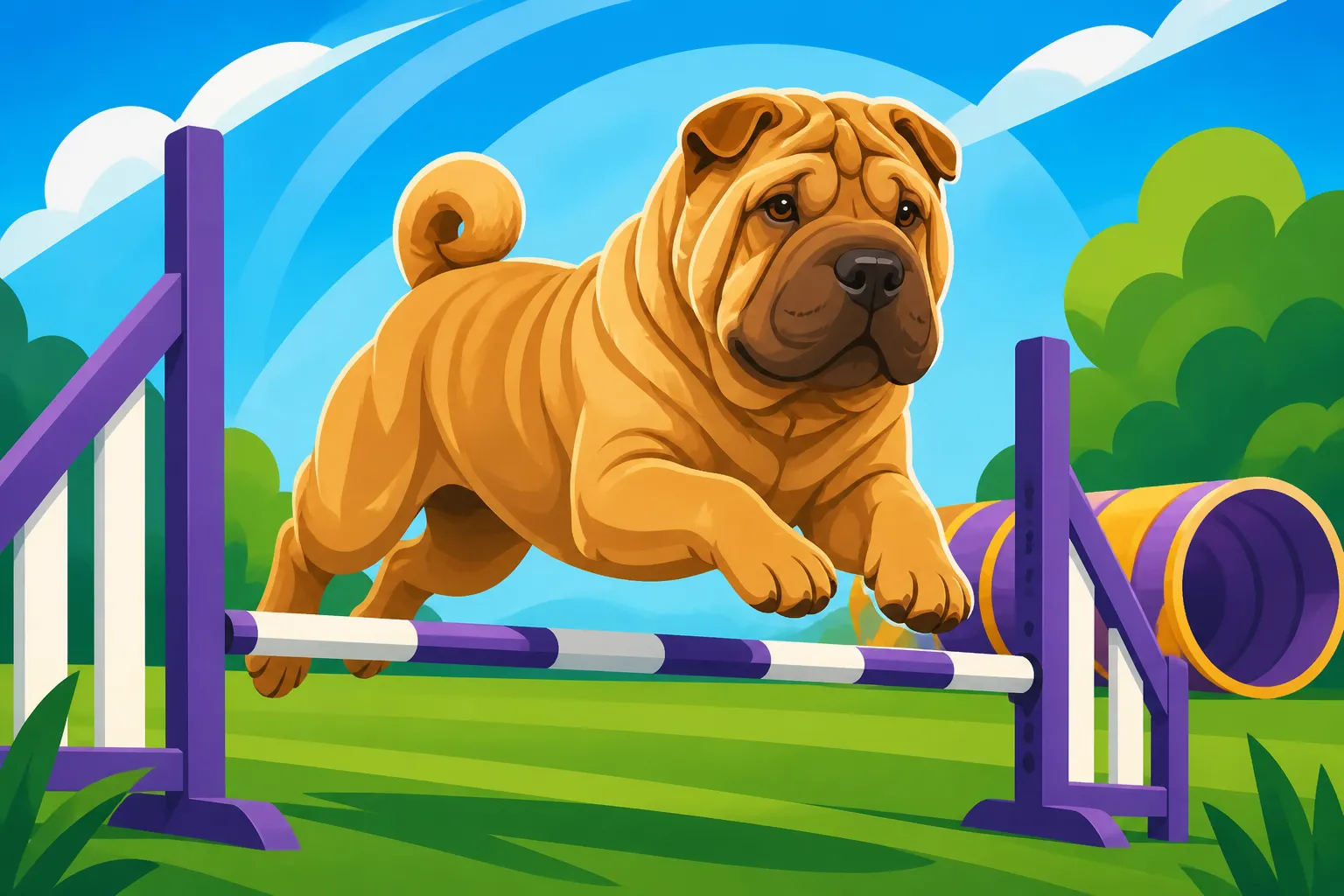
When it comes to jumps, always start low. Very low. Even if your Shar Pei could technically clear a higher jump, consider the impact on their joints, especially if they have a tendency towards conditions like Whether a Shar Pei Gets Hip Dysplasia. Focus on proper form and confidence before even thinking about increasing height. Ground-level bars or even just stepping over objects can be a great starting point. The goal isn't to clear Olympic-sized hurdles; it's to engage their minds and bodies safely.
Tunnels are often a Shar Pei favorite, as they love to explore. However, ensure the tunnel is stable and wide enough so they don't feel claustrophobic or bump their delicate eyes. Start with a very short, straight tunnel, enticing them through with treats or a favorite toy. Gradually increase the length and introduce gentle curves. Remember their limited peripheral vision, so make the entrance clear and inviting.
Weave poles can be the trickiest obstacle for any dog, let alone a Shar Pei. These require intricate body movements and focus. Begin with wide channels, essentially guiding them through a "gate" rather than tight poles. Gradually narrow the channel as they gain understanding and confidence. Patience is key here. A Shar Pei will likely take much longer to master weave poles than other breeds, and that's perfectly okay. Celebrate every successful weave, no matter how clunky it looks at first. You can find basic, adjustable agility equipment, including jumps and weave poles, on sites like Amazon, which allows you to customize them for your dog's size and progress.
Managing Heat and Ensuring Comfort During Training
As discussed, Shar Pei are susceptible to overheating. This means agility training often needs to be scheduled for the coolest parts of the day – early morning or late evening. Mid-day summer sessions are generally off-limits. Keep a close eye on your dog for any signs of heat stress: excessive panting, lethargy, bright red gums, or stumbling. If you see these, stop immediately and cool them down.
Always have fresh, cool water readily available. Consider a portable fan or cooling mats for breaks. If training outdoors, seek out shaded areas. In truly hot climates, indoor, air-conditioned facilities might be the only safe option for agility training. Even on a moderately warm day, a Shar Pei's tolerance can be surprisingly low. Their walks, for example, are often limited by temperature, as noted in An Hour a Day Suits a Shar Pei, and Heat Cuts It Short. Agility requires more intense bursts of energy, making diligent heat management even more crucial.
Focusing on Fun Over Flawless Competition
The ultimate goal for agility with a Shar Pei should be mutual enjoyment, not winning ribbons. If you approach it with the mindset of achieving competitive perfection, you're likely to end up frustrated. Instead, focus on the process, the small victories, and the joy your dog expresses when they successfully navigate an obstacle or learn a new skill.
Celebrate every success with enthusiasm, treats, and praise. If your Shar Pei skips an obstacle or decides a particular jump isn't worth their effort today, don't dwell on it. Simply move on or modify the task. The bond you build through this shared activity, and the mental and physical exercise your dog receives, are far more valuable than any perfect run time. For a Shar Pei, agility is about engagement and enrichment, not elite performance.
Beyond the Ribbons: The True Benefits of Agility for Your Shar Pei
While your Shar Pei might not become an agility champion, the journey itself offers profound benefits that extend far beyond the course. It’s an investment in their overall well-being and your relationship.
Mental Stimulation and Problem-Solving Skills
Shar Pei are intelligent dogs, and like all intelligent breeds, they thrive on mental stimulation. Agility, even at a recreational level, provides an excellent outlet for their minds. They have to learn sequences, understand your cues, and figure out how their bodies can best navigate different obstacles. This problem-solving engages their brains in a way that a simple walk around the block cannot.
You'll see their confidence grow as they master new challenges. A Shar Pei that is mentally engaged is less likely to become bored, destructive, or develop behavioral quirks born of under-stimulation. Agility exercises those parts of their brain that process information, anticipate movements, and connect actions with rewards. It's truly incredible to watch a Shar Pei "figure out" a new obstacle, their eyes lighting up with that characteristic Shar Pei curiosity.
Strengthening the Bond Between You and Your Dog
Perhaps the most significant benefit of engaging in agility with your Shar Pei is the profound strengthening of your bond. Agility is a team sport, requiring clear communication, trust, and mutual understanding. As you learn to read your dog's body language more acutely, and they learn to rely on your guidance, your relationship deepens. The shared experience of overcoming challenges, celebrating successes, and simply spending focused, fun time together is invaluable.
For a breed that can sometimes be perceived as aloof, this kind of collaborative activity can really foster a deep connection. You become their partner, their guide, and their biggest cheerleader. It's a powerful way to enhance How a Shar Pei Bonds to Its Family, turning everyday companionship into a dynamic, engaging partnership. The trust built on the agility course often translates into a more harmonious relationship at home.
Controlled Exercise and Weight Management
Let's face it, getting a Shar Pei to enthusiastically engage in strenuous exercise can sometimes be a challenge. Agility offers a controlled, engaging way to ensure they get the physical activity they need without being overly repetitive or boring. The bursts of running, jumping, and weaving provide a fantastic workout that can help maintain a healthy weight and muscle tone.
Maintaining a healthy weight is particularly important for Shar Pei, given their potential for joint issues and heat intolerance. An overweight Shar Pei will struggle more with agility obstacles and be at a higher risk for health complications. Agility can be a fun component of a comprehensive fitness plan, helping to keep them lean, active, and healthy. Even short, consistent sessions can make a big difference in their overall physical condition, contributing to their longevity and quality of life.
| Agility Component | Standard Approach | Shar Pei Adaptation | Key Considerations |
|---|---|---|---|
| Jumps | High, fast, varied | Low, focus on form, slower approach | Joint health, vision, positive reinforcement. |
| Tunnels | Fast entry, long, curved | Clear, wide entries, shorter, gentler curves | Comfort, reduced peripheral vision, avoids startling. |
| Weave Poles | Close, quick entries, 12 poles | Start wide, few poles, channel guides | High difficulty, requires patience, slow progression. |
| A-frame/Dog Walk | Steep, fast climbs and descents | Lower incline, slower, focus on stability | Joint impact, confidence building, careful foot placement. |
| Training Pace | High intensity, long sessions | Short bursts, frequent breaks, fun-focused | Attention span, heat tolerance, prevents boredom. |
| Motivation | Eager to please, general rewards | High-value treats/toys, constant enthusiasm | Independent nature, finding their "why." |
| Weather | Less concern for moderate heat | Critical planning for cool times, shade, hydration | Brachycephalic tendency, dense coat, heat stroke risk. |
Disclaimer
This article is for general informational purposes only and does not constitute professional advice. Laws, prices and regulations vary by location and change over time. Consult a qualified professional for guidance on your specific situation.