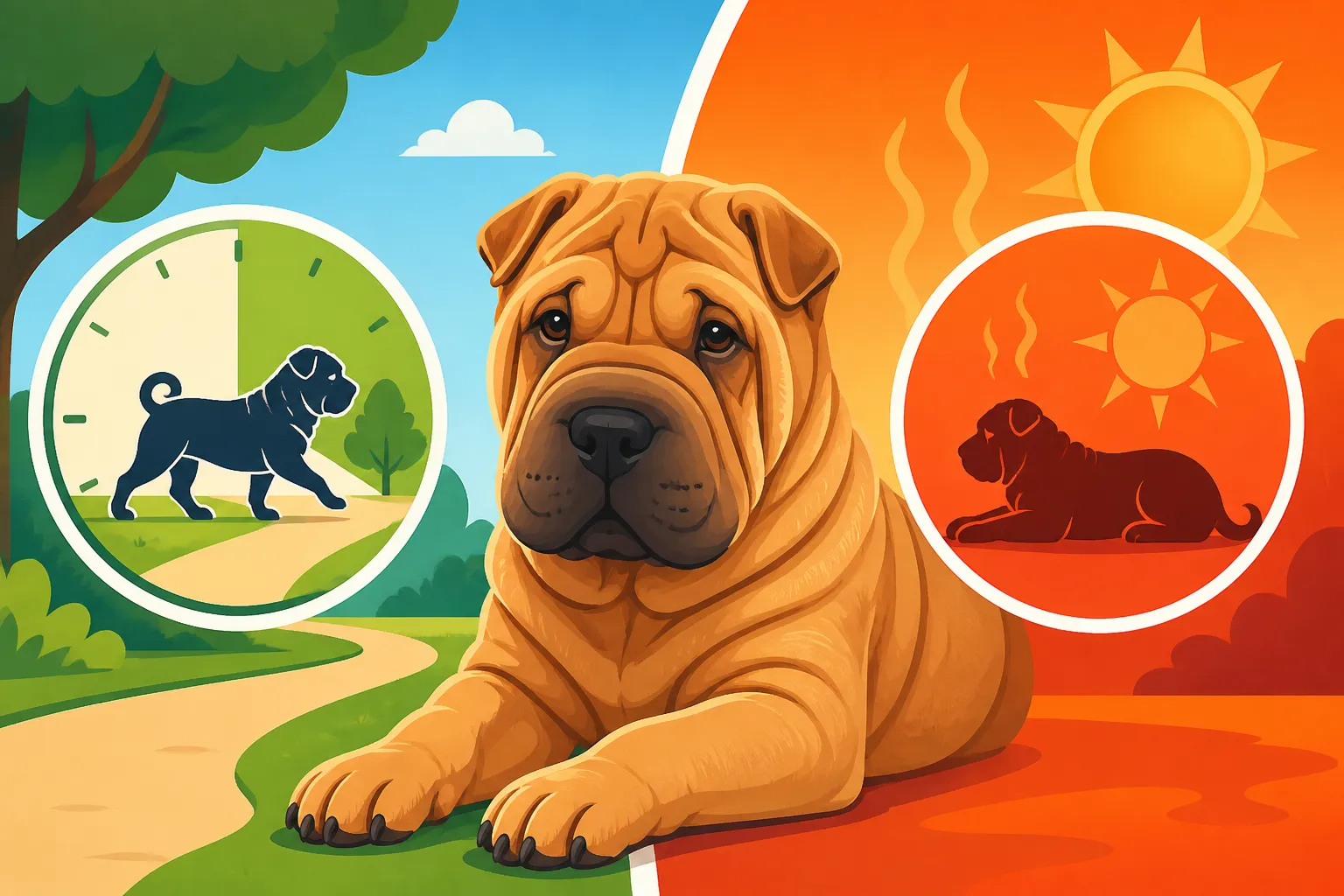
An Hour a Day Suits a Shar Pei, and Heat Cuts It Short
One of the biggest misconceptions about owning a Shar Pei is that they’re perfectly content to be couch potatoes all day long. While their stoic demeanor and sometimes independent nature might give that impression, the reality is that these incredible dogs need consistent, appropriate exercise to thrive. The real challenge for Shar Pei owners isn't just how much exercise, but how to manage it, especially when battling the relentless enemy of heat. This guide will walk you through creating a balanced exercise routine for your Shar Pei, with a critical focus on navigating warm weather safely.
Understanding the Shar Pei's Activity Level
It's easy to look at a Shar Pei's soulful eyes and wonderfully wrinkled face and assume they're built for lounging. Many people come into Shar Pei ownership thinking they've found a low-maintenance exercise companion, only to realize their dog has a surprising amount of zest for life. Dispelling this "couch potato" myth is the first step to ensuring your Shar Pei lives a happy, healthy life.
Dispelling the Couch Potato Myth
Let's be clear: a Shar Pei is not a Border Collie, nor are they typically suited for competitive agility or marathon running. However, labeling them as lazy or low-energy does them a disservice and can lead to significant behavioral and health problems down the road. They are a robust, intelligent, and often surprisingly athletic breed when given the opportunity. Their history as farm dogs and guardians, while not requiring sustained running, certainly demanded alertness and physical capability.
A Shar Pei denied sufficient physical and mental outlets can become bored, frustrated, and even destructive. This might manifest as excessive chewing, digging, barking, or even undesirable guarding behaviors. It's often not stubbornness or a "bad attitude" that leads to these issues, but rather an unmet need for appropriate activity. We, as their guardians, need to understand that their quiet nature doesn't equate to a lack of internal drive. They simply express their needs differently than some of the more overtly energetic breeds.
The "Moderate" Sweet Spot
So, if not a couch potato, what is a Shar Pei? They generally fit perfectly into the "moderate" exercise category. This means they benefit immensely from a routine that includes daily physical activity, combined with opportunities for mental engagement. Think quality over quantity when it comes to their exercise. A focused, engaging 30-minute walk where they get to sniff and explore their environment is often more beneficial than an hour of aimless wandering in a yard.
Consistency is truly key here. Regular exercise helps maintain a healthy weight, which is particularly important for a breed prone to joint issues and other health concerns. It also helps regulate their mood and energy levels, contributing to a calmer, more settled dog at home. A Shar Pei that gets its needs met is a joy to live with, adapting beautifully to family life. Without that consistent effort, you might find yourself battling a restless, unhappy dog. For more details, you can explore How Much Exercise a Shar Pei Needs.
Tailoring Daily Exercise for a Shar Pei
Once you understand that your Shar Pei isn't just a living lawn ornament, the next step is to figure out what their daily exercise looks like. It's not about forcing them into activities they're not built for, but rather finding a routine that respects their unique physical and mental makeup.
The Daily Walk: More Than Just a Potty Break
For most Shar Pei, a couple of well-structured walks each day will form the backbone of their exercise routine. Aim for two walks, each lasting roughly 20-30 minutes, or one longer session of about 45-60 minutes, depending on your dog's age, fitness level, and the weather. These aren't just for relieving themselves; they are prime opportunities for physical movement, mental stimulation, and socialization.
During these walks, encourage sniffing. A dog's nose is their primary way of experiencing the world, and allowing them to follow interesting scents is incredibly enriching and tiring. Vary your routes to keep things fresh and expose them to different sights and sounds. Leash manners are absolutely paramount for a Shar Pei. They can be strong-willed and, if not properly trained, can pull quite hard. Consistent, positive reinforcement training from a young age will make walks enjoyable for both of you. Never underestimate the power of a good walk to settle a Shar Pei's mind and body.
Beyond the Leash: Playtime and Training
While walks are essential, they shouldn't be the only form of exercise. Shar Pei often enjoy interactive play, especially with their trusted family members. A game of fetch in a securely fenced yard, tug-of-war with an appropriate toy, or even a flirt pole can provide bursts of high-intensity activity that work different muscle groups. Just be mindful of their joints and avoid excessive jumping or twisting, particularly with younger dogs.
Mental exercise is just as crucial, if not more so, for a Shar Pei. Their intelligence, combined with their independent streak, means they need to use their brains. Short, engaging training sessions where you teach new commands or practice old ones can be surprisingly tiring for them. Puzzle toys, snuffle mats, and scent work games are fantastic for keeping their minds active, especially on days when physical exercise is limited due to weather. These activities prevent boredom and help channel their natural problem-solving abilities into something productive. Resources like BAXTER & Bella offer excellent online courses that can guide you through fun, engaging training exercises that double as mental workouts for your Shar Pei.
The Critical Role of Temperature Regulation
This is where Shar Pei ownership truly deviates from many other breeds. Managing their body temperature, especially in warm weather, isn't just a suggestion; it's a matter of life and death. Ignoring this critical aspect can lead to severe health consequences.
Why Shar Pei Struggle with Heat
Shar Pei are, unfortunately, not built for the heat. Their unique physical characteristics conspire against them when temperatures rise. First, their coat, while short, is incredibly dense and provides excellent insulation – which is great in cold weather but a massive disadvantage in heat. It traps body heat close to their skin, making it very difficult for them to cool down.
Secondly, many Shar Pei possess some degree of brachycephalic (short-nosed) features, though not as extreme as a Bulldog or Pug. Even a slightly shorter muzzle can impact their ability to efficiently pant and exchange heat. Panting is a dog's primary way of cooling down, and any impedance to this process makes them incredibly vulnerable. Add to this the deep wrinkles, especially around the face and neck, which can further trap heat and moisture, creating a microclimate that prevents efficient cooling. This combination means they simply cannot dissipate heat as effectively as breeds with longer snouts and thinner coats. This is why Why Heat Limits a Shar Pei's Walk is so crucial to understand. In fact, it's worth knowing What Temperature Is Too Hot for a Shar Pei before you even step outside.
Understanding Heatstroke: A Silent Danger
Heatstroke is not just your dog getting "a little too warm"; it's a medical emergency that can rapidly lead to organ failure, brain damage, and death. It happens when a dog's body temperature rises to dangerous levels and they can no longer regulate it. The progression can be terrifyingly fast. What starts as heavy panting can quickly escalate to stumbling, dark red or purple gums, vomiting, diarrhea, and ultimately, collapse and seizures.
The danger with Shar Pei is that they can often seem fine one moment and then deteriorate rapidly. Their stoic nature might even make them try to push through discomfort longer than other breeds. Prevention is the only truly effective strategy. Once heatstroke sets in, even with aggressive veterinary intervention, the prognosis can be guarded, and long-term damage (especially to kidneys and brain) is possible. This is not a situation you ever want to find yourself in.
Recognizing Signs of Overheating in Your Shar Pei
Being proactive and recognizing the subtle signs of overheating before it becomes heatstroke is paramount for any Shar Pei owner. Your dog can't tell you they're too hot, so it's up to you to be their vigilant advocate.
Subtle Early Warning Signs
The first signs of overheating can be easy to miss if you're not paying close attention. Look for changes in their normal behavior and breathing patterns. One of the most common early indicators is excessive panting, especially if it's more rapid, louder, or shallower than what you'd typically hear from your dog. They might also appear more restless, shifting positions frequently as if trying to find a cooler spot.
Other subtle signs include seeking shade more aggressively than usual or an uncharacteristic refusal to continue walking or playing. If your Shar Pei, who usually loves a good stroll, suddenly digs their heels in or tries to turn back, it could be their way of telling you they're too warm. They might also seem duller or more lethargic than their usual self, even if they've had their normal energy levels just moments before. These are all signals that you need to act immediately to cool them down. It's truly startling How Easily a Shar Pei Overheats if you're not careful.
Urgent Red Flags and Emergency Action
If you notice any of these more severe symptoms, it's no longer just "overheating"; you are likely dealing with a full-blown emergency requiring immediate veterinary attention. Urgent red flags include stumbling, disorientation, or visible weakness in their legs. They might appear confused or have difficulty responding to commands. Vomiting or diarrhea are also critical signs, as these indicate internal distress.
Perhaps the most alarming visual cue is a change in their gum color. If your Shar Pei's gums turn bright red, dark red, or even purple, it means they are in severe trouble and their body's cooling systems are failing. Ultimately, collapse or seizures are catastrophic signs that require you to act instantly.
Emergency Action:
- Get to a cool place immediately: Move your dog out of the sun and into air conditioning or a shaded, breezy area.
- Apply cool water: Wet your dog down with cool (not ice-cold) water. Focus on the belly, paw pads, and inner thighs where blood vessels are close to the surface. You can use a hose on a gentle setting or wet towels. Do not use ice or ice-cold water, as this can cause blood vessels to constrict, trapping heat inside, and can lead to shock.
- Offer water: If they are conscious and able to drink, offer small amounts of cool water. Do not force it.
- Call your vet immediately: Even if your dog seems to be recovering, internal damage may have occurred, and a vet check is crucial. Inform them you're on the way so they can prepare. Time is absolutely of the essence in heatstroke cases.
Practical Strategies for Keeping Your Shar Pei Cool
Preventing your Shar Pei from overheating requires a multi-pronged approach, integrating specialized gear with smart environmental management. It's about creating a lifestyle where coolness is prioritized.
Cooling Gear and Products
Investing in good cooling gear is not a luxury; it's a necessity for a Shar Pei, especially if you live in a warmer climate or experience hot summers. Cooling mats are a godsend. These often contain a gel that activates with pressure, providing a cool spot for your dog to lie on, or are simply made of materials that stay cooler than the ambient air. You can find a wide variety of these on platforms like Amazon, from basic gel mats to elevated cots that allow air circulation. Ensure you pick one that is durable enough to withstand a Shar Pei's unique "test of strength." Knowing Whether a Cooling Mat Helps a Shar Pei can make a huge difference in their comfort at home.
Cooling vests or bandanas are another excellent tool, particularly for short periods outdoors. These typically work by evaporative cooling; you wet them with water, and as the water evaporates, it draws heat away from your dog's body. The key is to ensure the vest is made of a breathable, wicking material that allows the evaporation to occur and doesn't just trap moisture and heat against their skin. You don't want something that feels like a thick, wet blanket. It’s important to ensure Whether a Cooling Vest Reaches a Shar Pei's Skin effectively. Always carry water and a portable bowl on walks, even short ones. Hydration is absolutely paramount, and fresh, cool water can help regulate their internal temperature. In fact, having What a Shar Pei Owner Should Have at Home includes a robust set of cooling tools.
Environmental Control at Home
Your home environment plays a massive role in your Shar Pei's comfort and safety. For many Shar Pei owners, especially in warmer regions, air conditioning is not an amenity; it's a fundamental necessity. In summer, running the AC to keep your home comfortably cool isn't just for your benefit, it's vital for your dog. For many, Whether Air Conditioning Is a Shar Pei Expense is a cost of ownership that cannot be avoided.
During the hottest parts of the day, keep curtains and blinds closed to block out direct sunlight, which can quickly heat a room. Fans, both ceiling and standing, can help circulate air and create a cooling breeze, but remember they only move air; they don't cool it down like AC does. Provide your Shar Pei with access to cool, tiled floors, which many dogs instinctively seek out. These surfaces draw heat away from their body. If you have outdoor spaces, ensure there's ample, reliable shade throughout the day. A shaded area with access to fresh water is the bare minimum for any dog, but for a Shar Pei, it's still best to keep them indoors during peak heat. All of these items contribute to What a Shar Pei's Cooling Gear Costs.
Adapting Exercise Routines for Different Seasons
The concept of a fixed, year-round exercise routine simply doesn't work for a Shar Pei. Their heat sensitivity means you must constantly adapt their schedule based on the weather, making seasonal adjustments a non-negotiable part of their care.
Summer Safety: Early Morning, Late Evening Walks
Summer is the most dangerous season for Shar Pei, and it demands the most vigilance. Your exercise schedule needs to revolve around the sun. This means embracing early morning walks, ideally at dawn, before the sun has a chance to bake the pavement and air. A second walk should be reserved for late evening, well after sunset, when temperatures have significantly dropped. Remember, the air temperature isn't the only factor; asphalt and concrete can retain heat for hours after the sun goes down, becoming hot enough to burn paw pads. Always check the pavement with the back of your hand – if you can't hold it there for five seconds, it's too hot for your dog's paws. For specific guidance, see Whether a Shar Pei Should Be Walked Only at Dawn in Summer.
During the middle of the day, physical exertion should be minimal to non-existent. Stick to short potty breaks in shaded, grassy areas, if absolutely necessary. Replace outdoor activities with indoor games, training sessions, or puzzle toys to provide mental stimulation without the risk of overheating. A kiddie pool with just a few inches of cool (not cold) water can also be a wonderful way for a Shar Pei to cool off in a safe, supervised environment, but only if they enjoy it. Never force them.
Winter Wonderland: Managing Cold and Wet
While Shar Pei generally tolerate cooler temperatures better than heat, extreme cold still requires consideration, especially for horse coat varieties whose fur is less insulating. Winter walks can be invigorating, but watch for signs of discomfort like shivering or reluctance to move. In icy conditions, paw protection is vital. Salt and de-icing chemicals used on sidewalks can be toxic and irritating to paw pads, so dog boots or a protective paw balm like Musher's Secret can be beneficial. Always wipe down their paws after a winter walk.
The biggest winter concern for Shar Pei often revolves around their skin folds. While a quick, brisk walk is usually fine, prolonged exposure to wet snow or rain, followed by inadequate drying, can lead to skin infections. Ensure your Shar Pei is thoroughly dried, especially in their deepest folds, after any damp outing. A quick rubdown with a towel might not be enough. If they enjoy playing in the snow, keep sessions short and make sure they have a warm, dry place to retreat to immediately afterward.
Here's a table summarizing how to adjust your Shar Pei's exercise routine for the seasons:
| Season | Ideal Exercise Times | Recommended Activities | Key Considerations |
|---|---|---|---|
| Summer | Early morning (dawn), late evening (dusk) | Leashed walks on cool pavement, indoor play, brain games, short potty breaks in shade | Avoid midday heat, check paw pad temperature, carry water, watch for overheating, utilize cooling gear |
| Autumn | Mid-morning, late afternoon | Leashed walks, exploring new scents in parks, supervised outdoor play, hiking on cooler days | Be mindful of falling leaves hiding hazards, monitor for seasonal allergies, watch for sudden temperature drops |
| Winter | Midday (warmest part), short brisk bursts | Brisk leashed walks, indoor fetch, puzzle toys, trick training | Protect paws from ice/salt, ensure thorough drying after wet outings, avoid prolonged cold exposure, consider a light coat for very sensitive dogs |
| Spring | Morning, afternoon | Leashed walks, exploring new environments, outdoor training sessions, short jogs | Be aware of sudden temperature fluctuations, monitor for new allergens, gradually increase activity as weather warms |
The Importance of Mental Stimulation for a Shar Pei
Physical exercise is only half the battle when it comes to a well-adjusted Shar Pei. Their intelligent, often independent minds require just as much, if not more, engagement to prevent boredom and undesirable behaviors.
Engaging Their Minds to Prevent Boredom
A bored Shar Pei is often a destructive Shar Pei. Unlike some breeds that might simply lie around and nap when under-stimulated, a Shar Pei with an active mind and nothing to do will often invent their own entertainment. This can unfortunately manifest as chewing on furniture, excessive digging in the yard, persistent barking, or even resource guarding if they become possessive of the few stimulating items they have. They are problem-solvers by nature, and if you don't give them appropriate problems to solve, they will find their own.
Puzzle toys that dispense treats, snuffle mats where they have to sniff out kibble, and interactive feeders are excellent ways to engage their minds during meal times or quiet periods. These activities mimic natural foraging behaviors and can be surprisingly tiring. Scent work, even just hiding treats around the house for them to find, taps into their incredible sense of smell and provides immense mental enrichment. Consider rotating toys to keep things fresh and interesting. A new toy every now and then, perhaps found on Amazon, can reignite their interest and provide a novel challenge.
Training as a Form of Exercise
Training is not just about teaching your dog to sit and stay; it's a powerful form of mental exercise that builds confidence, strengthens your bond, and prevents boredom. For a Shar Pei, whose independent nature can sometimes be mistaken for stubbornness, short, frequent training sessions are far more effective than long, drawn-out ones. Their attention span might be shorter for repetitive tasks, but they are quick learners when motivated.
Teaching new tricks, practicing obedience commands in different environments, or even working on canine good citizen skills all require your Shar Pei to think, focus, and respond. This mental effort burns calories and energy just as effectively as physical activity. For owners looking to deepen their training knowledge and keep their Shar Pei engaged, online platforms like BAXTER & Bella provide structured programs and support that can introduce you to new games and exercises, keeping both you and your dog motivated. Consistent training helps to channel their intelligence into positive behaviors, making them a more enjoyable and well-rounded companion.
Creating a Balanced Lifestyle and Knowing When to Call the Vet
Ultimately, providing an hour a day of appropriate exercise for your Shar Pei and managing their heat sensitivity is part of a larger, holistic approach to their care. It's about looking at their overall well-being and knowing when to seek professional help.
The Holistic Approach to Shar Pei Wellness
Exercise and diligent heat management are two crucial pillars in the temple of Shar Pei wellness, but they are by no means the only ones. A truly happy and healthy Shar Pei thrives when all aspects of their life are in balance. This includes a high-quality, appropriate diet, regular veterinary check-ups, consistent grooming (especially of their unique skin folds and ears), and a stable, loving home environment. All of these factors interact and influence each other. For instance, an overweight Shar Pei will struggle even more with heat, and an underlying health issue could suddenly impact their exercise tolerance.
Regular veterinary visits are not just for emergencies; they are essential for preventive care. Your vet can monitor for common Shar Pei health issues that might affect their ability to exercise, such as joint problems or cardiovascular conditions. They can also offer personalized advice on diet and supplement needs. Understanding the full spectrum of their needs helps you provide comprehensive care. Sometimes, you might need to adjust their care due to other conditions, such as knowing Whether a Shar Pei Should Be Cooled During a Fever, which is a completely different kind of temperature regulation challenge.
When to Seek Professional Guidance
Knowing when to call your veterinarian is a critical part of being a responsible Shar Pei owner. If you notice any persistent changes in your Shar Pei's exercise tolerance – perhaps they become winded more easily, are reluctant to walk, or their recovery time after activity seems prolonged – it warrants a call to the vet. Unexplained lethargy, a sudden change in appetite, or any signs of discomfort should never be ignored.
With their heat sensitivity, if your Shar Pei exhibits any of the urgent red flags for overheating, even if they seem to recover somewhat, it is imperative to contact your vet immediately. Internal damage can occur even without outward, lasting symptoms. Shar Pei can be incredibly stoic, often masking pain or discomfort until a condition is quite advanced. This means you, as their owner, need to be hyper-vigilant and err on the side of caution. Don't hesitate to seek professional guidance if you have any concerns about their health, exercise capacity, or heat management strategies. It's always better to be safe than sorry when it comes to these wonderful, sensitive dogs.
Disclaimer
This article is for general informational purposes only and does not constitute professional advice. Laws, prices and regulations vary by location and change over time. Consult a qualified professional for guidance on your specific situation.


