Whether the Shar Pei Is Related to the Bullmastiff
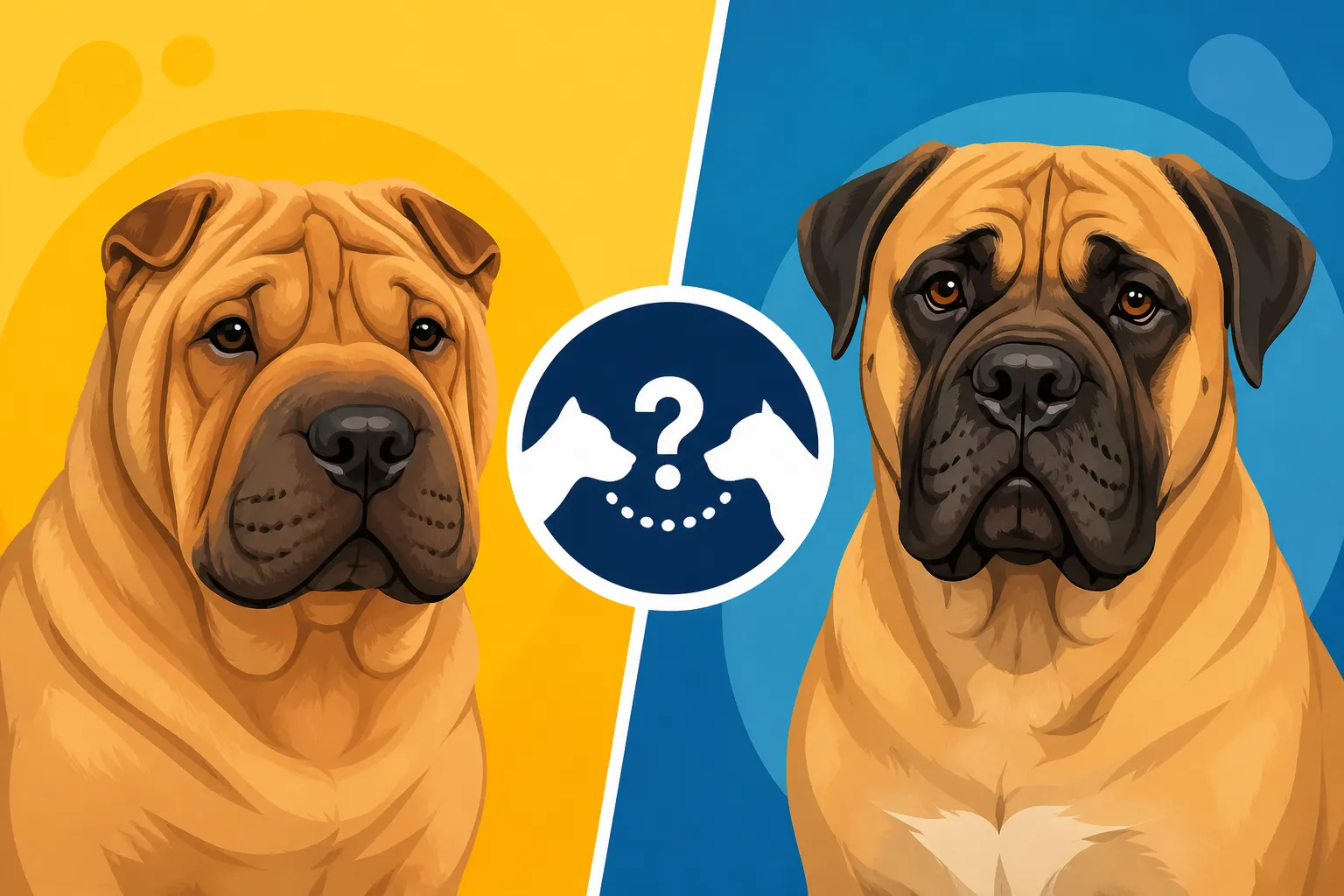
People often assume the Shar Pei and Bullmastiff must be related because both are solidly built, broad-headed dogs with a serious, watchful look. But resemblance is not proof of shared recent ancestry. This guide compares where the breeds came from, what their histories can—and cannot—tell us about their relationship, and how their similarities differ from their everyday needs.
Are Shar Pei and Bullmastiffs related
The short answer on their relationship
The Shar Pei is not considered a close relative of the Bullmastiff. They developed in different places, for different purposes, and within distinct breed histories. A Shar Pei’s loose, folded skin and compact, square outline may bring a Bullmastiff to mind, but those features alone do not establish that one breed descended from the other or that they share a recent common ancestor.
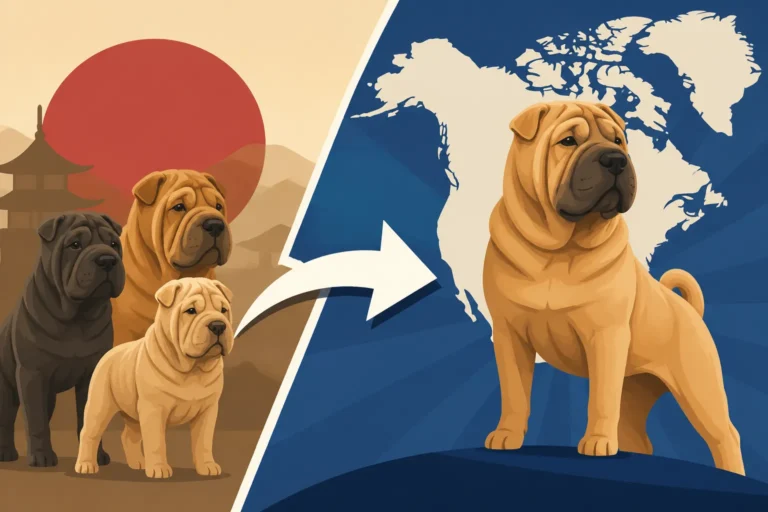
The Bullmastiff was developed in Britain from mastiff-type dogs and bulldogs. The familiar account of its history describes a working dog bred to help gamekeepers deter poachers on large estates. The Shar Pei, by contrast, is associated with southern China, where it was kept as a versatile farm and village dog. Its history is not documented in the same way as the Bullmastiff’s, so claims about the precise dogs behind the breed should be treated cautiously.
There is a useful distinction between similarity, distant ancestry, and direct breed relationship. Two dogs can share a broad, sturdy build because that shape is useful for work or simply because of how modern breeding has shaped them. And, like many dog breeds, they may ultimately share distant ancestors somewhere in the long history of domestic dogs. Neither possibility makes the Shar Pei and Bullmastiff close relatives in the everyday sense.
Why the dogs can look alike
Both breeds have substantial heads, strong bodies, and an appearance that many people read as imposing. That can make them seem more alike than they are. But a closer look shows that their defining features differ. The Shar Pei is known for its small ears, distinctive muzzle, and loose skin, especially in puppies. The Bullmastiff is generally much larger and heavier, with a short coat and a broad, powerful frame but not the Shar Pei’s characteristic folds.
Their size is one of the clearest practical differences. A Bullmastiff is a giant, heavy dog, while the Shar Pei is medium-sized by comparison. Even when a Shar Pei looks especially substantial, it is not built on the same scale. The differences in size, outline, and skin are easier to judge than a supposed connection based on a shared “mastiff-like” impression.
It is also easy to confuse a dog’s look with its ancestry. A wrinkled face does not show that a dog came from a mastiff, and a large head does not prove that two breeds are closely related. If you want to explore the Shar Pei’s physical traits in more detail, The Shar Pei Against the Other Wrinkled Breeds compares its appearance with other dogs often described as wrinkled.
| Feature | Shar Pei | Bullmastiff |
|---|---|---|
| Historical region | Southern China | Britain |
| Traditional role | Versatile farm and village dog | Estate and gamekeeper’s working dog |
| Typical build | Medium-sized, compact, loose-skinned | Very large, muscular, heavy-bodied |
| Signature appearance | Wrinkles, small ears, distinctive muzzle | Broad head, substantial frame, short coat |
| Evidence of a close relationship | No established close relationship | No established close relationship |
What the breeds’ histories tell us
The Shar Pei’s Chinese history
The Shar Pei is associated with China, but its early history is less firmly documented than the Bullmastiff’s. Accounts commonly describe it as a practical working dog used in rural settings. Depending on the place and period, dogs of this kind may have helped with guarding, hunting, or farm tasks. That broad picture is more defensible than a confident claim that every modern Shar Pei descends from one clearly recorded line of dogs.
The breed’s name is often translated as “sand skin,” a reference to its coat’s texture. Its Chinese background and distinctive appearance are part of what makes it tempting to connect the Shar Pei to other ancient or powerful-looking breeds. But a breed’s country of origin does not, by itself, reveal which other breeds it is related to. For more on the name and historical role, see What Shar Pei Means in Chinese and What the Shar Pei Was Used For in China.
You may also encounter sweeping claims that the Shar Pei is an “ancient breed” in exactly the same sense as breeds with extensive, continuous historical records. The word ancient is often used loosely in discussions of dog breeds, and surviving evidence does not always support a precise family tree. It is safer to separate the breed’s long association with China from certainty about its specific ancestors. Whether the Shar Pei Is an Ancient Breed looks more closely at that distinction.
The Bullmastiff’s British history
The Bullmastiff’s history is usually described as a more recent, purpose-driven development in Britain. Its name reflects its association with mastiff-type dogs and bulldogs, though that does not mean every modern Bullmastiff can be traced through a simple, complete family tree to a specific pair of ancestors. Breed histories often preserve a useful outline of how a dog was developed without documenting every crossing in detail.
The gamekeeper story also helps explain the Bullmastiff’s traditional image: a powerful dog expected to work closely with people and respond to a particular job. That background is quite different from the Shar Pei’s rural Chinese history. The two breeds may share broad traits such as strength or confidence, but they arrived at those traits through separate settings and breeding histories.
That difference matters if you are comparing the breeds as potential companions. The Bullmastiff’s very large size can affect everyday tasks such as transport, housing, handling, and equipment choices. The Shar Pei’s distinctive skin and facial structure bring other care considerations. Neither set of needs tells you that one breed is a version of the other; they show why breed history and physical traits should be considered separately.
Why resemblance is not proof of shared ancestry
The trouble with reading a family tree from appearance
Dog breeds are often grouped by broad body type or historical function, but those groupings are not the same thing as proof of close genetic kinship. A powerful build can emerge in different populations because people selected for similar practical qualities. Likewise, a broad head or short muzzle can become prominent through selective breeding without indicating that two breeds recently shared the same ancestors.
The Shar Pei’s skin folds are particularly striking, so they can dominate a visual comparison. Yet wrinkles are a physical trait, not a pedigree. They do not show that the Shar Pei descended from the Bullmastiff, nor do they establish that the two breeds were developed together. For another comparison that can help put the Shar Pei’s features in context, see The Shar Pei Against the Bulldog.
A more reliable way to discuss breed relationships is to distinguish documented history from guesswork. Breed records, historical accounts, and genetic research can each offer clues, but none should be stretched beyond what it supports. If a claim relies only on “they look alike,” it is better treated as an impression than as evidence of a direct relationship.
Tongue color and other tempting clues
The Shar Pei’s blue-black tongue is another feature sometimes used to suggest a connection to other breeds. The Chow Chow is also known for a blue-black tongue, which makes comparisons between the two especially common. But sharing a conspicuous trait does not, on its own, prove a direct shared ancestor or tell us how recently two breeds might be related.
That is a general caution worth keeping in mind: a single visible feature rarely provides a full answer to a question about ancestry. Traits can be shared across breeds for different reasons, and some breed histories are incomplete. Whether the Shar Pei and the Chow Chow Are Related and Whether the Blue Tongue Proves a Shared Ancestor explore why those questions need more than a quick visual comparison.
The Bullmastiff’s appearance offers no stronger shortcut. Its size and broad head may look “mastiff-like,” but resemblance to a type of dog is not the same as a direct connection to every other breed that seems to fit the type. In practical terms, the best-supported answer is straightforward: the Shar Pei and Bullmastiff have separate, regionally distinct histories, and they are not recognized as close relatives.
What to consider if you are choosing between them
If you are asking about ancestry because you are deciding which breed might suit your home, focus on their real differences rather than their shared tough-looking appearance. Think about the dog’s adult size, your ability to handle it safely, the time you can give to training and care, and whether you can meet its exercise and veterinary needs. The Shar Pei’s skin and ears deserve particular attention; Skin Is the Shar Pei's Largest Problem by Surface Area and A Shar Pei Has the Narrowest Ear Canals of Any Breed discuss why those areas can require thoughtful care.
The Shar Pei’s muzzle and eye structure can also affect how you assess an individual dog. A breed label cannot tell you everything about a dog’s breathing, vision, comfort, or health, so ask about the individual’s history and have a veterinarian examine any dog you are considering. For background on the Shar Pei’s facial structure, see Whether the Shar Pei Is a Brachycephalic Breed.
If you eventually bring home either breed, choose supplies around the dog in front of you rather than assuming both need the same things. A Bullmastiff’s size affects basics such as bedding and walking equipment; a Shar Pei’s skin folds may mean you need to ask your veterinarian about suitable cleaning and drying routines. Retailers such as Chewy can be one place to compare everyday supplies, but product choice should follow your dog’s size, skin condition, and veterinary guidance. For a Shar Pei, Chewy may help you browse routine-care items, while your vet can advise what is appropriate for sensitive or irritated skin. If you are shopping for a Bullmastiff, Chewy’s general pet-supply range may be a convenient place to compare options sized for a much larger dog.
The bottom line is that a Shar Pei and a Bullmastiff can share a strong, imposing look without being close relatives. Their histories point in different directions: the Shar Pei is associated with rural China, while the Bullmastiff was developed in Britain for a distinct working role. Similar looks are a reason to compare them—not a substitute for evidence about ancestry.
Disclaimer
This article is for general informational purposes only and does not constitute professional advice. Laws, prices and regulations vary by location and change over time. Consult a qualified professional for guidance on your specific situation.