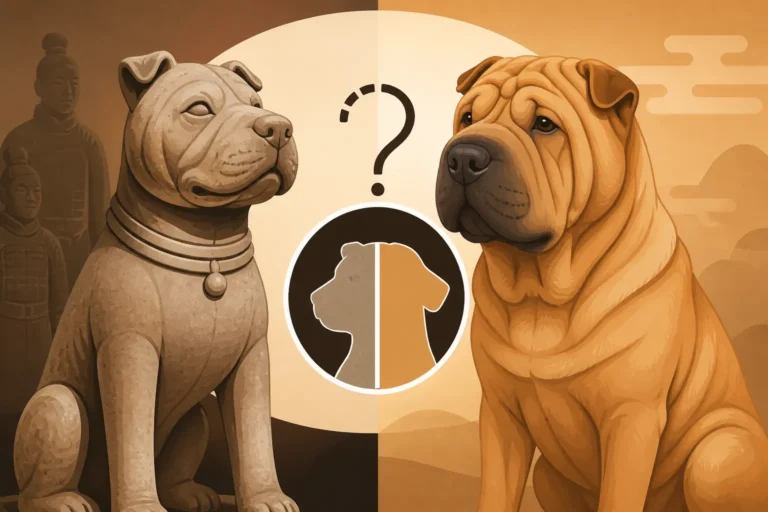
Whether the Shar Pei and the Chow Chow Are Related
The Shar Pei and Chow Chow share a striking blue-black tongue, Chinese roots, and a reputation as distinctive ancient breeds. That resemblance naturally raises a question: are they closely related, or does the shared feature tell only part of the story? This guide separates what their history and appearance suggest from what can reasonably be concluded about their ancestry.
Are the Shar Pei and Chow Chow closely related
What the breeds have in common
The Shar Pei and Chow Chow are both associated with China, and both are recognized for a blue-black tongue. They also have a distinctive, self-contained look that can make them seem like members of the same old family: the Chow Chow has a dense coat and broad head, while the Shar Pei is known for its short coat, small ears, and loose skin.
Those similarities are real, but they do not establish that one breed descended directly from the other. Dogs can share physical traits because they inherited them from distant common ancestors, because similar traits emerged in separate populations, or because people selected for them over many generations. Appearance can point to a question worth investigating; by itself, it cannot provide a family tree.
Both breeds have long histories tied to East Asia, but the written and archaeological evidence does not give us a complete record of how either developed. Dog populations changed as people moved, traded, worked, and bred dogs for different purposes. The modern breeds we recognize today are the result of that long process, not necessarily unchanged copies of dogs from a single ancient population.
For more context on the Shar Pei’s history, see Whether the Shar Pei Is an Ancient Breed and What the Shar Pei Was Used for in China. Those topics help explain why “Chinese breed” and “closely related breed” are not interchangeable descriptions.
What “related” can mean
When someone asks whether two dog breeds are related, they might mean several different things. They may be asking whether one breed directly descended from the other, whether both came from a shared regional dog population, or whether the breeds share a particular inherited trait. Those are different claims, and the available evidence may support one more strongly than another.
A direct ancestor relationship would mean that one breed, or a population very close to it, contributed substantially to the formation of the other. A more distant relationship could mean that both breeds share older ancestors somewhere in their history. Since all domestic dogs share ancestry at some point, the useful question is how close and specific that shared ancestry is.
For the Shar Pei and Chow Chow, shared Chinese roots and the shared tongue color make a connection plausible as a broad historical possibility. They do not establish a direct line of descent or show exactly when their histories crossed. A careful answer is that they may share distant ancestry or regional roots, but the visible evidence does not prove that one is the ancestor of the other.
What the blue-black tongue can and cannot tell us
A shared trait is a clue, not proof
The blue-black tongue is the feature most often used to argue that the Shar Pei and Chow Chow are close relatives. It is distinctive enough to invite comparison, especially when people encounter both breeds for the first time. But a shared trait does not automatically reveal how recently two populations shared an ancestor.
To establish a close relationship, researchers would need to consider more than one visible feature. Genetic evidence, the history of breeding populations, and reliable records can all help build a stronger picture. Even genetic results need interpretation: dogs may share some ancestry without one modern breed being the source of another.
It is also possible for a trait to persist across related populations over a long period, even as those populations become distinct breeds. Conversely, a trait can appear in separate populations through changes in inherited variation. The tongue color is therefore a useful reason to ask about a connection, not a standalone answer.
The Shar Pei’s tongue is also part of a broader breed identity. For a closer look at the trait itself, see The Blue Black Tongue a Shar Pei Shares With One Other Breed and Which Other Breed Has a Blue Black Tongue. For the specific question of what the resemblance proves, read Whether the Blue Tongue Proves a Shared Ancestor.
Why a tongue-color comparison has limits
People often treat an unusual shared feature as if it were a kind of biological signature. That is understandable: if two breeds share a trait that few other dogs show, it seems reasonable to suspect a close connection. But the rarity of a feature does not tell us the exact path it took through a breed’s history.
A physical characteristic can be inherited from distant ancestors and remain visible in several branches of a population. It can also become common in a breed because breeders repeatedly selected dogs with that feature. Without a broader set of evidence, it is hard to distinguish those possibilities.
This is why the tongue is best understood as one piece of a much larger puzzle. It supports comparison between the breeds, but it cannot show whether their lineages split recently or far back in time. Nor can it settle whether the modern Shar Pei and Chow Chow have a direct ancestor-descendant relationship.
| Question | What the evidence can reasonably suggest | What it does not establish |
|---|---|---|
| Do both breeds have a blue-black tongue? | Yes, this is a well-known shared feature. | That one breed descended directly from the other. |
| Do both breeds have Chinese associations? | Yes, both are connected with China. | That they developed from the same recent population. |
| Could they share older ancestry? | It is plausible, given their regional histories. | The precise timing or route of that ancestry. |
| Does appearance settle the question? | It helps explain why people compare them. | A definitive genetic family tree. |
How breed histories make a simple answer difficult
The Shar Pei’s past is not fully documented
The Shar Pei is commonly linked with southern China, and its history is often described through its traditional roles and distinctive features. But early dog breeding was not recorded in the same systematic way as modern pedigree breeding. Local dogs could be crossed, moved, and selected without leaving behind documents that identify each line.
That matters because modern breed names can make histories look neater than they were. A present-day breed may have emerged from a wider and more varied population. Dogs that shared a region or a practical role could have influenced one another over time, even if they were not considered separate formal breeds in the way they are now.
The Shar Pei’s name and historical context offer useful clues, but neither gives a complete account of its ancestry. If you are curious about the name, see What Shar Pei Means in Chinese. If you are weighing claims about ancient depictions, Whether Han Dynasty Statues Show a Shar Pei explores why resemblance in an old image is not the same as definitive breed identification.
Modern breeds are not frozen in time
A modern pedigree breed is shaped by selective breeding. Over generations, people favor certain appearances and temperaments, and breeding populations become more distinct. That process can make two breeds look very different today, even if their distant ancestors came from related regional dogs.
The Shar Pei’s appearance has also changed through the history of breeding. The modern dog’s folds, for example, should not be treated as proof that every dog in its ancestry looked exactly the same. Looking at the development of a breed means considering how human preferences and breeding choices influenced its features. See Whether the Original Shar Pei Was Wrinkly at All for more on that question.
The Chow Chow has its own long and distinctive history, but shared regional origins do not imply an identical path of development. Even if the breeds had contact or a distant common source, each could have been shaped by different communities and breeding goals. That makes a simple “yes, they are the same family” answer too broad, while a confident “no connection at all” would also go beyond what appearances alone can show.
How to describe the relationship accurately
A practical answer for owners and breed enthusiasts
If someone asks whether the Shar Pei and Chow Chow are related, a balanced response is: they are distinct breeds with Chinese roots and a notable shared tongue-color trait; they may have distant historical connections, but the shared trait does not prove that one breed descended from the other.
That answer leaves room for what is plausible without presenting speculation as settled fact. It also avoids a common mistake: treating a shared feature as proof of a precise family relationship. The two breeds can be compared meaningfully while still recognizing that their exact historical connection is uncertain.
This distinction is useful when reading breed histories online. A statement that the breeds “share a Chinese origin” is broad. A statement that one “comes directly from” the other is much stronger and needs stronger evidence. Pay attention to whether a writer is discussing geography, shared ancestry, or direct descent, because those phrases do not mean the same thing.
What to look for in claims about ancestry
When you encounter a claim that the Shar Pei and Chow Chow are close relatives, ask what evidence supports it. Does the claim rely only on tongue color and general appearance, or does it discuss broader genetic and historical information? Does it distinguish a possible distant ancestor from a direct ancestor? Those questions can help separate a reasonable possibility from an oversimplified conclusion.
It is also worth remembering that breed histories often combine documented facts with educated interpretation. When records are incomplete, a cautious explanation is more useful than a tidy story that claims certainty. The uncertainty is not a failure to understand the breeds; it reflects how difficult it is to reconstruct the history of dog populations that existed before modern pedigree records.
Ultimately, the Shar Pei and Chow Chow are not the same breed, and the shared blue-black tongue does not settle their relationship. Their Chinese associations and common feature make a distant connection plausible, but the most accurate description is that the exact closeness and route of their ancestry are not established by appearance alone.
Disclaimer
This article is for general informational purposes only and does not constitute professional advice. Laws, prices and regulations vary by location and change over time. Consult a qualified professional for guidance on your specific situation.