Whether the Original Shar Pei Was Wrinkly at All
A common question behind the Shar Pei’s famous folds is whether the dogs in China looked like today’s deeply wrinkled show dogs. The short answer is probably not: historical evidence suggests the breed had loose skin and some wrinkles, but it is too limited to prove exactly how much. This guide explains what old images can—and cannot—tell us about the original Shar Pei.
Was the original Shar Pei wrinkly
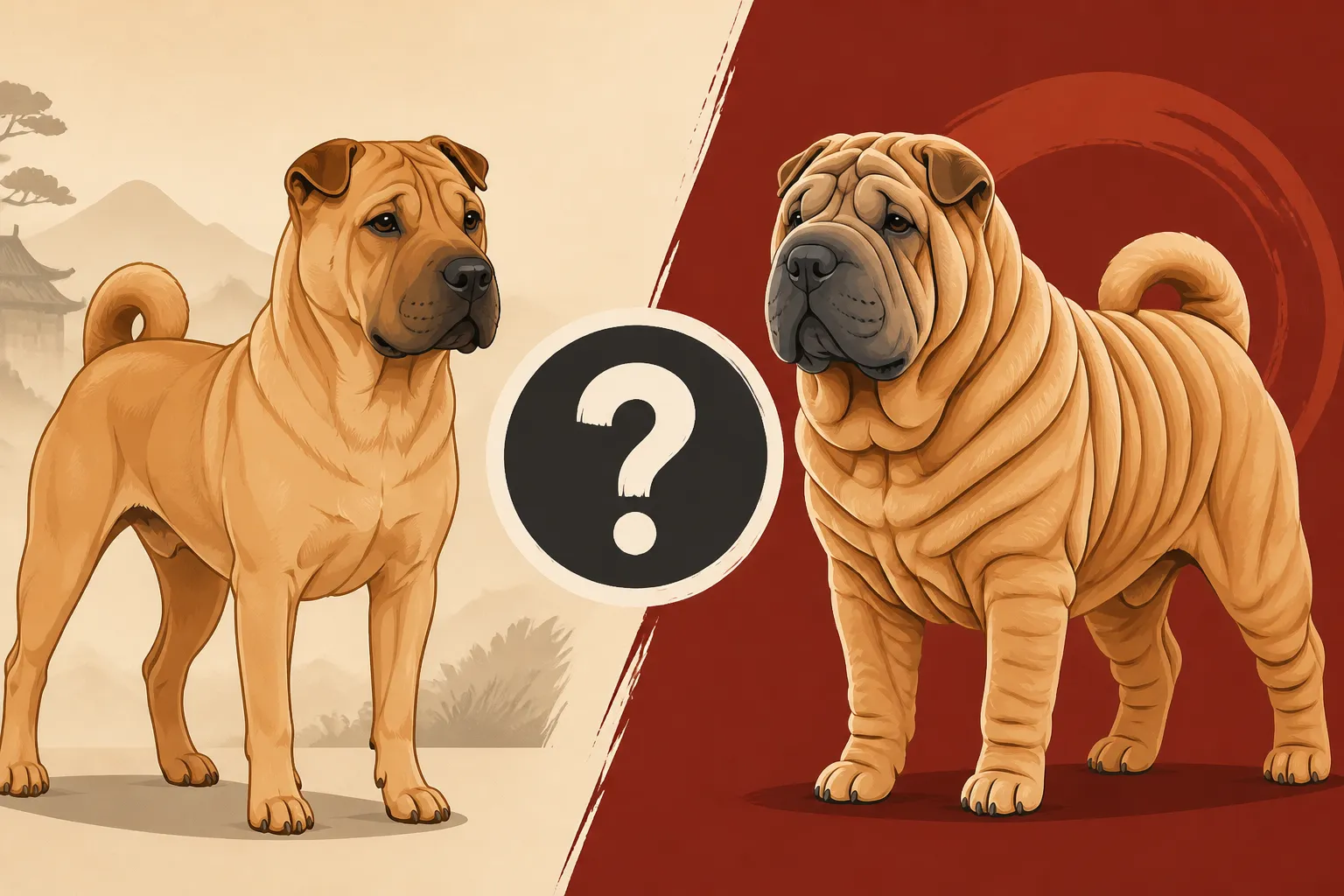
The best-supported answer is that early Shar Pei likely had wrinkles, but probably not the pronounced folds many people associate with the modern breed. That distinction matters: “wrinkly” is not an all-or-nothing trait. A dog can have loose skin around its head and neck without having deep folds across much of its body.
Descriptions and surviving images are limited, and the dogs shown are not always identifiable with certainty as Shar Pei. So it is safer to talk about a likely range of appearances than to claim that every early Shar Pei looked one particular way.
Loose skin and wrinkles are not the same thing
Loose skin can gather into wrinkles when a dog moves, lowers its head, or turns its neck. The amount of visible folding also depends on age, body condition, coat, and the way a dog is posed. A photograph showing a smooth-looking body does not necessarily mean that the dog had tight skin; a photograph emphasizing a head fold does not prove it had heavy folds everywhere.
That is why a simple comparison—“the old dogs had no wrinkles, but today’s dogs do”—is too neat. Historical images may suggest that some Shar Pei had fewer or less pronounced folds, but the images cannot reliably measure skin thickness, looseness, or variation among dogs.
The modern breed includes a range of appearances too. One dog may have conspicuous head and neck folds while another has a more moderate look. The question of How Many Wrinkles an Adult Shar Pei Should Have is therefore not answered by one universal count or a single historical ideal.
Old pictures are clues, not a complete record
Photographs of early Shar Pei are especially useful because they offer a visual glimpse of dogs from before the breed became widely popular outside its region. Some appear less heavily folded than many contemporary examples. But early photographs are few, and image quality, pose, lighting, and reproduction can all affect what viewers see.
There is also a basic identification problem: an old picture may be labeled as a Shar Pei without enough documentation to confirm the dog’s pedigree or exact type. Even when the identification is sound, one dog cannot represent an entire population. The topic of Whether Photos of Early Shar Pei Show Fewer Folds is best treated as a question about suggestive evidence, not a settled visual census.
A few surviving images can tell us that a less exaggerated appearance existed. They cannot tell us how common it was, how much variation there was between regions, or whether a particular dog’s look was typical. Claims about the “original” Shar Pei should leave room for that uncertainty.
What historical evidence can tell us
The Shar Pei has a long association with southern China, but details about its early development are difficult to establish. Breed histories often connect the dog with rural life and working roles, yet records that would let us track its appearance generation by generation are sparse. That makes it hard to draw a straight line from ancient depictions to the dogs photographed in the twentieth century.
Art and objects do not settle the question
Statues, figurines, and other old objects are sometimes presented as proof that the Shar Pei has looked a certain way for centuries. They may show dogs with features that remind viewers of the breed, but resemblance alone is not enough to establish a direct relationship. An artist may have used a stylized shape, and a sculpture may not preserve fine details such as skin folds.
The same caution applies to broad claims that the Shar Pei’s modern appearance can be read directly from an ancient image. Without a clear chain of evidence linking an object to a known breed population, it is more accurate to say that some depictions look Shar Pei-like than to treat them as precise portraits of the original breed.
This uncertainty also affects claims about the breed’s age and continuity. How Old the Shar Pei Breed Really Is is not something an old-looking statue can answer on its own. Historical resemblance can be interesting, but it is different from documented ancestry.
Written records leave gaps
Written accounts can help describe how people understood or used dogs, but they do not always provide the detailed physical descriptions that modern breed enthusiasts want. Even when an account refers to a dog from a particular place, it may not specify whether it had wrinkles, how extensive they were, or whether the dog resembled a modern Shar Pei.
A lack of detailed documentation does not mean that early Shar Pei had no wrinkles. It means we cannot confidently reconstruct their exact appearance from written records alone. The history is further complicated by population decline and later efforts to preserve the breed, which narrowed the pool of dogs available to represent it.
For context on that period, What Being Saved Did to the Shar Pei's Health explores how the breed’s survival and later development shaped the dogs people know today. Preservation helped keep the Shar Pei from disappearing, but it did not leave us with a complete photographic or written record of the breed before that effort.
How the modern Shar Pei may have become more wrinkled
The Shar Pei’s appearance did not remain frozen in time. As the breed became known beyond its original region, breeders and buyers influenced which dogs were bred and which features attracted attention. That makes it plausible that modern preferences helped increase the visibility or exaggeration of wrinkles in some lines, though it is difficult to measure exactly how much.
Selection can change a breed’s appearance
When breeders repeatedly choose dogs with a particular feature, that feature may become more common or more pronounced over generations. This is not unique to the Shar Pei; selective breeding has shaped size, coat, head shape, and other traits in many breeds. If especially wrinkled dogs were favored, that could have contributed to a more heavily folded look in some modern populations.
But the phrase “breeders made the Shar Pei wrinklier” can suggest a single coordinated decision or a precise before-and-after transformation. The real history is likely more complex. Breeding choices vary among individuals and regions, and the appearance of a population can shift gradually rather than through one deliberate change.
Whether Western Breeders Made the Shar Pei Wrinklier and Whether the Shar Pei Was Bred for Wrinkles After 1980 are useful questions to keep separate. The first asks about influence across a broader period and place; the second points to a particular era. Neither should be treated as proof that all breeders wanted the same look or that every modern dog has more folds than every early dog.
Puppy folds can make the comparison misleading
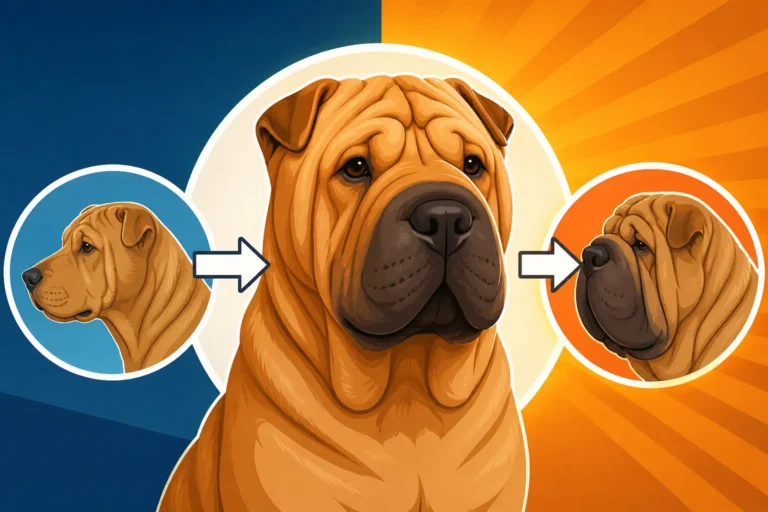
Shar Pei puppies often look much more folded than adults. As a puppy grows, the skin and body change, and some of those folds become less noticeable. Looking at a heavily wrinkled puppy beside an adult from an old photograph can make the historical difference seem larger than it is.
Age is only one part of the picture. Body size, lineage, and individual variation also affect how the folds look. If you are trying to judge whether a puppy’s appearance predicts its adult coat and skin, Whether a Shar Pei Puppy Grows Into Its Skin gives a more relevant comparison than a single historic image.
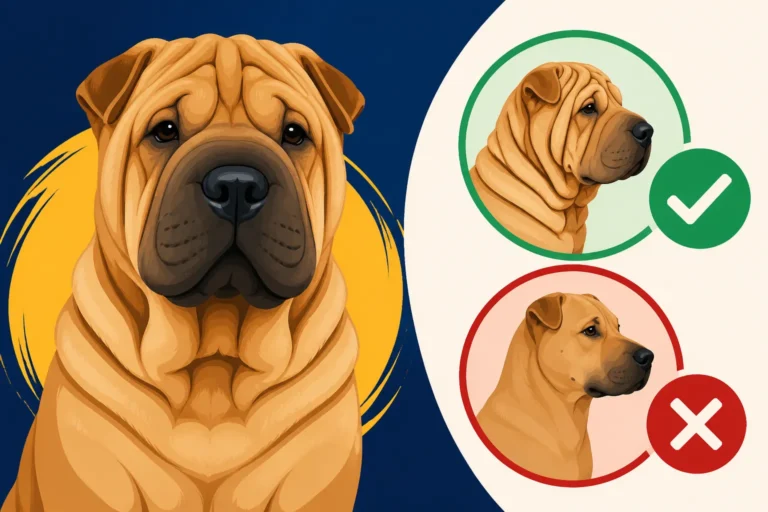
For adult dogs, the question is not simply whether folds exist, but where they are and how prominent they are. Many adults retain folds around the head and neck, while the body may look less folded than it did in puppyhood. Whether an Adult Shar Pei Should Have Head Wrinkles Only addresses that distinction without assuming that every dog should match one exact silhouette.
| Evidence or factor | What it may suggest | What it cannot prove |
|---|---|---|
| Early photographs | Some dogs appear less heavily folded than many modern examples | How common that appearance was across the whole population |
| Old sculptures or figurines | Certain dogs may resemble Shar Pei in general outline | That the object depicts a documented Shar Pei or shows folds accurately |
| Written descriptions | How people described dogs or their roles | The exact depth and distribution of skin folds |
| Modern variation | Shar Pei still differ in how wrinkled they look | What every early Shar Pei looked like |
| Puppy-to-adult changes | A puppy’s folds may become less prominent as it matures | That all puppies will develop the same adult appearance |
What to conclude when comparing old and modern Shar Pei
The most balanced conclusion is that the original Shar Pei was probably not wrinkle-free, but the surviving evidence does not support a precise portrait of its typical appearance. Early dogs likely varied, and at least some may have had a more moderate amount of loose skin than many people associate with the modern breed.
It is also possible to acknowledge that later breeding preferences influenced the breed without pretending we can assign a precise amount of change to one country, decade, or group of breeders. Historical photos can support a cautious comparison; they cannot establish a complete standard for what every Shar Pei once looked like.
Separate appearance from health
Wrinkles are visually distinctive, but a dog’s health cannot be judged from fold count alone. Skin condition, eye comfort, ear health, movement, and overall wellbeing all matter. A dog with fewer visible folds may still have health problems, while a wrinkled dog should not automatically be assumed to be unhealthy.
If you are choosing a puppy, focus on the breeder’s health practices and the individual dog’s needs rather than treating a particular degree of wrinkling as a guarantee. A responsible discussion should include the parents’ health history, the puppy’s eye and skin condition, and plans for veterinary care. What a Shar Pei Weighs and How Tall It Stands can help with basic breed expectations, but size and appearance are only parts of the picture.
For owners, the practical priority is to notice changes: persistent redness, odor, itching, discharge, or discomfort deserves attention, regardless of whether a dog looks more or less wrinkled than an old photograph. The breed’s history is fascinating, but day-to-day care should respond to the dog in front of you.
A careful answer to the original question
Was the original Shar Pei wrinkly at all? Probably yes, in the sense that loose skin and some folds were part of the breed’s appearance. Was it as wrinkly as every modern Shar Pei people see today? The evidence does not let us say that. Historical examples suggest a less exaggerated look in some dogs, while gaps in the record make sweeping claims unreliable.
That answer may feel less satisfying than a definite yes or no, but it is more honest. The breed’s appearance likely varied then, just as it does now, and the surviving evidence gives us hints rather than a complete record. When comparing an early Shar Pei with a modern one, treat photographs as useful clues—not as proof that there was one fixed original look.
Disclaimer
This article is for general informational purposes only and does not constitute professional advice. Laws, prices and regulations vary by location and change over time. Consult a qualified professional for guidance on your specific situation.