Whether Western Breeders Made the Shar Pei Wrinklier
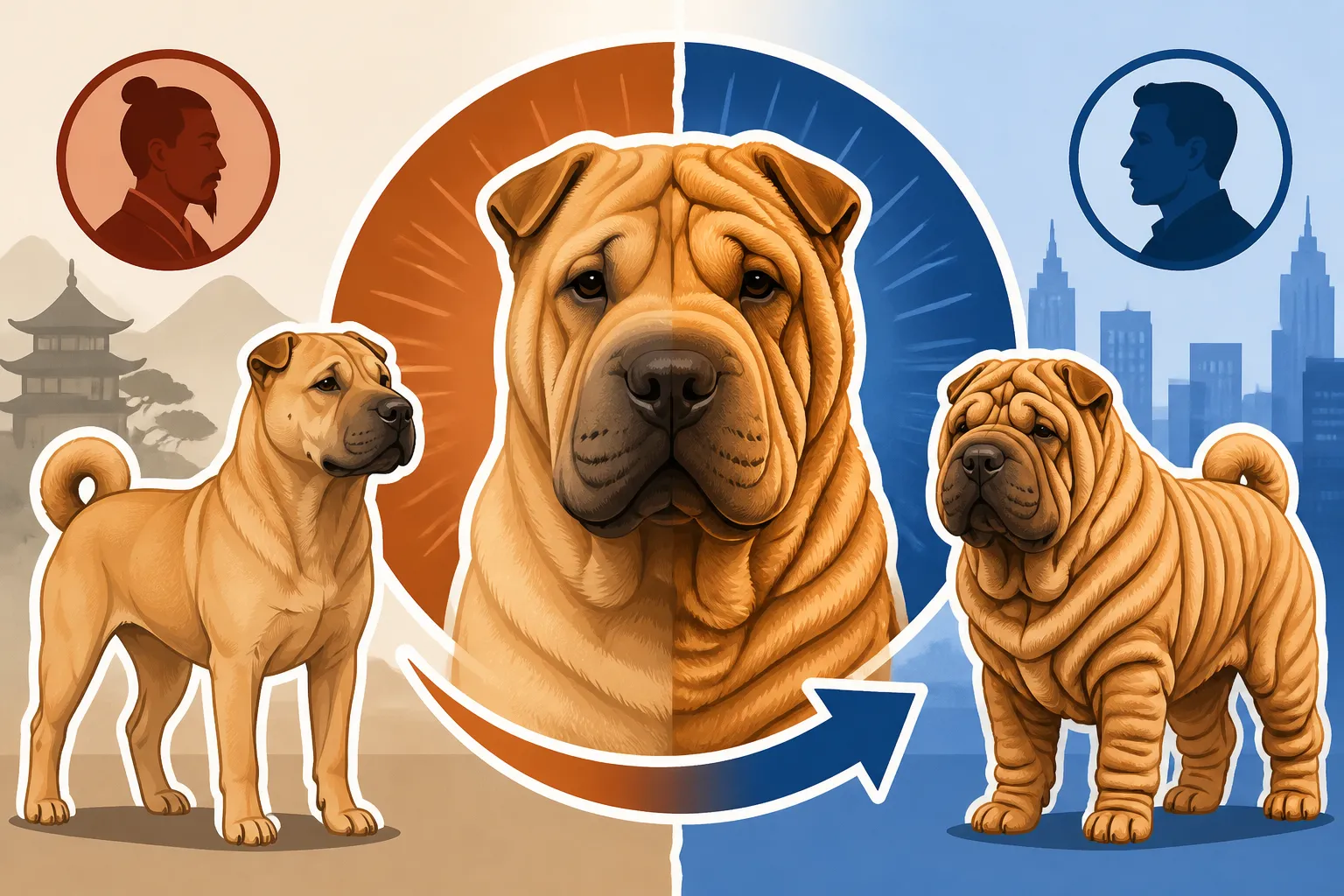
A Shar Pei’s famously wrinkled look is not simply an ancient feature that Western breeders invented from scratch. The evidence points to a more complicated story: Chinese Shar Pei already had loose skin, but Western demand and selective breeding likely helped make heavier wrinkles more common and conspicuous. Here’s what we can say, what remains uncertain, and why the distinction matters.
Did Western breeders make the Shar Pei wrinklier
The most accurate answer is probably to some extent, but not from nothing. Shar Pei with loose skin existed before the breed attracted intense attention in the West. However, the dogs that became especially popular in the United States and elsewhere were selected and promoted for a dramatic appearance, and that could influence which dogs were bred and which traits became more visible in later generations.
It is easy to turn that history into a simple claim that Western breeders “created” the wrinkles. The available evidence does not support such certainty. Photographs from earlier periods are limited, and a dog’s apparent wrinkliness can change with age, body condition, posture, and the way a photograph is taken.
What the early dogs can and cannot tell us
Shar Pei existed in China before the breed became popular in the West. Accounts and photographs suggest that loose skin and wrinkles were part of the breed’s appearance, but that does not tell us exactly how common heavy wrinkles were across the population. Nor does it establish that every early Shar Pei looked alike.
A photograph can be particularly misleading. A young dog often has more folds than an adult, while an adult’s skin may look tighter as its body grows. A side-on image may show folds that are hard to see from the front; a dog standing with its neck turned may look more wrinkled than one standing naturally. Old photographs also vary in clarity and angle, making close comparisons difficult.
That is why the question of Whether the Original Shar Pei Was Wrinkly at All is not answered by a single “yes” or “no.” The breed did not suddenly acquire loose skin after reaching the West, but the degree and distribution of wrinkles in early dogs are harder to reconstruct. A related look at Whether Photos of Early Shar Pei Show Fewer Folds helps explain why pictures can suggest a trend without proving exactly how widespread it was.
How rarity and demand may have shaped breeding
The Shar Pei’s modern history included a period of severe scarcity. Dogs were preserved by breeders in Hong Kong and elsewhere, and appeals to save the breed helped draw attention from people outside the region. Once the Shar Pei became a novelty and a sought-after pet, the number of people wanting puppies could rise faster than the number of carefully bred dogs available.
That kind of demand can shape a breed even without a formal plan to exaggerate one trait. If buyers repeatedly seek the most wrinkled puppy, breeders may be more likely to choose parents with pronounced folds. If photographs, advertisements, and public attention celebrate a highly distinctive look, that look can become a selling point. Over generations, repeated choices may make a feature more common or more extreme.
This is one part of the wider story behind What Being Saved Did to the Shar Pei's Health. Saving a breed from near disappearance is meaningful, but a small founding population and intense demand can also narrow the choices breeders have. Breed history, selection, and health are linked; the story is not simply that Western breeders either rescued the Shar Pei or changed it for the worse.
How Western breeding could amplify wrinkles
Selective breeding can increase the likelihood of a visible trait when dogs with that trait are repeatedly chosen as parents. It does not require breeders to understand the underlying biology. In the Shar Pei’s case, a strong preference for a heavily folded appearance could have encouraged the reproduction of dogs whose inherited traits produced more noticeable skin folds.
That still does not mean every wrinkle is a direct result of a specific Western breeding decision. A dog’s appearance reflects inherited variation, development, and the choices made across multiple generations. The history is best understood as a combination of traits that already existed and later breeding preferences that may have shifted how often those traits appeared.
From an existing trait to a more dramatic look
Imagine a population in which some puppies are moderately folded and others are especially wrinkled. If people consistently choose the most heavily folded dogs for breeding, the next generations may include more dogs with that appearance. If buyers then continue rewarding the same look, the preference can reinforce itself.
This is a general pattern in dog breeding, not proof of a single coordinated effort to make Shar Pei more wrinkled. Breeders may select for a collection of features at once, including head shape, coat, body, and temperament. A wrinkle-heavy look can become more prevalent as one part of that process, even if no one breeder set out to create a dramatically different dog.
The phrase “Western breeders made the Shar Pei wrinklier” therefore compresses several different questions: Were early Chinese dogs less wrinkled on average? Did Western selection favor more folds? Did the breed standard encourage a particular look? The evidence is stronger for the general possibility of selection than for exact claims about how much the average dog’s wrinkles changed. For the historical context of that demand, Whether the Shar Pei Was Bred for Wrinkles After 1980 is a useful related question.
What genetics adds to the picture
Shar Pei wrinkles are associated with inherited variation involving the gene HAS2, which affects the production of hyaluronic acid in skin. Research has linked changes in gene copy number with differences in the amount of hyaluronic acid and with the breed’s distinctive skin traits. The relationship between inherited variation and an individual dog’s appearance is not a simple wrinkle-counting formula, however.
Genetics helps explain how a trait can be passed on and why some dogs develop a more pronounced appearance than others. It does not, by itself, tell us which people selected which dogs in a particular decade or prove that all modern wrinkles arose through Western breeding. The question of Which Gene Duplication Causes a Shar Pei's Wrinkles addresses the biological side, while breed history helps explain how people may have influenced which versions of a trait became more common.
It is also important not to treat a dog’s number of folds as a reliable genetic test. A puppy may look extremely wrinkled and later appear less so as it matures. Two dogs with a similar adult appearance may not have identical inherited variants. Visible traits can point to a pattern, but they cannot reveal an individual dog’s full genetic makeup or predict every health outcome.
| Question | What we can reasonably say | What remains uncertain |
|---|---|---|
| Did Shar Pei have wrinkles before Western popularity? | Loose skin and wrinkles were part of the breed’s earlier appearance. | How common or pronounced heavy wrinkles were across early populations. |
| Could Western breeding increase the prominence of wrinkles? | Repeatedly choosing more heavily folded dogs could make that look more common. | Exactly how much the average appearance changed, and when. |
| Did Western breeders create Shar Pei wrinkles from scratch? | There is no good reason to treat the trait as entirely new. | The precise balance between older variation and later selection. |
| Can appearance alone predict a dog’s health? | Wrinkles may be relevant to care and breed health discussions. | A fold count cannot diagnose genetic risk or predict an individual dog’s future. |
Breed standards, puppy appearance, and health
Breed standards describe an idealized appearance for judging and breeding; they are not a complete record of how every Shar Pei looked historically. Standards can also influence selection because breeders often aim to produce dogs that fit the written description. If a standard recognizes a distinctive feature, it may help preserve that feature, although its exact effect depends on how breeders interpret and prioritize it.
In the Shar Pei, age matters. Puppies commonly have more loose skin than adults, and the skin often becomes less folded as the dog grows. A photograph of a deeply wrinkled puppy should not be treated as a guarantee of the adult look—or as proof that an adult dog’s body will remain covered in the same folds.
What the standard does and does not prove
The breed standard recognizes wrinkles as part of the Shar Pei’s appearance, but standards are not historical photographs and cannot tell us how common a trait was in the past. They describe what a particular kennel club considers desirable within its breed definition. They may guide breeders, but they do not prove that a trait originated in the country where the standard was written.
The wording and emphasis of a standard also matter. A description may distinguish between a puppy’s loose skin and an adult’s appearance, rather than suggesting that every adult should have extensive folds over the whole body. That distinction is important when people compare a wrinkled puppy with an older dog. For a closer look at the written ideal, see Whether a Shar Pei's Wrinkles Are in the Standard.
When people ask if modern Shar Pei have “too many” wrinkles, they may be asking about appearance, welfare, or both. Those are related but different conversations. A dog can have visible folds without those folds being infected, while a dog with less dramatic folds can still have skin irritation or another health problem.
Why the question matters to owners today
Heavy folds can hold moisture and debris, and skin irritation may be easy to miss beneath loose skin. Owners should pay attention to changes such as redness, persistent odor, discharge, tenderness, or repeated scratching, and seek veterinary advice when those signs appear. Routine care should be gentle; scrubbing or applying unapproved products to irritated skin can make a problem worse.
For basic supplies, some owners compare options at pet retailers such as Chewy, but the right cleaning product depends on the dog’s skin and the veterinarian’s guidance. Product availability is not a substitute for an examination when a fold is inflamed or painful. Chewy may be convenient for ordinary supplies, yet it cannot determine whether a smell or rash is an infection, allergy, or another condition.
Food can also become part of the conversation when a dog has recurring skin trouble, though wrinkles alone do not prove a food allergy. If a veterinarian recommends a specific diet or product, owners can check with the clinic and then compare appropriate purchasing options, including Chewy where available. The goal is to address the dog’s actual symptoms, not to assume that a certain wrinkle pattern automatically calls for a particular food or skin treatment.
The broader health question is whether breeding for fewer wrinkles could improve welfare. Reducing exaggerated features may be part of a thoughtful breeding discussion, but wrinkles are not the only relevant trait. Breeders also need to consider overall health, inherited disease risks, temperament, and genetic diversity. Whether Breeding for Fewer Wrinkles Would Help explores why reducing one visible feature may be worthwhile without being a complete solution on its own.
A careful conclusion about Western influence
Western breeding likely helped amplify the heavily wrinkled appearance that became strongly associated with the modern Shar Pei, particularly as the breed attracted attention and people selected for a distinctive look. But “Western breeders made the Shar Pei wrinklier” is too absolute if it implies that the earlier breed had no wrinkles or that one group deliberately invented them.
A more balanced account is that loose skin was already part of the breed, while later breeding choices may have increased the prominence of certain appearances. Historical photographs offer clues, not a precise measurement of change. Genetic research explains how inherited variation can contribute to wrinkles, but it cannot by itself reconstruct every breeding decision.
For an individual owner, the practical lesson is not to judge a Shar Pei’s wellbeing by fold count alone. A wrinkled puppy may grow into a less folded adult, and a visually moderate dog can still need attentive skin care. Watch the dog in front of you, learn its normal skin and coat, and involve a veterinarian when something changes. The related question Whether a Less Wrinkled Shar Pei Is Healthier is worth considering alongside the breed’s history, because appearance and health are connected but are never interchangeable.
Disclaimer
This article is for general informational purposes only and does not constitute professional advice. Laws, prices and regulations vary by location and change over time. Consult a qualified professional for guidance on your specific situation.