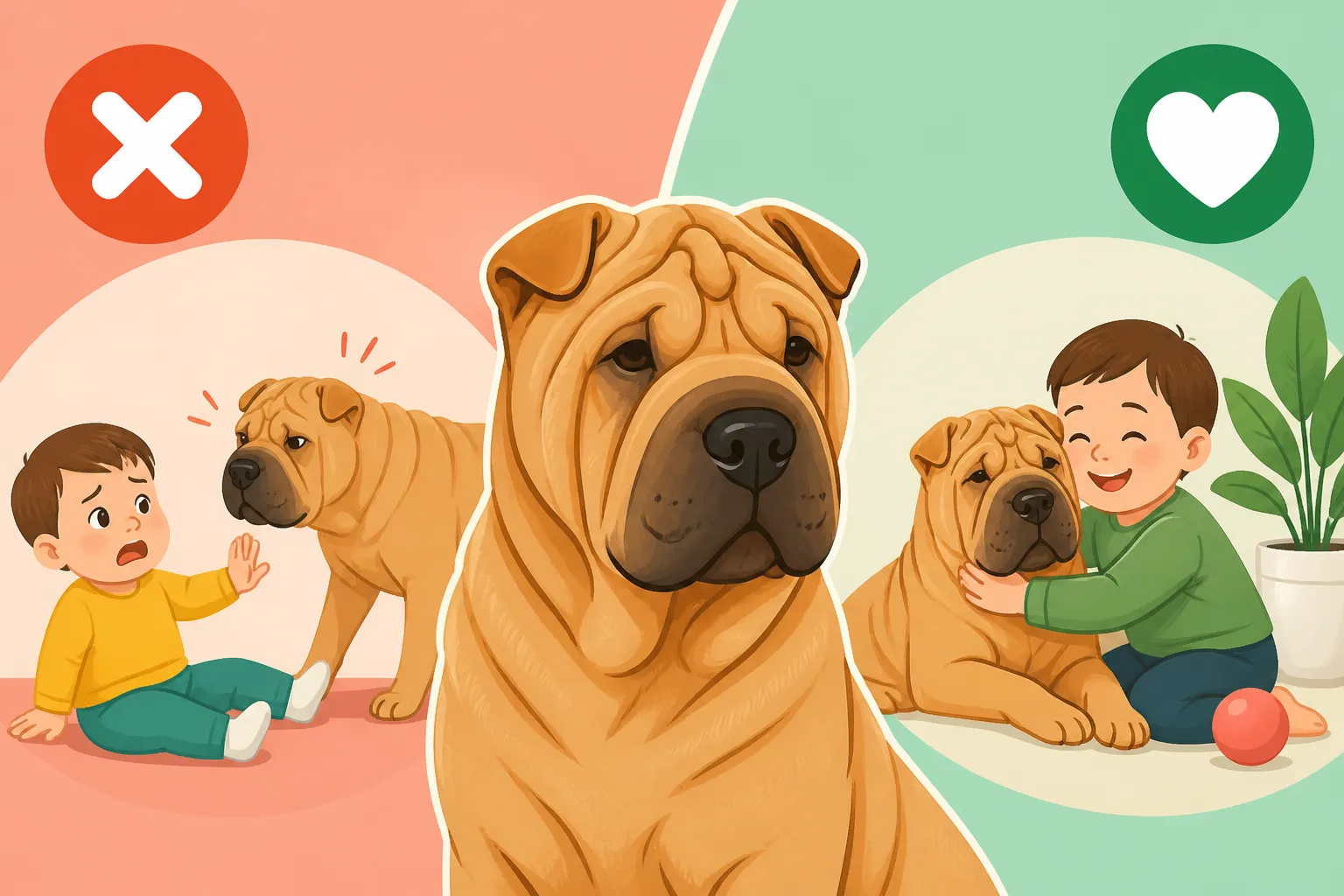
Whether a Shar Pei Suits a Family With Toddlers
A Shar Pei can live with a family that has toddlers, but it is not a pairing to leave to good intentions alone. Toddlers move quickly, grab without warning, and are still learning boundaries; Shar Pei often value personal space and may be startled by sudden contact. This guide explains what makes the match safer, what to watch for, and when another breed may suit your household better.
Can a Shar Pei Live With Toddlers
There is no breed-wide yes or no. Some Shar Pei are relaxed around children they know, while others find toddler noise, unpredictable movement, or close handling stressful. The individual dog’s temperament, early experiences, health, and the adults’ ability to manage interactions all matter.
A toddler’s behavior is also part of the equation. A child who is too young to follow simple safety rules cannot be expected to protect the dog’s boundaries. In practice, the adults must do the work: supervise closely, create child-free rest areas, and prevent situations where the dog feels cornered or handled roughly.
What Shar Pei temperament means in a family home
Shar Pei are often described as loyal and reserved, rather than eager to greet everyone. A dog may be devoted to its household and still prefer not to be hugged, climbed on, or approached while sleeping. Those preferences are not signs of a bad dog; they are boundaries that a family needs to respect. For more on this tendency, see A Shar Pei Was Bred to Guard, Not to Greet.
It helps to picture an ordinary busy afternoon. A toddler drops a toy beside the dog’s bed, squeals, then reaches toward the dog’s face. Even a dog that has been calm all morning might find the sudden approach uncomfortable. The question is not simply whether the Shar Pei “likes kids.” It is whether the adults can consistently keep the child from startling, crowding, or touching the dog when it wants space.
Breed tendencies can offer context, but they cannot predict exactly how a particular dog will behave. A well-socialized, patient Shar Pei may cope well with a calm child and careful adults. Another may find the same household overwhelming. It is safer to assess the dog in front of you than to assume that either friendliness or risk is guaranteed by breed.
Why toddler behavior can be hard for dogs
Toddlers are still developing impulse control. They may pull ears or skin, lean over a dog, chase it, squeal close to its face, or try to take food or toys. Often, they are curious rather than deliberately rough. But a dog can still experience those actions as uncomfortable or frightening.
Shar Pei may be especially difficult for young children to read. Their facial folds and naturally reserved manner can make expressions less obvious to an inexperienced observer. They may turn away, become still, or leave instead of making a dramatic display of discomfort. Children should not be expected to interpret those signals reliably; adults need to notice and act first. Why a Shar Pei Is Hard to Read explores this challenge further.
A dog also needs a way to leave. If a toddler follows it into a corner, blocks a doorway, or reaches into its bed, the dog may feel trapped. That is why “the dog has always been gentle” is not a safety plan. Calm behavior in the past cannot guarantee comfort in every future interaction.
When the match may not be right
A Shar Pei may be a poor fit if the adults cannot supervise actively, the home has no way to separate dog and child, or the dog has shown fear or aggression around children. A household where the toddler is frequently allowed to chase, grab, or climb on the dog is also not a safe setup, even if the dog has tolerated it so far.
Take extra care when considering an adult rescue dog with little known history around young children. That does not make adoption impossible, but it does mean the family should ask detailed questions, arrange careful introductions, and be realistic about what the dog’s previous behavior can and cannot tell them. If a dog has a known bite history, a qualified behavior professional should be involved before the dog is placed in a home with a toddler.
The Main Risks and Warning Signs
Bites are often discussed as if they happen without warning. In many cases, a dog has first shown discomfort through changes in posture or attempts to avoid contact. Those signs can be subtle, especially when adults are focused on the child. Learning to recognize them gives caregivers a chance to create distance before the situation escalates.
This does not mean every yawn or turn of the head signals a crisis. Look at the whole picture: what was happening, whether the dog can move away, and whether its body looks loose or tense. When in doubt, calmly separate the dog and child rather than asking the dog to tolerate more.
Watch for discomfort, not just growling
A dog may show stress by turning its head away, shifting its weight back, moving off, licking its lips, yawning when it is not tired, or becoming unusually still. Some dogs also tuck their tail, pin their ears back, or avoid looking at the person approaching them. These signals are reasons to give the dog space, not to coax it closer.
Growling is a clear warning that the dog is uncomfortable. Do not punish it or encourage the child to continue interacting. Scolding a dog for growling may suppress an important warning without changing the fear or discomfort underneath it. Separate them calmly, make sure the child is safe, and consider professional guidance if the behavior repeats.
Pay attention to changes in the dog’s normal behavior, too. A Shar Pei that starts leaving the room whenever the toddler approaches, guarding its bed, or snapping during routine handling is telling you that the current setup is not working. How a Shar Pei Warns Before It Reacts offers more detail on signals that deserve attention.
Situations that deserve particular care
Some moments are predictably harder than others. Avoid allowing a toddler to approach the dog while it is asleep, eating, chewing a treat, or resting in a crate or bed. Do not let a child take toys away, touch the dog’s face, climb onto its back, or crowd it while it is trying to leave.
Food and treasured objects need special management. Feed the dog in a separate area behind a closed door or secure barrier, and pick up bowls when the dog has finished. Keep toys and chews out of reach when the child is playing nearby. These steps are not a sign that the dog is dangerous; they remove common sources of conflict before a young child can accidentally create one. See Why a Shar Pei Guards Its Food and Its Doorway for related breed-specific context.
Consider the dog’s field of vision as well. A Shar Pei may not notice a toddler approaching from the side or behind as quickly as a person expects. Teach adults and older children to approach where the dog can see them, and never let a toddler sneak up on a resting dog. Why a Shar Pei Startles: It Cannot See You Coming explains why surprise can be a concern for this breed.
How to make the home safer
Use physical separation as a normal part of daily life, not only after a problem. A sturdy baby gate can keep the dog’s resting area separate from play, while a closed door can provide a quieter break during busy parts of the day. Choose barriers that are properly installed and that the toddler cannot climb or push over.
Set up a dog-only retreat where the child is never allowed to follow. This might be a gated room, a quiet corner behind a barrier, or another space that the dog can reach but the toddler cannot. A crate can be useful as a resting place if the dog is comfortable with it, but it should never be used as a place for the child to poke at or disturb the dog.
When comparing gates, pens, or other household supplies, focus on fit, stability, and whether the setup actually prevents access. Families may find options through retailers such as Chewy, but the brand matters less than choosing a barrier that suits the home and using it consistently. A gate that is too low, loosely mounted, or left open does not provide dependable separation.
Building Safe Habits for the Child and Dog
A safe household is built through repeated routines. The goal is not to make the dog tolerate everything a toddler might do. It is to prevent uncomfortable contact, reward calm behavior at a comfortable distance, and teach the child simple rules over time.
Socialization can help a dog become more comfortable with ordinary household sounds and experiences, but it does not mean forcing contact with children. Introductions should be gradual and positive, with the dog free to move away. Socialize a Shar Pei Before Twelve Weeks or Pay for It Later discusses early socialization, while a cautious plan is still important for adult dogs.
Supervise every interaction
Active supervision means an adult is close enough to intervene immediately and is watching the dog and child—not cooking, looking at a phone, or assuming another person is paying attention. If the adult cannot focus, the dog and toddler should be separated. A quick glance from across the room is not enough when a small child can reach the dog in seconds.
Use a simple routine for greetings. Have the child stay beside an adult, keep hands low and still, and allow the dog to choose whether to approach. Avoid putting the child’s face near the dog’s face or encouraging hugs. If the dog walks away, the interaction is over. Do not call it back so the child can pet it again.
A good rule is to keep contact short and calm. An adult can reward the dog for relaxed behavior at a distance, then end the interaction before the dog becomes tired or restless. Treats can be useful, but they should be delivered by an adult or in a way that does not invite a toddler to reach into the dog’s mouth or take food away.
Teach toddler-friendly rules in small steps
Young children learn through short, repeated reminders. Use simple rules such as “Let the dog sleep,” “Hands gentle,” and “Call an adult before you go near the dog.” Demonstrate what gentle contact looks like on a toy or stuffed animal rather than relying on the toddler to work it out during a real interaction.
Practice everyday situations before they become exciting. Show the child how to walk past the dog’s bed without stopping, leave the food area alone, and wait for an adult before offering a toy. Praise the child for following those rules. The point is not to make a toddler responsible for safety; it is to reduce impulsive behavior while adults remain in charge.
If the child is too young to understand or remember the rules, treat that as normal. Keep the dog and toddler separated unless an adult is actively managing the interaction. A Shar Pei With Children in the House covers broader family considerations that matter beyond the toddler years.
Help the dog feel secure without forcing friendship
Give the dog predictable rest and avoid making it the center of every family activity. If the household becomes noisy, offer a quiet break behind a gate. Reward the dog for calmly settling in its own space, and let that space remain off-limits to the child.
Use positive reinforcement to build practical skills, such as going to a mat, coming away from a child, or allowing routine handling by an adult. Training should be gentle and adapted to the individual dog. Do not punish fear, force the dog to accept hugs, or use the toddler as a tool to “get the dog used to children.” A dog that is overwhelmed is not learning that the child is safe; it may simply be learning that it has no way out.
If a dog becomes tense, repeatedly avoids the child, growls, snaps, or guards spaces and objects, separate them and seek help from a veterinarian or a qualified behavior professional. Pain or illness can also change a dog’s tolerance. A veterinary check is sensible when behavior changes suddenly, especially if the dog seems uncomfortable with touch.
Deciding Whether a Shar Pei Fits Your Family
Before bringing a Shar Pei into a home with a toddler, be honest about your routines. A family may be ready if adults can provide close supervision, maintain reliable barriers, protect the dog’s quiet space, and teach consistent child-safe habits. The match is much harder if caregivers are stretched thin or expect the dog and toddler to “work it out.”
Meet the individual dog in a calm setting, and ask specific questions about its history with children, handling, food, resting places, and sudden noises. A brief friendly meeting cannot prove that a dog is comfortable living with a toddler. Look for a pattern of relaxed behavior, and make decisions with the help of a reputable rescue, breeder, veterinarian, or qualified behavior professional.
| Household situation | What it may mean for the match | Sensible next step |
|---|---|---|
| Adults can supervise and separate dog and child | A careful introduction may be manageable | Set up barriers and a dog-only resting space before arrival |
| The dog has no known history with young children | Its response may be uncertain | Arrange gradual introductions and seek qualified guidance |
| The dog avoids the toddler or shows tension | The current interaction may be too much | Create distance and do not force contact |
| The toddler cannot follow simple safety rules yet | The child cannot manage the risk independently | Rely on adult supervision and physical separation |
| The dog has growled, snapped, or bitten | There is a serious safety concern | Keep them apart and consult a veterinarian or behavior professional |
Questions to ask before choosing a dog
Ask whether the dog has lived with young children, how it behaves around sudden movement and noise, and whether it guards food, beds, toys, or doorways. Find out how it responds to being touched during rest, whether it can comfortably leave an interaction, and what situations have caused it to retreat or become tense. Ask for concrete examples rather than a general assurance that the dog is “good with kids.”
For a puppy, ask how it has been introduced to ordinary household experiences and how the breeder approaches temperament and early handling. A puppy’s behavior can change as it matures, so no early assessment is a guarantee. Families still need supervision, training, and boundaries as the dog grows.
For an adult dog, records and observations from a foster home can be helpful, but they are not a promise that the dog will behave identically in a new household. A careful transition, a quiet starting space, and gradual exposure to family routines give the dog a better chance to settle. How a Rescue Shar Pei Learns to Trust Strangers may also help families understand why patience matters when a dog moves into a new home.
The everyday commitment matters more than the label
Think through a normal day, not just the first introduction. Who keeps the toddler away from the dog’s food? Where can the dog rest during a playdate? What happens when one adult is bathing the child and the other is out? Is there a reliable plan for visitors, busy evenings, and moments when the toddler is upset and loud?
Supplies can support that routine, but they cannot replace it. A secure gate, washable bedding, and suitable toys can make management easier; families can look at retailers such as Chewy when comparing household and dog-care items. Choose products that fit the dog and your space, and remember that the most important safety tool is an adult who notices when either the child or dog needs a break.
A Shar Pei and a toddler may share a home successfully when the adults treat supervision, separation, and the dog’s right to retreat as everyday essentials. If those measures are not realistic for your household, waiting until the child is older—or choosing a dog whose individual temperament and history are a better fit—may be the kinder choice for everyone. For a wider look at the breed’s needs, Whether a Shar Pei Suits a First Time Owner can help put the decision in context.
Disclaimer
This article is for general informational purposes only and does not constitute professional advice. Laws, prices and regulations vary by location and change over time. Consult a qualified professional for guidance on your specific situation.