Whether a Shar Pei’s Tail Must Curl Over Its Back
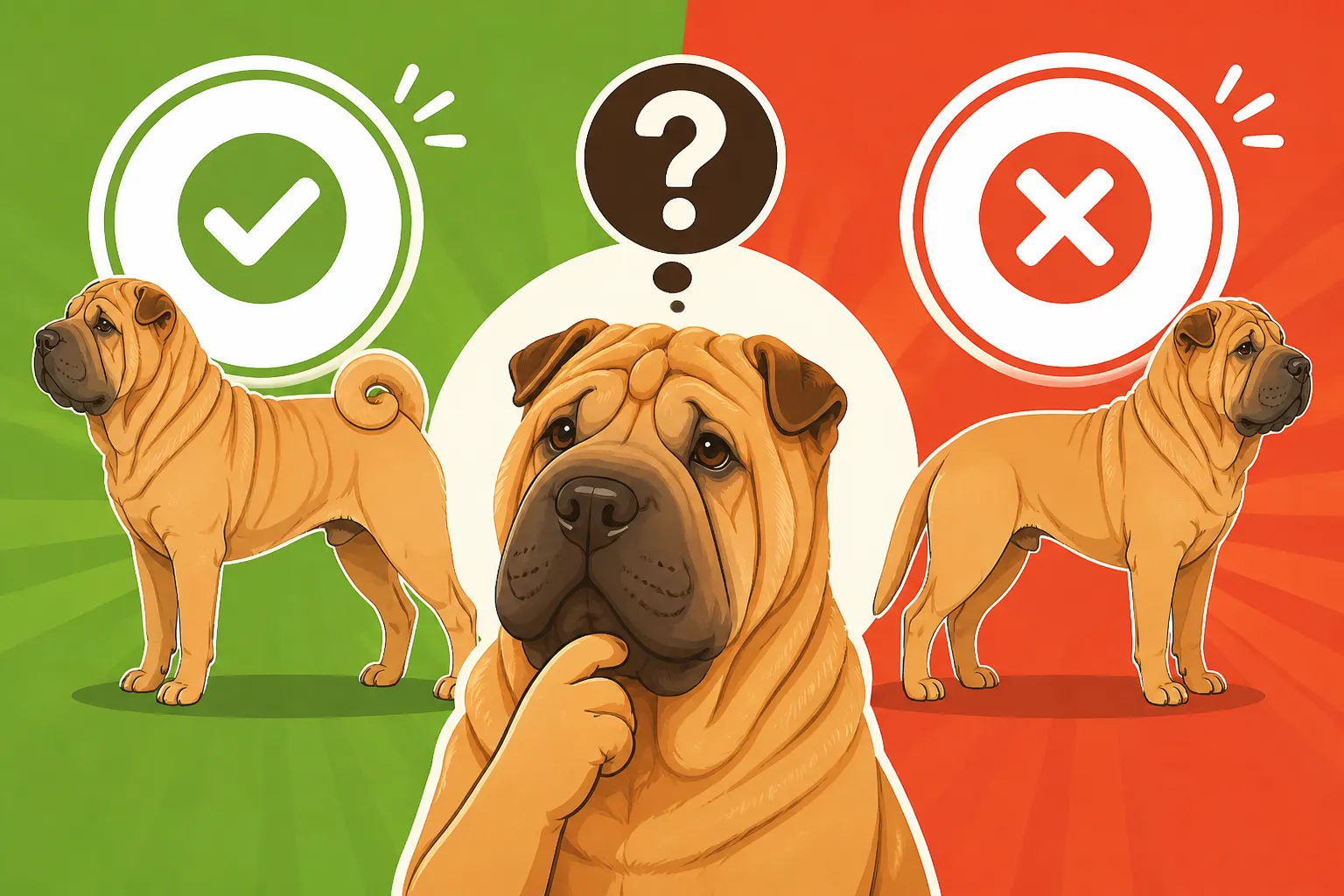
A Shar Pei’s tail does not have to curl neatly over the center of its back. The breed’s characteristic tail is carried in a curve, but it may rest over the back or to either side, and its position can change with posture and mood. This guide explains what tail shape is typical, what matters in breed standards, and when a change deserves attention.
What a Shar Pei’s tail should look like
The characteristic curve
A Shar Pei’s tail is typically set high, thick at the base, and tapered toward the tip. It is commonly carried in a curve over the back or to one side. That curve can look like a loose arc or a tighter loop, so two healthy Shar Pei can have noticeably different-looking tails.
The phrase “curled over its back” can create the impression that every Shar Pei should have a tight, centered ring. That is too narrow an interpretation. A tail lying across the back, leaning toward one hip, or forming a relaxed curl may all fit the general breed type. The important distinction is between a naturally varied curve and a tail that is persistently held in an unusual position because the dog seems uncomfortable.
The tail is one part of a dog’s overall structure, not a stand-alone health test. A curl by itself does not prove that a Shar Pei is purebred, healthy, or closer to an ideal example of the breed. For a broader look at breed features, see What a Shar Pei Weighs and How Tall It Stands and Whether a Shar Pei's Wrinkles Are in the Standard.
Must the tail curl over the back
No. A Shar Pei’s tail is characteristically curved, but it does not have to sit directly over the middle of the back. Breed descriptions allow for the tail to be carried over the back or to either side. Individual anatomy, how the dog is standing, and its level of alertness can all affect what you see.
A tail that curves toward the dog’s left or right side may look quite different from photographs where the tail forms a high, tidy loop. That variation is not automatically a fault or a sign of a problem. If you are looking at a puppy, remember that posture can also change from one moment to the next: a relaxed dog may carry its tail differently from one watching a visitor or waiting for a walk.
For someone comparing a dog with a written breed standard, it helps to separate the tail’s general shape and set from its exact resting position. Standards describe a typical breed outline; they are not a promise that every dog will hold its tail in exactly the same pose. The discussion of Whether a Shar Pei's Tail Curls for a Reason offers more background on why the breed’s tail shape is a recognizable feature.
| What you notice | What it may mean | What to consider |
|---|---|---|
| A loose curve over the back | A common way to carry the tail | Look at the dog’s overall comfort and movement |
| A curve toward one side | A normal variation in carriage | Side preference alone is not a diagnosis |
| A tighter curl or loop | A possible variation in tail shape | Do not judge health from curl tightness alone |
| A tail held lower while resting | Could reflect a relaxed posture or individual habit | Watch for sudden changes, pain, or other symptoms |
| A new droop, stiffness, or reluctance to wag | Could be associated with discomfort or injury | Contact a veterinarian if it persists or comes with other signs |
Why a Shar Pei’s tail may sit differently
Posture and mood change tail carriage
A dog’s tail is not fixed in one pose throughout the day. A Shar Pei may carry it higher when alert, shift it while turning, and let it rest differently when settled at home. The curl may still be present even when the tail’s overall position looks lower or less prominent.
Pay attention to the whole dog rather than interpreting one snapshot. A Shar Pei watching someone approach may hold its body with more alertness than one asleep on a bed. Likewise, tail position is only one part of canine communication. Ears, weight shifts, facial tension, movement, and distance from a person or dog all add context.
Shar Pei faces can be difficult for unfamiliar people to read, and a curled tail does not tell the entire emotional story. Learn to look at the dog’s complete posture and give it room when it seems uncertain. How a Shar Pei Uses Its Tail and How a Shar Pei's Wrinkles Hide Its Expression can help put tail and facial signals into a wider context.
Shape and carriage are not the same thing
Tail shape describes the tail’s physical form; carriage describes how the dog holds it at a particular moment. A naturally curled tail may be carried more loosely when the dog is relaxed, while the same tail can appear more elevated when the dog is attentive. This is why a single photograph may not tell you how the tail usually sits.
If you are evaluating a puppy or considering a Shar Pei from a breeder, observe the dog moving and resting rather than relying only on posed pictures. Ask about any known tail injury or surgery, and notice whether the dog moves freely without guarding the hindquarters. A tail that looks different from the one in a breed illustration is not, on its own, evidence of a health issue.
Tail appearance also should not be confused with the dog’s temperament. A curled tail does not mean a Shar Pei is friendly, confident, or eager to meet strangers. A respectful introduction matters more than trying to infer personality from one body feature. For more on interpreting the breed’s behavior, see How a Shar Pei Behaves Toward Other Dogs and How a Shar Pei Shows Affection.
When a tail change deserves attention
Look for sudden changes, not just a different curl
A tail that has always rested slightly to one side is different from a tail that suddenly droops, becomes stiff, or is held in a new position. A change can have many possible explanations, including soreness or injury, and the tail’s appearance alone cannot identify the cause.
Notice what else is happening. Is your dog reluctant to sit, climb steps, or move its hindquarters? Does it flinch when the area near the tail is touched, or seem unusually quiet? Are there changes in appetite, walking, toileting, or general behavior? These details can help you describe the situation clearly when you call your veterinary clinic.
Avoid pulling, straightening, or repeatedly handling the tail to test it. If the change appeared suddenly, seems painful, or comes with other concerning symptoms, contact a veterinarian for advice. A photo or short video of the tail at rest and during normal walking may be useful, but it should not delay care if your dog appears distressed.
Check the skin and surrounding area gently
The base of a Shar Pei’s tail can sit close to skin folds, so routine observation is sensible. During ordinary grooming, look for redness, dampness, unpleasant odor, swelling, or discharge around the tail base. Do not assume that every odor or patch of irritated skin is caused by the tail’s shape; skin problems can have different causes and may need veterinary assessment.
Keep any cleaning gentle and dry the area thoroughly if it gets wet. Avoid putting powders, creams, or human products into a fold unless your veterinarian recommends them. Owners who are gathering everyday grooming supplies may compare options at a local pet shop or on Chewy, but a product’s availability does not make it suitable for irritated skin. If the area looks sore, ask the clinic what to use before applying anything.
For general context on the breed’s skin care, Skin Is the Shar Pei's Largest Problem by Surface Area explains why ongoing skin checks matter. The tail’s curl is not usually the reason to clean or treat the area; the aim is simply to notice changes early and keep the skin comfortable.
Practical ways to assess a Shar Pei’s tail
Observe the dog in ordinary situations
If you are trying to understand your own dog’s usual tail carriage, watch during several everyday moments: standing comfortably, walking at an easy pace, greeting a familiar person, and resting at home. You do not need to stage a reaction or handle the tail. A few calm observations can show whether the tail position varies naturally with activity.
When meeting a Shar Pei for the first time, approach thoughtfully instead of reaching for its tail or hindquarters. Give the dog space, let the owner guide the introduction, and avoid surprising it from behind. This is especially helpful for a breed whose field of vision and individual comfort around handling may affect how it responds to someone approaching. How to Approach a Shar Pei Safely has more guidance for calm introductions.
If you are comparing dogs, consider the whole picture: movement, comfort, skin condition, and the dog’s response to normal handling. A tail that curls to one side should not outweigh signs that the dog is comfortable and moving normally. Conversely, a textbook-looking curl should not distract from a sudden change or visible discomfort.
Keep equipment and grooming comfortable
A curled tail generally does not require special equipment. Choose a properly fitted collar or harness that does not rub the neck, shoulders, or skin folds, and check the fit as your dog grows or changes weight. A harness should allow normal movement without pressing against sensitive areas; the tail should not need to be repositioned to make gear fit.
When shopping for routine supplies, you might compare sizing guides at a local store or browse Chewy’s available harness options. Fit the item to your individual dog rather than choosing it because it is labeled for a particular breed. If your Shar Pei has irritated skin or reacts strongly to handling, ask your veterinarian for practical fitting advice.
Grooming should be similarly low-pressure. There is no need to manipulate the tail into a particular curl, and repeated bending or tugging can make a dog uncomfortable. If cleaning or examining the tail base is difficult, introduce brief, gentle handling gradually and reward calm behavior. For a dog with pain, persistent irritation, or a sudden change in tail carriage, a veterinary check is more useful than trying a new grooming product from Chewy or elsewhere.
The central takeaway is simple: a Shar Pei’s tail is characteristically curved, but it does not have to curl neatly over the center of the back. A curve over either side can be typical, and tail posture may vary. Focus less on achieving a particular silhouette and more on whether your dog moves comfortably, has healthy-looking skin, and behaves as usual.
Disclaimer
This article is for general informational purposes only and does not constitute professional advice. Laws, prices and regulations vary by location and change over time. Consult a qualified professional for guidance on your specific situation.