Whether Photos of Early Shar Pei Show Fewer Folds
A familiar claim says early Shar Pei looked less wrinkled than the dogs seen today. Many older photographs do show dogs with less exaggerated skin, but the images are limited evidence: they vary in date, age, pose, and quality, and they cannot tell us exactly how the breed looked as a whole. This guide explains what those photographs suggest—and what they cannot prove.
What early Shar Pei photographs appear to show
Many older dogs look less heavily wrinkled
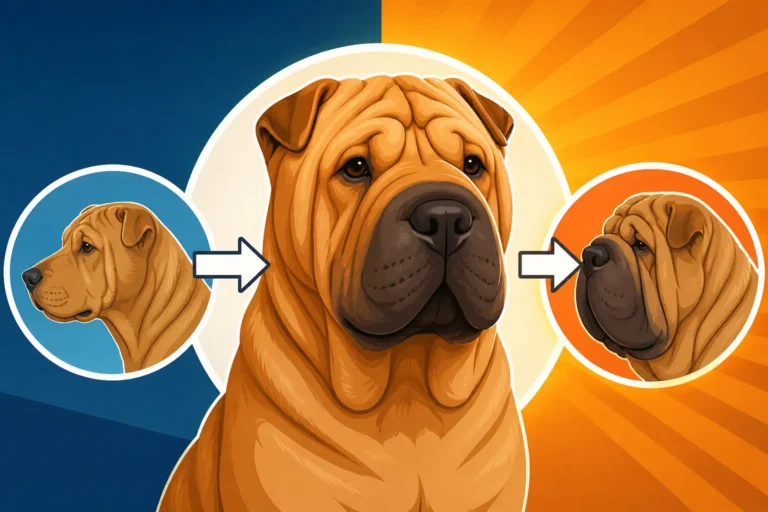
In a number of photographs from the period when Shar Pei were being preserved and introduced outside southern China, the dogs appear less folded than some modern examples. Their wrinkles may be concentrated around the head and neck rather than running prominently over the body. The muzzle can look less padded, too, giving the dog a more moderate outline.
That visual difference is worth noticing, but it is not a reliable measurement by itself. A photograph captures one dog from one angle, often in a particular pose. If the dog is standing sideways, a neck roll may be hidden; if it is looking down, loose skin around the head may bunch up and appear more pronounced. Lighting, focus, and the thickness of the coat can also change how clearly folds show.
It helps to compare multiple photographs rather than treating one striking image as the definitive “old Shar Pei.” A picture of a lean adult with a smooth body does not establish that all early dogs were lightly wrinkled. It shows that at least some dogs in the available record had a less exaggerated appearance.
Photographs are not the same as a complete historical record
The phrase “early Shar Pei” can mean different things. Some people mean dogs photographed before the breed became known internationally; others mean the dogs in the first generations bred outside their home region. Those are not necessarily the same population, and the photographs may not be evenly distributed across time or place.
The surviving record is also selective. People tend to preserve unusual, attractive, or useful images, not make a systematic photographic survey of every dog. A small group of pictures cannot tell us the full range of appearance in a population. Nor does an old photograph always come with clear information about the dog’s age, family line, location, or exact date.
There are also images often described as “ancient Shar Pei” that are statues, drawings, or other artworks rather than photographs. Such objects can be interesting cultural evidence, but they are not literal portraits with dependable detail about skin folds. The connection between an artwork and the modern breed may be debated, so it is sensible to keep that material separate from photographs of identifiable dogs.
For a related look at how older dogs compare with current breed expectations, see Whether Photos of Early Shar Pei Show Fewer Folds and Whether the Original Shar Pei Was Wrinkly at All. The key is to ask what each image can actually establish, rather than asking it to answer the entire history of the breed.
Why the breed’s appearance may have changed
Breeding preferences can influence visible traits
A breed’s average appearance can shift when breeders repeatedly select dogs with particular features. If heavily wrinkled dogs are favored for breeding or promotion, those traits can become more common or more pronounced over generations. That does not mean every breeder made the same choice, or that appearance changed in a single deliberate step. It means selection can gradually influence the traits people see most often.
The modern Shar Pei includes considerable variation. Some have substantial folds and a thick, padded muzzle; others look more moderate, with wrinkles mainly around the face and shoulders. Coat type and family line contribute to the overall impression as well. A photograph may make two dogs look more alike or more different than they would in person, depending on their build, coat, and posture.
The distinction between the traditional and modern look is often discussed through the terms “bone mouth” and “meat mouth.” These labels describe differences in muzzle shape and overall appearance, but they should not be used as a shortcut for judging a particular dog’s health or ancestry. Meat Mouth and Bone Mouth Are Two Different Shar Pei explains the terminology in more detail, while What a Bone Mouth Shar Pei Is focuses on the more moderate type.
Puppy skin and adult skin can create misleading comparisons
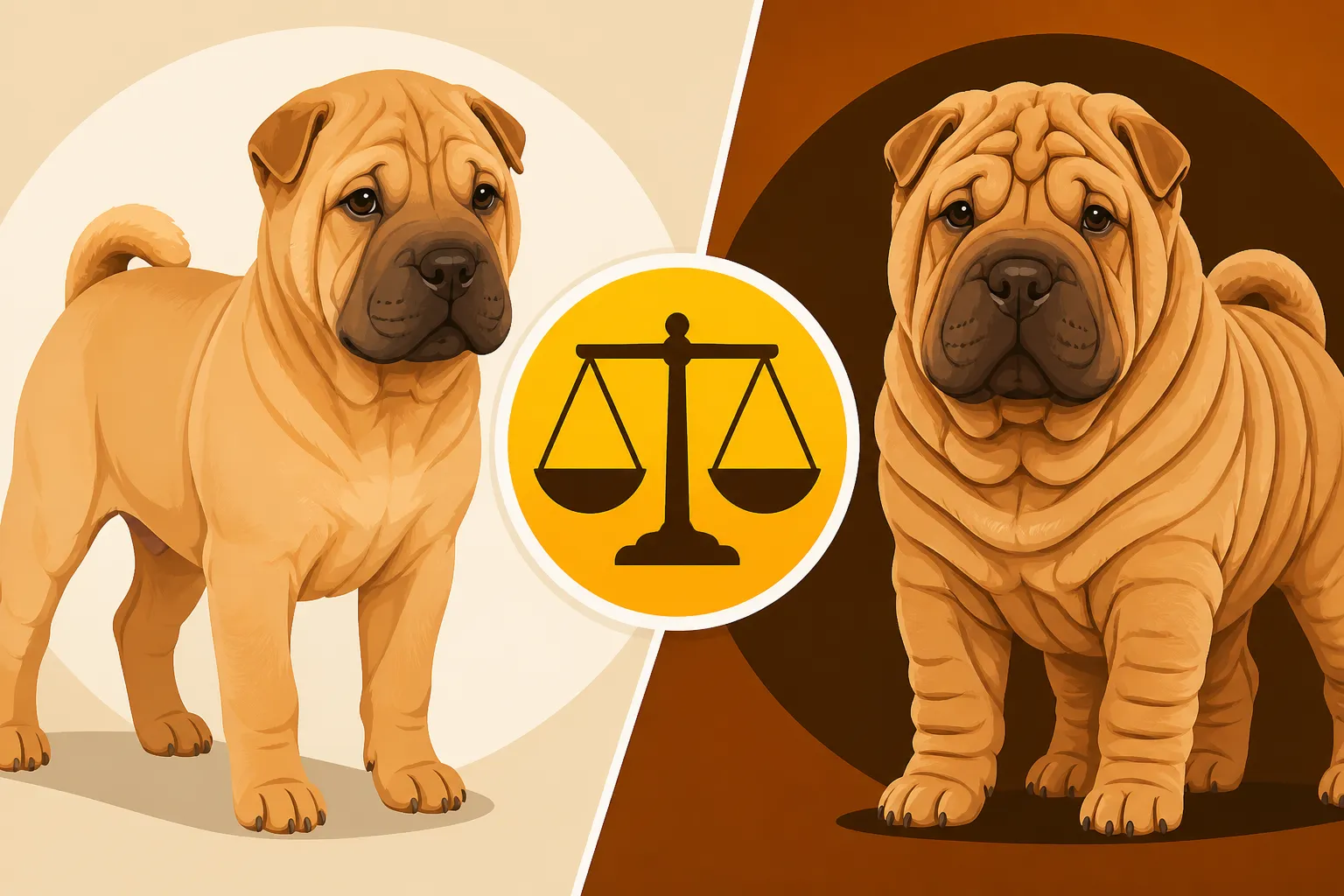
Age matters enormously. Shar Pei puppies often have more loose skin and wrinkles than adults. As a puppy grows, the body lengthens and fills out, so some of that loose skin becomes less obvious. Comparing a wrinkly puppy in a recent photograph with a lean adult in an older picture can make a historical difference seem much larger than it is.
The camera angle can add to the confusion. A close-up portrait emphasizes the face and neck, while a full-body side view makes body folds easier to judge. A dog that is sitting or turning may show creases that are barely visible when standing naturally. Even the way a handler positions the head can alter the appearance around the eyes and muzzle.
So when you see a comparison, check whether the dogs are similar in age and whether the images show comparable views. A useful comparison needs more than an old photo and a modern one placed side by side. It needs context about the dogs and a cautious reading of what is visible.
The wrinkle trait has a biological basis, but appearance is not a simple tally
Shar Pei skin is associated with changes in the biology of hyaluronic acid, a substance found in connective tissues. Research has linked variation in a region affecting hyaluronic acid production with the breed’s characteristic skin and with Familial Shar Pei Fever risk. That provides a biological explanation for why wrinkle development is not merely a grooming or coat effect.
Still, visible folds are not a simple count of genetic copies or a dependable health test. A dog’s appearance reflects multiple influences, including inherited variation, age, body condition, and how skin is distributed over the frame. Looking at a photograph cannot reveal the dog’s genetic profile or predict its future health.
For background on this distinction, see Which Gene Duplication Causes a Shar Pei's Wrinkles and Why Hyaluronic Acid Makes a Shar Pei Wrinkle. These topics help explain why a visible trait can have a genetic basis without making every dog’s appearance identical.
How to read an old Shar Pei photograph carefully
Start with the image’s date, place, and purpose
Before comparing folds, find out what is known about the photograph. Was it taken in Hong Kong, mainland China, or elsewhere? Is it a family snapshot, a posed portrait, or a breed-promotion image? Is the dog identified by name or lineage? Even basic information like an approximate date can help place the image in context.
A posed photograph may have been selected because the dog looked especially typical—or especially distinctive. That makes it useful as an example, but not necessarily representative of the average dog of its time. A photograph circulated in a magazine or promotional campaign can also shape public perception by repeatedly showing one type of dog.
When an image is shared without a date or reliable caption, treat claims about it cautiously. “This proves the old Shar Pei had no wrinkles” is stronger than the picture can support. A safer conclusion might be, “This dog appears to have fewer visible body folds than many modern examples.”
Compare like with like
A practical comparison should focus on features that can be seen in both images. Look at the head, neck, torso, muzzle, and overall body condition separately. Avoid reducing the whole question to “more wrinkles” or “fewer wrinkles,” because folds can differ by location.
| Feature to compare | What to look for | Why it matters |
|---|---|---|
| Age | Puppy, adolescent, or adult | Puppies commonly appear looser-skinned than mature dogs |
| View | Side profile, front view, or close-up | Different angles reveal different folds |
| Body condition | Lean, fit, or carrying extra weight | Weight and skin distribution affect the outline |
| Muzzle | Moderate or visibly padded | Muzzle shape influences the overall “wrinkled” impression |
| Photo quality | Clear, blurred, shadowed, or retouched | Poor lighting can hide or exaggerate skin texture |
| Date and location | Known, estimated, or missing | Historical context affects how confidently the image can be interpreted |
This approach is more useful than selecting the most dramatic old and new photographs and treating them as a complete breed history. It also makes room for variation: some earlier dogs may have had more folds than others, just as modern dogs differ from one another.
Separate appearance from health assumptions
A dog with fewer visible wrinkles is not automatically healthy, and a dog with pronounced folds is not automatically unwell. Skin depth and distribution are only part of the picture. Eyes, ears, skin comfort, mobility, breathing, and overall veterinary history matter too.
The same caution applies to claims that changing the breed’s appearance would solve its health concerns. Reducing excessive folds may be discussed as one possible welfare consideration, but it does not by itself address every inherited risk associated with Shar Pei. What Being Saved Did to the Shar Pei's Health offers broader context on the breed’s history and health, while Whether Breeding for Fewer Wrinkles Would Help considers the limits of appearance-focused solutions.
For an owner looking at a specific dog, photographs should never substitute for an examination. A vet can assess actual skin irritation, eye problems, ear disease, or other concerns that an image cannot reveal. Historical pictures are useful for thinking about breed change; they are not a diagnostic tool.
What the photographs can—and cannot—tell us
A cautious answer to the question
Yes, many photographs of earlier Shar Pei appear to show dogs with fewer or less pronounced folds than some modern examples, especially across the body. They often suggest a more moderate outline, with skin folds more concentrated around the head and neck. That observation is plausible and consistent with the visible variation between traditional-looking and more heavily wrinkled dogs.
But photographs do not prove that every early Shar Pei was less wrinkled, or that the breed had one uniform appearance before modern breeding. The record is limited, and comparisons can be distorted by age, camera angle, image quality, and selective preservation. It is also difficult to distinguish a genuine population-wide shift from the natural variation visible among individual dogs.
The most responsible conclusion is therefore measured: older photographs offer evidence that less heavily folded Shar Pei existed, while the available images alone cannot quantify how common that type was or exactly how the breed’s average appearance changed over time.
Why the question still matters
This is more than a debate about which dog looks “traditional.” The question invites a broader discussion about how people shape breeds through their preferences and what happens when a striking feature becomes a selling point. A photograph can prompt that conversation, but it cannot settle it on its own.
It is also a reminder to look beyond the most recognizable feature. Shar Pei are not simply a set of wrinkles. Temperament, structure, skin comfort, eye and ear health, and responsible breeding all matter. Whether the Shar Pei Standard Should Change explores how breed expectations enter these discussions, and Whether the Shar Pei Is Bred for Health Now looks at the broader welfare question.
When you encounter an old Shar Pei photograph, enjoy what it shows—but keep the claim proportional to the evidence. It may reveal a dog with a more moderate appearance. It cannot, by itself, tell the whole story of the breed.
Disclaimer
This article is for general informational purposes only and does not constitute professional advice. Laws, prices and regulations vary by location and change over time. Consult a qualified professional for guidance on your specific situation.