Whether Breeders Are Reducing Shar Pei Wrinkles
Shar Pei breeders do sometimes select dogs with fewer or less pronounced wrinkles, but there is no single breeding trend across the breed. The reasons can include appearance, skin care, and concern about health risks associated with the genetics behind wrinkling. Here’s what breeders can realistically change—and why fewer folds alone don’t guarantee a healthier dog.
Are Shar Pei breeders reducing wrinkles
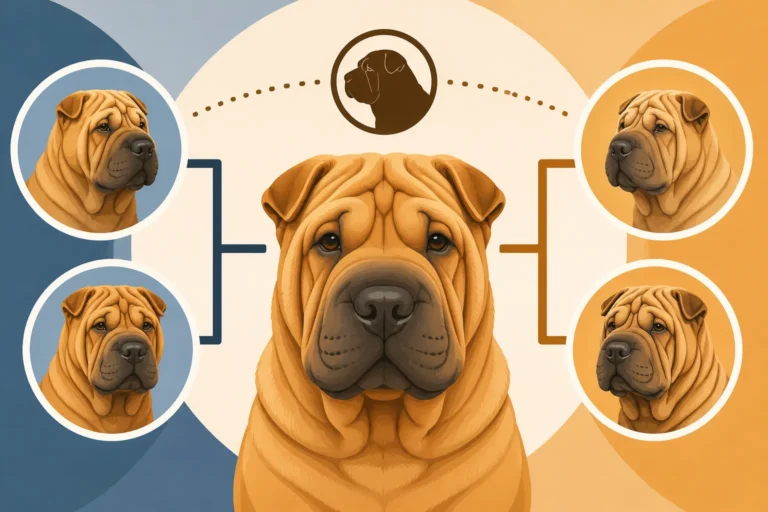
Some breeders favor a more moderate look, especially in adult dogs, while others continue to produce heavily wrinkled puppies because that appearance is popular with buyers or prized in their breeding circles. So the honest answer is: some breeders are reducing wrinkles, but it is not a universal or guaranteed shift.
A breeder may describe a dog as “less wrinkled” based on the amount of loose skin you can see. That visible appearance matters, but it does not tell the whole story about the dog’s inherited traits. Nor does it show whether the breeder has made health-focused choices in other areas, such as evaluating family health histories or avoiding extreme physical features.
It also helps to separate a deliberate breeding goal from the normal changes a Shar Pei goes through as it matures. Many puppies have abundant folds that become less noticeable as their bodies grow. A puppy that looks deeply wrinkled today may have a much smoother body as an adult, while folds around the head and neck can remain.
If you’re comparing puppies, don’t rely on photos of one particularly smooth or particularly wrinkly dog. Ask to see adult relatives, ask how the breeder describes their goals, and ask what health information they use when choosing a pairing. The question Whether a Wrinkly Shar Pei Puppy Stays Wrinkly is useful context because puppy appearance can give an incomplete picture of the adult dog.
What breeders mean by fewer wrinkles
“Reducing wrinkles” can mean several different things. A breeder might aim for fewer folds across the body, less excess skin around the neck, or a less heavily folded face. Those are not identical goals, and two breeders can use the same phrase while selecting for noticeably different appearances.
A careful breeder should be able to explain what they mean in concrete terms. For example, they might describe wanting adult dogs with wrinkles mainly around the head and neck rather than deep folds over much of the body. Look at mature dogs in the breeding program, not just puppies: adult coats and skin give you a better sense of what the breeder’s choices have produced.
Breed standards and show preferences can also influence what breeders select for. Standards are not the same around the world, and individual breeders may weigh show qualities, health, temperament, and family suitability differently. If a breeder says they are reducing wrinkles, ask whether they mean a specific physical change or a broader effort to avoid exaggeration.
Why breeders may choose a more moderate look
Heavy skin folds can create places where moisture, dirt, and friction collect. That does not mean every wrinkly Shar Pei will have skin disease, but it does mean owners may need to pay attention to the skin and dry folds thoroughly after bathing or getting caught in the rain. Breeders who want less excess skin may hope to make routine care easier and reduce some fold-related problems.
There is also a growing awareness that the Shar Pei’s distinctive appearance is tied to more than skin care. Research has connected the breed’s wrinkles to a genetic change involving increased production of hyaluronic acid. The relationship between wrinkle-related genetics and health is complex, though, and the visible number of folds is not a simple health test. For more background, see Which Gene Duplication Causes a Shar Pei's Wrinkles and Whether a Less Wrinkled Shar Pei Is Healthier.
Buyer demand matters too. Some people seek the classic, heavily folded puppy they have seen in photographs; others deliberately look for a more moderate dog. Breeders may respond to those preferences, but a buyer’s idea of a “healthier look” should not substitute for thoughtful questions about the dog’s family and health history.
What genetics can and cannot tell you
The wrinkles are not simply a cosmetic feature that can be switched off by choosing a smooth-looking parent. The trait involves inherited biology, and the number or pattern of genetic copies associated with it can vary. That makes breeding decisions more complicated than pairing one wrinkly dog with one less-wrinkly dog and expecting a predictable result.
The wrinkle-related genetic change is associated with hyaluronic acid, a substance involved in the skin’s structure. Researchers have also studied links between the same biological pathway and Shar Pei fever and related inflammatory disease. These are important connections, but they do not mean that every wrinkled dog will become ill or that every less-wrinkled dog is protected.
When reading claims about breeding, watch for language that turns a complicated risk into a guarantee. “Less wrinkly” describes what you can see. It does not, by itself, establish the dog’s genetic copy number, predict whether it will develop fever, or rule out other inherited and non-inherited health problems.
Visible folds are not a genetic test
A Shar Pei with fewer visible folds may still carry wrinkle-associated genetic variants. Conversely, the amount of visible skin folding can be influenced by age, body condition, family traits, and how the dog is developing. Appearance can offer clues, but it cannot confirm an individual dog’s genetic makeup.
If a breeder says a puppy has “fewer copies” because it looks smoother, ask what evidence supports that statement. A visual assessment is not the same as a genetic test. The topic Whether a Shar Pei's Copy Number Can Be Tested explains why a test result, if available and appropriately interpreted, is different from judging a dog by its face or body.
Even a genetic result needs context. It can help describe inherited variation, but it is not a complete forecast of an individual dog’s health. A responsible discussion should include what the result can tell you, what it cannot tell you, and whether it has been interpreted alongside family history and veterinary information.
Fewer wrinkles do not guarantee lower disease risk
It is reasonable to ask whether breeding for fewer wrinkles could reduce health concerns. The answer is that selecting for a less exaggerated appearance may be one part of a broader effort, but it should not be presented as a guaranteed way to eliminate fever or other disease. The relationship among genes, visible traits, and individual outcomes is not that simple.
A puppy can look relatively smooth and still develop a health problem. A heavily wrinkled dog may remain healthy in a particular respect. Neither example proves that appearance is irrelevant; it shows why a single visible feature cannot carry the weight of a full health assessment.
If you are looking at a litter, ask the breeder about recurring fever episodes, kidney problems, skin and ear disease, and other concerns in close relatives. A candid answer is more useful than a promise that a puppy is safe because it has fewer folds. You can also explore Whether Breeding for Fewer Wrinkles Would Help and Whether Breeders Knew the Wrinkle Gene Carried the Fever for related questions about breeding goals and inherited risk.
How to assess a breeder’s claims
You do not need to be a genetics expert to have a useful conversation with a breeder. You do need more than a quick answer about how wrinkly the puppies are. Ask what the breeder is selecting for, how they assess adult dogs, and what health information they consider before breeding.
Pay attention to whether the breeder talks about individual dogs rather than making sweeping promises about the whole breed. A thoughtful answer might acknowledge uncertainty, describe the appearance they prefer, and explain how that goal fits alongside health, temperament, and sound structure. Be cautious of absolute claims such as “this line can’t get fever” or “a smooth puppy won’t have skin issues.”
A simple comparison can help organize what you learn:
| What you observe or ask | What it can tell you | What it cannot prove |
|---|---|---|
| A puppy has fewer visible folds | The puppy looks more moderate at that age | Its adult appearance or genetic test result |
| Adult relatives have less excess skin | The family may show a more moderate look as adults | That the puppy will develop identically |
| The breeder describes a goal of reducing folds | Wrinkle reduction is part of the breeder’s stated approach | That the goal has reduced disease risk |
| The breeder shares health history | You can learn about known issues in the family | That the puppy will never develop a health problem |
| A genetic test is discussed | There may be information about a particular inherited trait | A complete prediction of the dog’s future health |
Questions to ask before choosing a puppy
Start with practical questions: What do the adult dogs in this line look like? Are body folds reduced in the adults, or do the puppies simply look less wrinkled at the moment? Can you meet or see mature relatives? Those questions keep the conversation grounded in observable examples.
Then ask about health. Has the breeder seen recurrent fever, kidney disease, chronic skin problems, or persistent ear disease in the dogs they breed or their close relatives? What veterinary care do they recommend for the puppies? A breeder may not know every health outcome in every distant relative, but they should be willing to discuss what they do know and what information they track.
Finally, ask how the breeder balances appearance with welfare. If their stated aim is fewer wrinkles, ask what that means in their breeding program and how they avoid making a visual claim sound like a health guarantee. A useful related read is Whether Western Breeders Made the Shar Pei Wrinklier, which explores how breeding choices and preferences can shape the dogs people see.
Warning signs in wrinkle-related claims
Be wary when a breeder treats wrinkle count as proof that a puppy is healthy. “This one has fewer folds, so it won’t get fever” is not a responsible guarantee. The same goes for claims that a puppy is free of future skin or kidney problems based only on appearance.
Another warning sign is a breeder who cannot show you adult dogs or explain how puppy appearance changes with growth. Photos can be helpful, but they can also be selective. Ask for a range of examples, including mature dogs, and notice whether the breeder answers questions directly rather than changing the subject to coat color or rarity.
A health-minded breeding conversation should not depend on a dramatic promise. It should include clear information about the dogs, a willingness to discuss uncertainty, and a plan for what happens if a puppy develops a health concern. If you are preparing to care for a Shar Pei, routine supplies for cleaning and drying folds may be available through retailers such as Chewy, but products do not replace veterinary guidance when skin looks sore, smells unusual, or stays irritated.
What wrinkle reduction means for future owners
For a future owner, fewer wrinkles may mean less skin surface to inspect or fewer areas where moisture can linger, but it does not mean there is no grooming work. Shar Pei still need regular checks of their skin, ears, eyes, and paws. If folds are cleaned, drying them well matters; repeated rubbing or using unsuitable products can irritate sensitive skin.
Keep expectations realistic as a puppy grows. A breeder’s selection choices can influence the likelihood of certain appearances, but individual puppies within a litter can differ. A puppy may gain or lose the appearance of folds as its body develops, and adult relatives provide useful context without being a guarantee of exactly what your dog will look like.
Before bringing a dog home, prepare for everyday care rather than assuming that a less folded dog will need none. Keep a simple routine and ask your veterinarian which cleaning products are appropriate if your dog has sensitive skin or a history of irritation. If you shop for basic supplies through Chewy or another retailer, look for items your veterinarian has said are suitable for your dog; avoid putting creams or cleaners into folds without checking that they are safe for canine skin.
Most importantly, choose a breeder based on the whole picture: the dogs’ health and temperament, the breeder’s transparency, and the care they provide—not just a smooth face or a dramatic wrinkle pattern. Wrinkle reduction can be a meaningful breeding goal, especially when it avoids exaggeration, but it is one piece of responsible breeding rather than a shortcut to guaranteed health. Owners comparing breeding ideals may also want to read Whether the Wrinkles Could Be Bred Out Entirely and Whether a Bone Mouth Shar Pei Is Healthier.
If your Shar Pei already has folds that are becoming red, moist, painful, or persistently smelly, contact your veterinarian rather than trying to solve the problem by changing cleaning products alone. Chewy may be one place to find routine pet-care supplies, but the right response to a suspected infection or ongoing irritation is a veterinary assessment, not a shopping choice.
Disclaimer
This article is for general informational purposes only and does not constitute professional advice. Laws, prices and regulations vary by location and change over time. Consult a qualified professional for guidance on your specific situation.