Whether a Shar Pei Poodle Cross Sheds Less
A Shar Pei–Poodle cross may leave less loose hair around the house, but it is not guaranteed to shed less than every Shar Pei. Coat type varies from dog to dog, and the curlier coat can hold loose hairs instead of dropping them onto the floor. This guide explains what to expect, how to assess a particular dog, and what grooming the coat may require.
Does a Shar Pei Poodle cross shed less
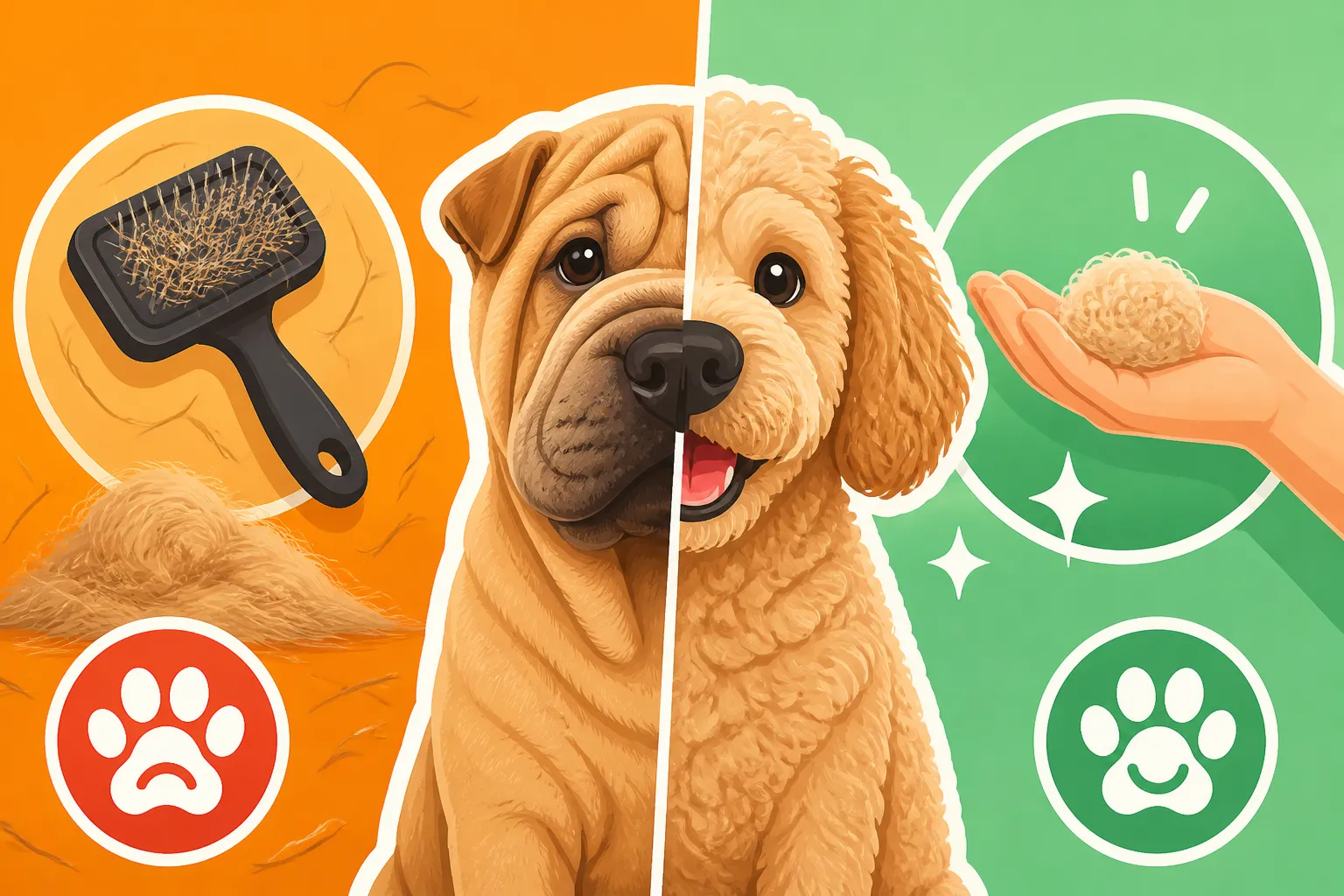
It can, especially if it inherits a curlier coat that traps loose hairs. But “Poodle cross” does not describe one predictable coat. A puppy may inherit more of the Shar Pei’s short, straight hair, more of the Poodle’s curls, or a mix that falls somewhere in between. Even dogs in the same litter can differ.
That uncertainty matters if your main reason for considering the cross is to reduce vacuuming. A curly-looking coat is not a promise of low shedding, and low shedding is not the same as no shedding.
How the two parent coats differ
Shar Pei coats are short and generally easy to brush, but short hair still sheds. Loose hairs can be especially noticeable on dark clothing, upholstered furniture, and bedding. The breed has different coat types, so the length and feel of a Shar Pei’s coat can vary. For a closer look at those differences, see Which Coat Type Most Shar Pei Have. If you want a practical sense of what routine loose hair may mean in a home, How Much a Shar Pei Sheds Day to Day covers the breed’s everyday shedding.
Poodles are often described as low-shedding because loose hairs tend to become caught in their textured, curly coat rather than falling freely onto the floor. Those hairs still need to be brushed or clipped out. A dog can therefore appear to shed very little while requiring more coat maintenance than a short-haired dog.
A cross may inherit either pattern, or a combination. A wavy coat might release some loose hair while still tangling more readily than a straight coat. A short coat may be easier to maintain but shed visibly. Coat inheritance is not a simple blend where half the Poodle coat and half the Shar Pei coat produce a reliably predictable result.
What “less shedding” looks like in real life
For one household, “less shedding” means fewer hairs on the couch. For another, it means less hair on black trousers or fewer hairs to sweep from the kitchen floor. A curly-coated cross might reduce the visible hair on those surfaces but still leave loose strands in a brush after grooming.
The hairs that remain caught in the coat can also mat, particularly around friction points such as behind the ears, under a collar or harness, and between the legs. If brushing is skipped, mats can tighten close to the skin. That makes a low-shedding coat less of a “set it and forget it” option than some people expect.
A useful way to compare coat types is to separate what you see around the home from the work needed to keep the dog comfortable:
| Coat the dog may inherit | Loose hair around the home | Likely grooming concern |
|---|---|---|
| Short and straight | May be noticeable on clothes and furniture | Regular brushing to remove loose hair |
| Wavy or mixed texture | Can vary; some loose hair may be caught in the coat | Watch for tangles, especially in friction areas |
| Curly or Poodle-like | Often less hair drops freely, but loose hairs can stay in the coat | Frequent thorough brushing and routine coat care |
These are general tendencies, not guarantees for an individual dog. A cross’s coat can change as it matures, and shedding can vary with the season, health, and the dog’s own coat cycle.
What coat might a Shar Pei Poodle cross have
A puppy’s coat is not always a reliable preview of its adult coat. It may become longer, curlier, coarser, or easier to maintain as the dog grows. That makes it hard to promise an adult shedding pattern based on a photograph or a brief visit with a young puppy.
Why puppies and littermates can differ
A puppy can inherit different combinations of coat traits from its parents. Even when one parent has tight curls, the puppy may have a looser wave or a straighter coat. Looking at the parents and any older relatives may offer clues, but it still cannot establish exactly how the puppy’s adult coat will behave.
Age matters too. A puppy coat can feel softer or look fluffier than the adult coat. As it changes, the texture may become more defined, and the grooming routine may need to change with it. For more on why early appearance can be misleading, see Whether a Shar Pei Puppy's Skin Predicts the Adult.
The same caution applies to the Shar Pei side. Shar Pei coats differ in length and texture, and those traits can influence what the cross inherits. Knowing the parent dogs’ actual coats may be more helpful than relying on a label such as “doodle” or “low-shedding.”
Why you cannot judge by the crossbreed name
Crossbreed names are convenient shorthand, not a guarantee of a particular coat. Two dogs with the same parent breeds can have very different coats, and descriptions such as “hypoallergenic” or “non-shedding” can create expectations that an individual dog may not meet.
It is also worth separating shedding from allergies. People who react to dogs may be affected by allergens associated with dander, saliva, or other sources, not just loose hair on the floor. A dog that sheds less visibly can still trigger symptoms. Anyone with significant allergies should spend time around the individual dog, if possible, and discuss their situation with a health professional before committing.
If you are choosing a puppy, ask what the breeder can realistically tell you about the parents’ coats, grooming needs, and any previous litters. Look for a straightforward answer rather than a guarantee that every puppy will be low-shedding. If you are considering an adult rescue, the coat you can observe is a better indicator than a puppy’s early fluff, though seasonal changes and ongoing care can still affect what you see.
How to care for a lower-shedding coat
A dog that drops fewer hairs around the house may need more hands-on coat care. The goal is not to brush aggressively or chase a perfectly shed-free home. It is to remove loose hair, prevent tangles, and keep an eye on the skin under the coat.
Brush for the coat the dog has
For a short, straight coat, gentle brushing can help lift loose hairs and give you a chance to check the skin. A suitable rubber grooming tool may work for some short coats, but tools should be chosen for the dog’s texture and used gently. How Often a Shar Pei Needs Brushing offers a useful starting point for the Shar Pei side of the mix, while Whether a Shar Pei Needs a Deshedding Tool is relevant if loose hair is the main frustration.
A wavy or curly coat usually needs more attention to tangles. Brush in manageable sections, moving slowly enough to reach the coat near the skin rather than smoothing only the surface. Pay particular attention to areas where friction and moisture collect. If brushing seems painful, the coat is tightly matted, or the dog resists handling, pause and seek help from a qualified groomer rather than pulling through knots.
Grooming also gives you a chance to notice changes such as redness, odor, scabs, or persistent scratching. A cross can inherit skin-related traits from either side, and a dense coat can make it harder to spot a problem early. Shar Peis have their own skin and fold-care considerations; Whether a Bear Coat Shar Pei Has More Skin Problems explains why coat appearance alone does not tell the whole health story.
Plan for bathing, drying, and professional grooming
Bathing frequency depends on the dog’s coat, skin, and activity rather than on the crossbreed label. Use a dog-appropriate shampoo and rinse thoroughly. Leftover product can irritate some dogs, while frequent bathing without a reason may not suit every skin type.
Drying is especially important if the dog has a thicker or curlier coat. Damp areas can be easy to miss beneath the surface, particularly around the ears, legs, and collar area. After a bath or a wet walk, check that the coat is dry where it sits close to the skin. If a groomer recommends a particular routine, ask them to show you how to check for tangles between appointments.
Some owners find it helpful to keep basic grooming supplies on hand, such as a brush suited to the coat, a comb for checking through tangles, and dog-safe shampoo. Chewy is one place owners may browse for these kinds of supplies, but the important part is matching the tool to the dog’s coat rather than buying a product simply because it is marketed for a Poodle mix. For skin concerns, ask your veterinarian before adding medicated products or changing the bathing routine.
How to decide whether this cross is right for your home
If reducing visible hair is a priority, think about the whole routine rather than the label. A dog may shed less onto furniture but need regular brushing, clipping, and professional grooming. Another may have a simple short coat that sheds more visibly but takes less time to maintain.
Questions to ask before choosing a puppy or adult dog
Ask to see the parent dogs’ coats and find out how their coats are maintained. If possible, ask about grooming needs in older offspring from previous litters. A breeder who explains that coat outcomes vary is being more realistic than one who promises a particular adult texture or claims a puppy will never shed.
If you are adopting an adult, ask how often the dog is brushed, whether it has needed clipping, and whether it has a history of matting or skin irritation. Spend time with the dog in a calm setting and notice whether you react to its presence if allergies are a concern. A short visit cannot predict every reaction, but it may be more informative than relying on a breed description.
It is also sensible to look beyond coat questions when assessing a Shar Pei mix. A cross is not automatically healthier just because it has two breeds in its background. The parents’ health, inherited traits, veterinary history, and the individual dog’s needs all matter. Whether a Shar Pei Mix Is Healthier explores why the mix label alone cannot answer that question.
Set expectations for cleaning and upkeep
Even a lower-shedding dog brings hair, dirt, and grooming needs into the home. If hair on fabric is your biggest concern, washable throws and regular vacuuming may help. The texture of the hair can affect where it collects and how easily it comes off surfaces; Whether a Shar Pei's Hair Sticks in Fabric discusses one common source of frustration for owners.
For a curly or mixed-texture coat, build brushing into the week from the start, using short, calm sessions and rewards so the dog learns to accept handling. Keep grooming supplies accessible rather than waiting until the coat is tangled. Chewy may be convenient for comparing brushes, combs, and washable bedding, but product choice should follow the dog’s actual coat and your groomer’s advice. If you are uncertain which brush is appropriate, a groomer can demonstrate how to use one without scraping or irritating the skin.
Most importantly, choose the dog you can care for rather than a shedding promise. A Shar Pei–Poodle cross may shed less visibly than a Shar Pei with a short, straight coat, but the outcome depends on the individual dog. Plan for both possibilities: some loose hair at home and a grooming routine that may be more involved than you first expected.
Disclaimer
This article is for general informational purposes only and does not constitute professional advice. Laws, prices and regulations vary by location and change over time. Consult a qualified professional for guidance on your specific situation.