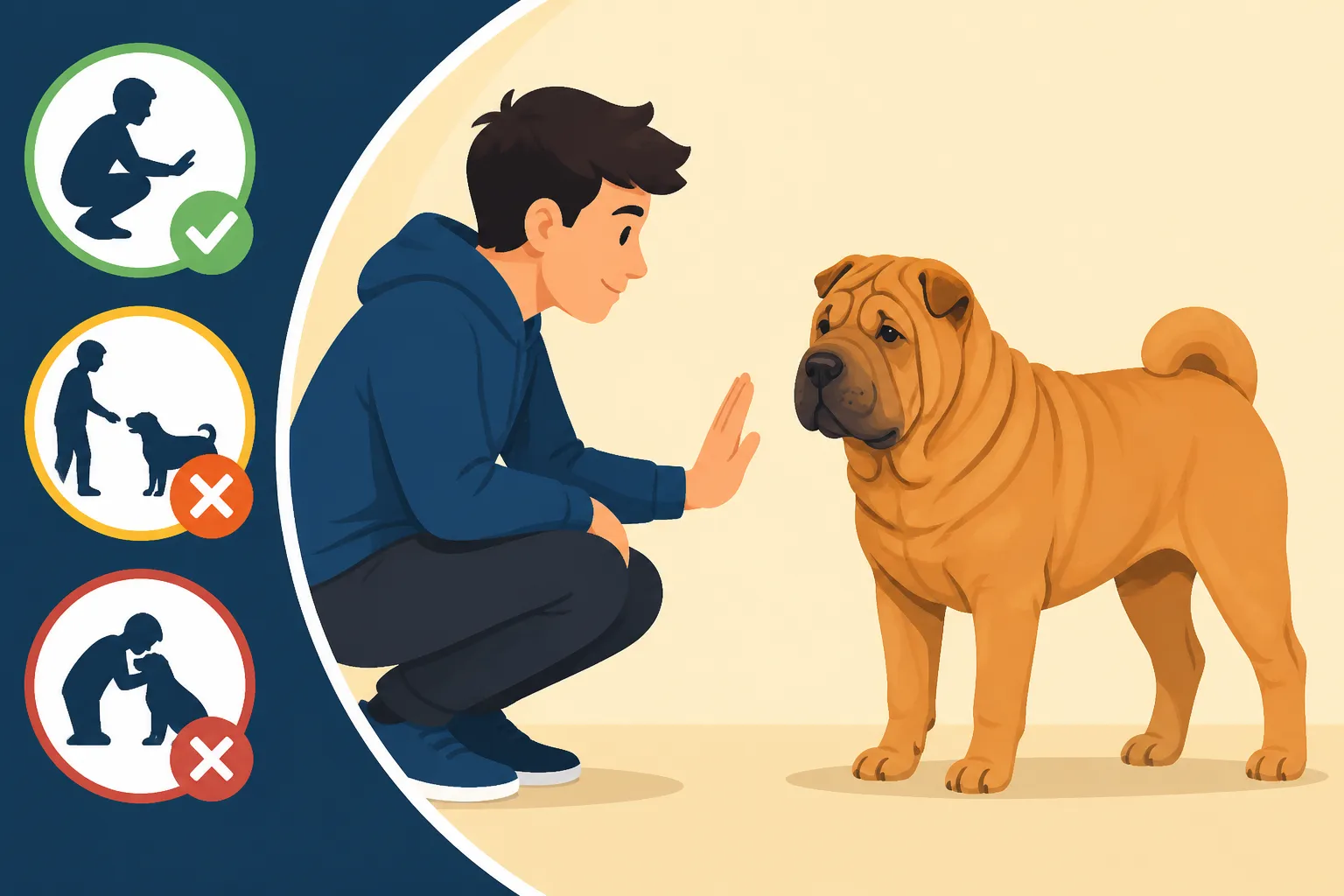
How to Approach a Shar Pei Safely
It’s a scenario many dog lovers face: you see a Shar Pei, with those irresistible wrinkles and a unique look, and your first instinct is to rush over for a cuddle. But if you’re not familiar with the breed, this well-meaning approach can actually be quite startling, even frightening, for the dog. This guide will walk you through how to safely and respectfully approach a Shar Pei, ensuring a positive experience for both you and this magnificent, often misunderstood, breed.
Understanding the Shar Pei's Inherited Temperament
To truly understand how to approach a Shar Pei, we first need to appreciate the history woven into their very DNA. These aren't your typical overly-eager-to-please Golden Retrievers. Shar Pei have a deep-seated heritage that dictates much of their interaction style, especially with those outside their immediate trusted circle.
The Shar Pei's Guarding Instinct
Long before they became adored family pets, Shar Pei were bred for a very specific and demanding job in rural China: guarding. They protected farms, families, and even livestock from intruders, both human and animal. This isn't just a historical footnote; it’s a foundational characteristic that still influences their behavior today. When you approach a Shar Pei, especially one you don't know, you're essentially walking into the territory of a dog whose instincts tell it to be vigilant. They're not necessarily aggressive, but they are inherently protective and discerning. This means they're likely to be wary of strangers, viewing any direct approach as a potential threat until proven otherwise. A Shar Pei Was Bred to Guard, Not to Greet covers this in more detail.
This guarding nature isn't about being mean; it's about being incredibly loyal and protective of their chosen family and space. They don't typically rush up to greet every person or dog they encounter. Instead, they observe, evaluate, and decide if an individual is trustworthy. This can be a huge surprise for people used to more boisterous breeds, who might interpret a Shar Pei's calm vigilance as disinterest or even hostility. It's a critical difference to remember: their initial reserve is a feature, not a bug, of their ancient breed standard.
Natural Aloofness Towards Strangers
Beyond their guarding instincts, Shar Pei are often described as independent and inherently aloof, particularly with people they don't know. They're not the type of dog to immediately solicit attention from a stranger. While they form incredibly strong bonds with their own families, becoming deeply devoted companions, their affection isn't typically offered freely to outsiders. Think of it as a selective club: you have to earn your membership. This aloofness isn't a sign of being unsocialized or poorly trained; it’s simply part of their breed's temperament. How Aloof a Shar Pei Really Is delves deeper into this trait.
This doesn't mean a Shar Pei is anti-social or incapable of forming new connections, but it does mean that any introduction needs to be on their terms, at their pace. Rushing in, leaning over them, or attempting direct eye contact can be perceived as pushy or threatening. They prefer to size you up from a slight distance, taking in your body language, scent, and demeanor before making a judgment. A respectful distance and a patient, calm attitude will always get you further than an enthusiastic, direct approach.
Navigating the Shar Pei's Unique Sensory World
The physical characteristics that make a Shar Pei so distinctive—those deep wrinkles and smaller eyes—also profoundly impact how they perceive the world around them. Understanding these sensory limitations is absolutely crucial for safe and comfortable interactions.
The Challenge of Limited Peripheral Vision
One of the most significant physical traits affecting a Shar Pei's interaction is their limited peripheral vision. Those characteristic folds around their eyes and their smaller eye size (often described as "deep-set" or "squinty" by the breed standard) can physically obstruct their view. This means they often can't see things approaching from their sides as clearly as other breeds can. It’s like wearing blinders; their field of vision is much narrower. Why a Shar Pei's Field of Vision Is Narrow explains this in more detail.
Imagine always having to turn your whole head to see something to your left or right. This is often the reality for a Shar Pei. Because of this, an unexpected touch or movement from the side can easily startle them. A dog that is startled can react defensively, even if it's not typically aggressive. It’s not that they’re being mean; they literally didn’t see you coming. This is why always approaching them head-on, or at a slight angle where they can clearly see you, is so important to prevent a surprise reaction.
Interpreting Muffled Facial Expressions
Another challenge in reading a Shar Pei is that their beautiful, dense wrinkles, especially around the muzzle and forehead, can obscure their facial expressions. For most dogs, a snarl, a tense brow, or a worried look is plainly visible, signaling their mood. With a Shar Pei, these nuances can be lost or severely muted by their skin folds. This makes them much harder to "read" than many other breeds, which can be frustrating for people trying to understand if a dog is friendly, anxious, or uncomfortable. Why a Shar Pei's Wrinkles Hide Its Expression elaborates on this.
Since their facial expressions are less clear, it puts more emphasis on their other communication signals. Owners learn to pay close attention to subtle shifts in ear position, tail carriage, and overall body tension. For a stranger, however, this means you can’t rely on a quick glance at their face to gauge their feelings. This difficulty in reading their cues makes a cautious, slow approach even more vital, as you might miss a subtle warning sign that would be obvious on another dog.
Deciphering Shar Pei Communication Signals
Since their facial expressions can be tricky, understanding a Shar Pei's overall body language becomes even more paramount. They do communicate, but often in more subtle ways that require careful observation. Learning these signals is key to a safe interaction.
Subtle Cues Before a Reaction
A Shar Pei will almost always give off signals before reacting negatively, but these can be much more understated than in other breeds. It’s rarely an instant snap. Look for signs like a slight stiffening of the body, a lowering of the head, a direct stare that holds too long, or a subtle shift in weight. They might also lean slightly away from you or avert their gaze, which, paradoxically, can be a sign of discomfort rather than disinterest. Some might give a low growl that's barely audible, or a soft, almost imperceptible lip curl. How a Shar Pei Warns Before It Reacts outlines these behaviors.
If you see any of these subtle cues, it's your cue to back off and give them more space. Ignoring these early warnings can escalate the situation. A Shar Pei generally prefers to avoid conflict, but if their warnings are consistently overlooked, they may feel they have no choice but to escalate their response to get their message across. Respecting their initial, quieter indications of discomfort is the cornerstone of responsible interaction.
The Importance of Tail and Body Posture
Without clear facial cues, a Shar Pei's tail and overall body posture become vital indicators of their mood. Their tail is usually carried high, curled over their back, which is a characteristic breed trait. However, the way it moves, or doesn't move, within that high carriage can tell you a lot. A tail held stiffly, with no wag, even if curled, can indicate tension or watchfulness. A tail tucked low between the legs is a clear sign of fear or extreme anxiety, though less common for a typical Shar Pei meeting a stranger. How a Shar Pei Uses Its Tail provides more insight into their tail talk.
Beyond the tail, observe their entire body. Is it relaxed and fluid, or stiff and rigid? Are their ears pinned back, or held alertly? Are they yawning excessively or licking their lips in a calm environment? These are often stress signals. A Shar Pei that is relaxed might have a soft gaze, a slightly open mouth (not panting heavily from stress), and a body that isn’t tense. If they seem to be leaning back or away from you, even subtly, it’s a sign that they're not comfortable with your proximity.
Implementing Safe Approach Techniques
Armed with an understanding of their temperament and sensory limitations, you can now approach a Shar Pei in a way that is respectful and promotes a positive interaction. The key is to be predictable, non-threatening, and to allow the dog to initiate or dictate the pace of the interaction.
The Indirect and Calm Introduction
When you first encounter a Shar Pei, whether it's on a walk or at a friend's house, avoid a direct, head-on approach. Instead, approach in a slight arc, allowing them to see you clearly without feeling cornered. Keep your body language open and relaxed; avoid standing squarely facing them, which can be perceived as confrontational. Keep your hands visible, not reaching out immediately. Imagine you are meeting a new human friend for the first time; you wouldn't typically run up and hug them without an invitation, would you? The same principle applies here.
Speak in a calm, soft voice, if you speak at all. High-pitched excited tones can sometimes be alarming to dogs. Avoid direct, sustained eye contact, which can be interpreted as a challenge. Instead, glance at them, then away, showing you mean no harm. Crouch down if appropriate, but not so low that you look subservient or vulnerable, and always ensure you can easily stand up again. Let the Shar Pei decide if it wants to come closer. If it does, let it sniff you first, perhaps an outstretched hand (palm down, fingers curled, making it less like a claw). Remember, a gentle sniff is not an invitation for a full-on pet yet.
Respecting Their Personal Space
A Shar Pei values its personal space, perhaps more than many other breeds. They are not usually "velcro" dogs with strangers. Even if they approach you and give a cursory sniff, it doesn't automatically mean they want to be petted, especially on the head or face. Many dogs, not just Shar Pei, find a hand coming down from above their head to be startling or threatening. It’s always safer to offer a hand for them to sniff at their chest or shoulder level, and then wait for them to lean into you or solicit further contact.
If they do seem receptive, start with a gentle scratch on the chest or under the chin, rather than reaching for the top of their head. Observe their reaction closely. If they stiffen, move away, or show any of those subtle stress signals mentioned earlier, stop immediately. It's not about forcing affection; it's about building trust. If you're visiting a home with a Shar Pei, never chase them, corner them, or try to pull them out from under furniture if they've retreated. Give them the freedom to decide when and how they want to interact. Providing space for them to retreat to, perhaps a comfy bed from Amazon or a specific corner of the room, empowers them to feel safe.
Educating Others for Positive Interactions
As a Shar Pei owner, or someone who frequently interacts with one, you become their advocate. It's your responsibility to educate others on how to interact with your dog safely and respectfully, protecting both the dog and the people around it.
Guiding Children on Safe Encounters
Children, with their boundless energy and unpredictable movements, can be particularly challenging for a reserved breed like a Shar Pei. It's vital to teach children explicit rules about interacting with any dog, but especially a Shar Pei. The golden rule: "No touch, no talk, no eye contact" until the dog has approached them and shown clear signs of comfort. Children should be taught to approach slowly, quietly, and never to run at a dog, scream, or grab at fur or tails. How to Teach Children to Approach a Shar Pei offers more specific advice.
Supervision is non-negotiable. Never leave a Shar Pei unsupervised with young children. Teach children to offer a hand palm-down for sniffing, and then to only pet gently on the side or chest if the dog leans in. Explain that a Shar Pei's wrinkles can make it hard to see their eyes, so they need to be extra gentle and listen to the dog's signals. For families with a Shar Pei, programs like BAXTER & Bella can offer fantastic resources for training and socialization, including how to manage interactions with children.
Briefing Guests and Service Providers
Whenever you have guests, delivery people, or service providers come to your home, it's a good idea to brief them on how to interact with your Shar Pei, or if they should interact at all. You can say something as simple as, "Please don't reach out to pet my dog; he's a Shar Pei and can be quite sensitive to new people. Let him come to you if he's comfortable." For visitors who insist on trying to pet, reiterate the slow, indirect approach, and suggest letting the dog initiate contact.
Consider using a dog gate or keeping your Shar Pei in a separate, comfortable room with toys and a chew during initial arrivals, especially if you have frequent visitors or a particularly cautious dog. This provides a calm, safe space for your dog and prevents any stressful interactions at the door. For professional service providers, a clear sign on your door, like "Beware of Dog – Do Not Pet," can also be helpful, though usually a verbal heads-up is sufficient. It's about setting boundaries that ensure everyone's safety and comfort.
Here's a quick reference table for safe versus unsafe approaches:
| Action / Signal | Safe Approach | Unsafe Approach |
|---|---|---|
| Approach Path | Gentle arc, allowing dog to see you clearly | Direct, head-on, or from behind/side without warning |
| Body Language | Relaxed posture, hands visible, slightly angled | Stiff, staring, leaning over the dog, quick movements |
| Eye Contact | Brief, soft glances, looking away | Sustained, direct stare |
| Vocalization | Soft, calm voice, or silent | High-pitched, loud, excited |
| Initial Touch | Allow sniffing first, offer hand at chest level | Reaching quickly for head, hugging, grabbing |
| Shar Pei's Reaction (Positive) | Approaches, sniffs, relaxed body, soft eyes | Retreats, stiffens, avoids eye contact, ears back |
| Shar Pei's Reaction (Negative) | Freezes, leans away, low growl, lip lick, stiff tail | Direct stare, barks, snarls, attempts to bite |
The more we understand and respect the inherent traits of the Shar Pei, the better we can ensure positive and safe interactions for everyone. They are incredible companions, but like all breeds, they thrive when their unique needs and communication styles are understood and honored.
Disclaimer
This article is for general informational purposes only and does not constitute professional advice. Laws, prices and regulations vary by location and change over time. Consult a qualified professional for guidance on your specific situation.


