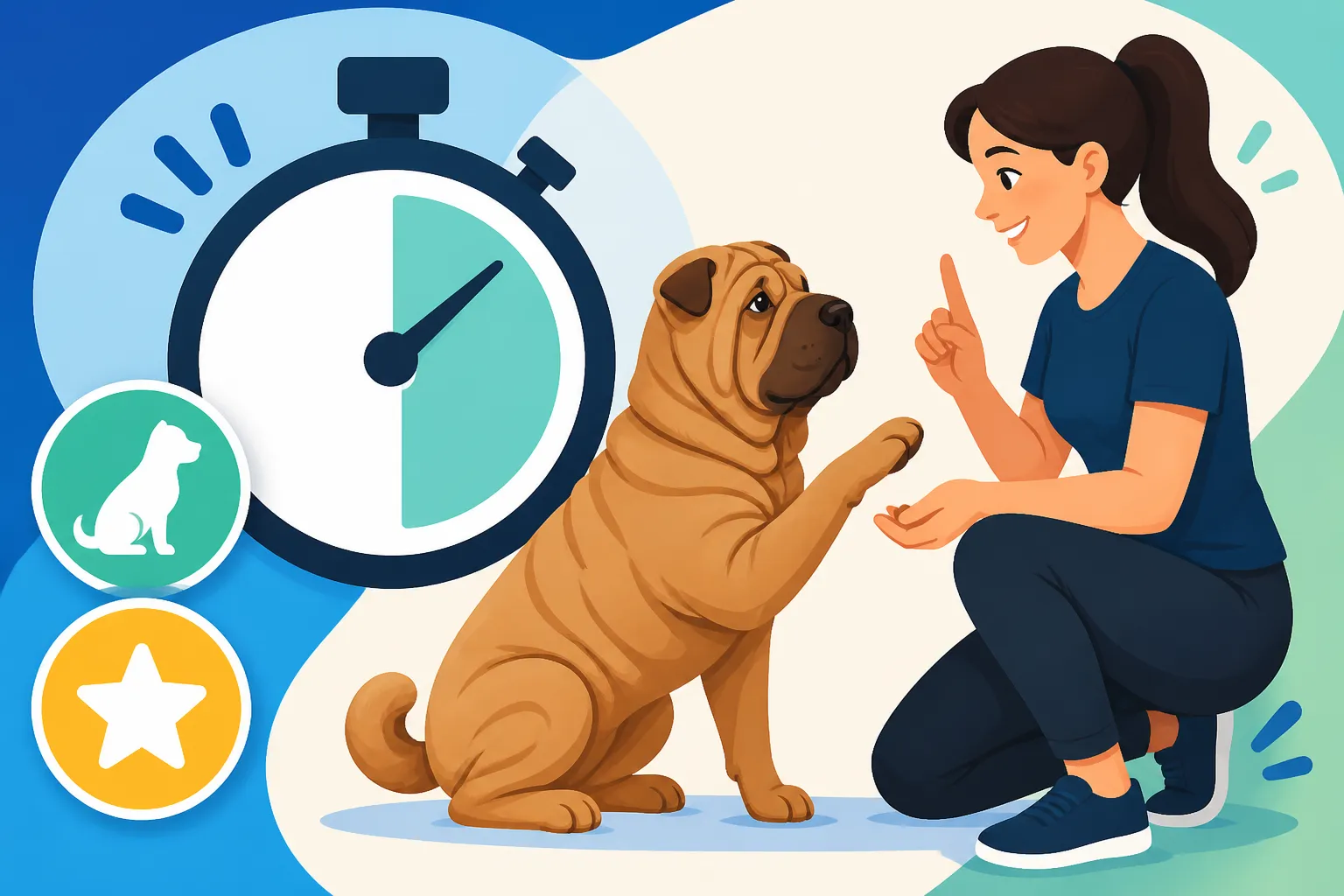
How Long a Shar Pei’s Training Session Should Be
One of the most common frustrations Shar Pei owners face when it comes to training is feeling like their dog just isn't "getting it," or worse, actively tuning them out after a few minutes. It's easy to get discouraged when you're putting in the effort, only for your distinctive, independent companion to yawn or wander off mid-command. This guide will help you understand the optimal length for Shar Pei training sessions, working with their unique temperament rather than against it, to make training a positive and productive experience for both of you.
The Shar Pei's Unique Learning Style and Attention Span
Let's be honest, a Shar Pei isn't always the poster child for eager-to-please obedience. Their independent spirit, which many of us adore, means they approach training with a different mindset than some other breeds. Understanding this is the first step to tailoring your approach for success.
Why the Shar Pei Isn't a Golden Retriever
If you've ever owned or spent time with breeds like Golden Retrievers or Border Collies, you know they live to work and please. They often have an almost boundless desire to engage, repeat, and perform for their people. The Shar Pei, however, was originally bred for a different purpose entirely. What Job the Shar Pei Held in Rural China wasn't about fetching sticks or running agility courses; it was about guarding property and working independently. This deep-seated heritage means they're naturally more discerning about how they spend their time and energy.
They're incredibly intelligent, don't misunderstand me, but their intelligence often manifests as problem-solving for their own benefit, not necessarily yours. This independent streak means that prolonged, repetitive drills can quickly become boring or seem pointless to them. They might learn a command quickly, but then decide, "Okay, I know this. What's next? And more importantly, what's in it for me?" Their willingness to perform isn't automatically tied to pleasing you; it's often tied to a clear, immediate, and high-value reward. Expecting them to have the same boundless enthusiasm for long training sessions as a more biddable breed is a recipe for mutual frustration.
Reading Your Shar Pei's Cues for Disengagement
One of the most crucial skills any Shar Pei owner can develop is the ability to read their dog's subtle body language. Shar Pei aren't always overt in their communication, and their deeply set eyes and sometimes stoic expressions can make them harder to read than other breeds. However, they will tell you when they've had enough.
Look for subtle shifts: a slight turning of the head, a slower response to a cue, a sudden interest in sniffing the ground, lip licking, yawning (when not tired), or a general stiffness in their posture. They might even just offer you a blank stare, their mind clearly miles away. Sometimes, they'll simply walk away, deciding the session is over, thank you very much. If you see these signs, it's not defiance; it's a clear signal that their engagement window is closing, or has already shut. Ignoring these cues and pushing for "just one more rep" will only build resentment and associate training with unpleasantness. You'll quickly find that How a Shar Pei Reacts to a Raised Voice is not with increased effort, but often with a deeper retreat into their own independent world.
The Pitfalls of Over-Training: Burnout and Frustration
Pushing a Shar Pei beyond their attention limit is entirely counterproductive. Instead of reinforcing good habits, you're inadvertently teaching them that training is tedious, boring, and something to be avoided. This can lead to what we call "learned helplessness" or, more commonly, a dog that just plain shuts down.
Imagine being forced to do a task you dislike for an hour straight. You'd likely become less efficient, more frustrated, and dread the next time that task came up. It's no different for our Shar Pei. Over-training can cause them to associate your training space or even your presence with annoyance, making them less likely to engage enthusiastically in future sessions. This isn't just about poor performance in the moment; it can actively erode the positive relationship you're trying to build around learning. You want training to be a fun game, a shared activity that strengthens your bond, not a chore they endure. Trying to force them to focus longer than they're naturally inclined will only reinforce The Headstrong Streak Nobody Trains Out of a Shar Pei.
Optimal Session Lengths by Age and Stage
The right length for a training session isn't a one-size-fits-all answer. It evolves as your Shar Pei grows, learns, and matures. What works for a bouncy puppy will absolutely not work for a seasoned adult.
Puppyhood: Short, Sweet, and Frequent Bursts (8-16 weeks)
For your little wrinkly bundle of joy, training sessions should be incredibly short – we're talking micro-sessions here. Think 2 to 5 minutes, max. A young Shar Pei puppy has an attention span about as long as a sneeze. Their world is all about exploring, playing, and napping. Trying to get them to focus for longer than a few minutes is like trying to hold water in a sieve.
The key here is frequency. Instead of one long session, aim for 5-10 very short sessions throughout the day. These aren't formal "sit-stay-come" drills, necessarily. They're about positive association, name recognition, and foundational concepts. A quick "sit" before getting their food, a "come" when you call them for a potty break, or a minute of lure-and-reward for a down. Keep it fun, upbeat, and always end on a success. This early stage is all about building a positive foundation and making learning feel like play. Resources like BAXTER & Bella online courses often emphasize these short, engaging sessions, which are perfectly suited for a Shar Pei puppy. It’s a vital part of The First Year With a Shar Pei Puppy to establish these good habits early.
Adolescence: Building Stamina with Variety (4 months – 1.5 years)
As your Shar Pei moves into adolescence, their attention span will lengthen slightly, but don't expect miracles. You can gradually increase sessions to about 5 to 10 minutes, perhaps 3-5 times a day. This is a crucial period for proofing behaviors – making sure they can perform commands reliably in different environments and with distractions.
Adolescent Shar Pei are notorious for testing boundaries and having selective hearing. They're exploring their independence, and often, what they already know might suddenly disappear when you need it most. This is where variety becomes your best friend. Don't just drill "sit" twenty times in a row. Incorporate different commands, work on impulse control (like waiting at the door), or introduce fun new tricks. You'll quickly discover How Fast a Shar Pei Gets Bored of Repetition. Keep your sessions unpredictable and engaging, and use different locations to generalize their learning. Maintaining motivation with high-value treats and praise is paramount during this phase to keep them invested.
Adult Shar Pei: Quality Over Quantity (1.5 years+)
For an adult Shar Pei, 10 to 15 minutes, once or twice a day, is often the sweet spot. At this stage, your dog has a solid understanding of most basic commands. Your training focus shifts from teaching new concepts to maintaining sharpness, practicing more complex sequences, or delving into specialized activities like scent work or trick training.
Consistency remains vital, even if the sessions are shorter. Regular, positive reinforcement keeps their skills sharp and strengthens your bond. An adult Shar Pei often has a well-defined set of motivators, be it a specific treat, a favorite toy, or a game of chase after a successful session. Capitalize on How Food Motivated a Shar Pei Is, but don't let it be your only tool. Introduce new challenges that tap into their natural intelligence and independence, like puzzle toys or scent games, to keep them mentally stimulated without requiring long, formal drills. The goal is to keep them engaged, thinking, and viewing training as a fun, collaborative activity, not a repetitive chore.
Maximizing the Effectiveness of Short Sessions
Since brevity is the soul of Shar Pei training, let's talk about how to make every single short session count. It's not just about the clock; it's about the quality of the interaction.
High-Value Rewards and Motivation
For a Shar Pei, rewards aren't just a nicety; they're the primary driver of engagement. Unlike some breeds who are content with a simple "good dog!", your Shar Pei often needs a compelling reason to participate. Identifying what truly motivates your individual dog is key. For many, it's food – and not just any food. We're talking about high-value, super-tasty treats like small pieces of cooked chicken, cheese, hot dogs, or specific soft, chewy training treats. You can find a huge variety of these high-value options on platforms like Amazon, making it easy to keep your treat pouch stocked.
Vary your rewards to keep things exciting. Don't always use the same treat; sometimes it's a favorite squeaky toy, sometimes it's a quick game of tug, or even just enthusiastic, genuine praise and a good scratch behind the ears. Pay attention to what your Shar Pei really works for, and reserve the absolute highest-value rewards for the most challenging tasks or when you need maximum focus. The more appealing the reward, the more engaged they'll be, even if it's only for a few minutes. This understanding of What Motivates a Shar Pei will transform your training.
Ending on a High Note: Always Leave Them Wanting More
This is arguably the most critical rule for training an independent breed like the Shar Pei. You want every training session to conclude with your dog feeling successful, happy, and eager for the next one. This means ending the session before they get bored, frustrated, or make a mistake.
Think of it like a cliffhanger in a good book or TV show. You finish the session when they've just successfully performed a command, are still wagging their tail (or whatever passes for a Shar Pei tail wag!), and are looking at you, ready for more. End it there with a big reward, a cheerful "All done!" or "Free dog!", and put the treats away. This strategy builds positive anticipation for future sessions. If you wait until they're sniffing the ground, yawning, or walking away, you've already pushed too far, and the last memory of training is one of disengagement. Always aim to leave them thinking, "Wow, that was fun! I wonder when we get to do that again?" rather than "Oh, thank goodness that's over."
Integrating Training into Daily Life
Formal training sessions are important, but for a Shar Pei, consistent reinforcement throughout the day is equally, if not more, valuable. This is where you turn everyday interactions into mini-training opportunities, building good habits without them even realizing they're "training."
For instance, ask for a "sit" before putting down their food bowl or before opening the door for a walk. Practice a short "stay" while you put on your shoes. Work on loose leash walking during every outing, even if it's just a few steps at a time. Reward good manners and calm behavior spontaneously. These informal, scattered moments add up to significant learning and reinforce that good behavior is always worthwhile. It keeps them mentally engaged and helps them generalize commands to real-world situations, rather than only performing them in a structured training setting. This continuous learning approach helps mitigate How Long a Shar Pei Will Work in a Session by breaking it into manageable, frequent chunks, and it's essential for a well-behaved companion.
Common Misconceptions About Shar Pei Training Length
There are a few myths out there about dog training that simply don't apply, or even actively hinder, progress with a Shar Pei. Let's clear some of those up.
The "More is Better" Trap
It's a common misconception that if you just train longer, your dog will learn faster or become more obedient. With a Shar Pei, this couldn't be further from the truth. Their independent nature and quick boredom mean that trying to force longer sessions will almost always backfire. Instead of getting "more" training, you'll get more frustration, more disengagement, and a dog that starts to actively dislike training.
Think about it: five 5-minute sessions spread throughout the day, each ending on a high note, are far more effective than one 25-minute session where your dog checks out after the first 7 minutes. The quality and positive association of those shorter bursts far outweigh the quantity of a prolonged, unenthusiastic session. You're building a foundation of positive experiences, which is invaluable for a breed that can sometimes be perceived as Stubborn or Independent: Reading a Shar Pei. Trying to push through an hour of drills with a Shar Pei is simply setting yourself up for disappointment and potentially creating negative associations with learning.
The Myth of Instant Obedience
Some owners might expect that once a command is taught, their Shar Pei should obey it perfectly, every single time, without hesitation. When this doesn't happen, especially after a few "successful" training sessions, it can be incredibly disheartening. However, instant, perfect obedience is largely a myth for any dog, and particularly for a Shar Pei. Training is an ongoing process of learning, proofing, and reinforcement, not a one-time event.
Your Shar Pei might know "sit" perfectly in your quiet living room, but can they do it at the busy dog park? Or when a squirrel runs by? That's where proofing comes in – gradually introducing distractions and new environments. For a Shar Pei, who might not feel the same intrinsic need to please as some other breeds, consistency and continued high-value reinforcement are critical. Don't get discouraged if your Shar Pei in The Shar Pei in Puppy Class isn't always performing flawlessly. Celebrate the small victories, understand that progress isn't linear, and remember that training is a lifelong journey of communication and strengthening your bond.
Not All Training Needs to Be Formal
Training doesn't always have to look like structured sessions with treats and clickers. In fact, for a Shar Pei, incorporating mental and physical enrichment that feels like play can be just as, if not more, effective. Enrichment activities like puzzle toys, sniff games, or even just a brisk walk where they can explore scents are all forms of mental stimulation that build a happy, well-adjusted dog.
Interactive play, where you engage with them using their favorite toy, can also be a powerful training tool. Use play as a reward, practice "drop it" and "take it," or incorporate a "sit" before launching a toy. These activities tap into How a Shar Pei Plays and can be excellent opportunities to reinforce behaviors in a low-pressure, fun environment. The more you can blur the lines between "training" and "just living life," the more your independent Shar Pei will engage and thrive. A tired, mentally stimulated Shar Pei is usually a well-behaved Shar Pei, regardless of how many formal "sits" they performed that day.
| Age/Stage | Optimal Session Length | Frequency | Primary Focus | Key Strategy |
|---|---|---|---|---|
| Puppy (8-16 weeks) | 2-5 minutes | 5-10 times/day | Name recognition, basic cues, positive associations | Keep it fun, upbeat, extremely short, and end on a high note. |
| Adolescent (4 mo – 1.5 yrs) | 5-10 minutes | 3-5 times/day | Proofing behaviors, building focus, introducing variety | Vary commands, locations, and rewards to combat boredom and test boundaries. |
| Adult (1.5 yrs+) | 10-15 minutes | 1-2 times/day | Maintenance, advanced skills, mental enrichment | Consistency, high-value rewards, integrate into daily life, explore new activities. |
Disclaimer
This article is for general informational purposes only and does not constitute professional advice. Laws, prices and regulations vary by location and change over time. Consult a qualified professional for guidance on your specific situation.