Whether the Shar Pei’s Ears Were Small on Purpose
A Shar Pei’s small, close-set ears are one of its most recognizable features, but that does not prove they were deliberately bred for a particular job. This guide explains what the breed’s ear shape is known for, what function may have influenced it, and why small outer ears are different from the narrow ear canals that can cause health problems.
What Shar Pei ears look like
Small, triangular, and close to the head
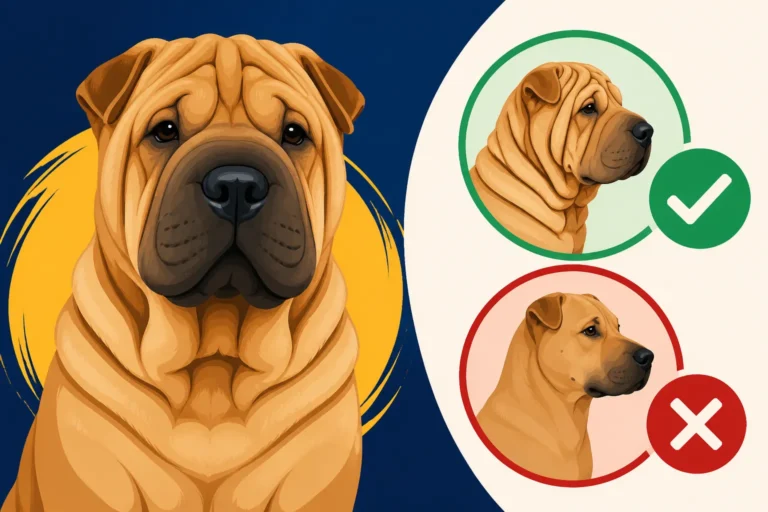
A Shar Pei’s ears are small in proportion to its head. They are usually triangular, set high, and carried close to the skull, with tips that may curl slightly. Their compact appearance is part of the breed’s characteristic silhouette, alongside the broad muzzle, curled tail, and loose skin.
That description applies to the visible ear flap, also called the pinna. The pinna helps collect sound and direct it toward the ear canal, but its size does not tell you everything about the structures inside the ear. Two dogs can have similarly small-looking outer ears and very different ear canals.
The Shar Pei’s ears are not simply tiny by accident in the sense that breed traits do not arise in a vacuum. Over generations, breeders select dogs that resemble the type they want to preserve. But the fact that a feature became characteristic does not tell us exactly why it first appeared, or whether people selected it for a practical purpose.
A breed feature is not proof of a designed function
People often assume that a distinctive body part must have been shaped for a specific task. In the Shar Pei’s case, it is tempting to say that small ears were deliberately selected because they were less likely to be grabbed or injured. That explanation is plausible as a general idea, but it should not be presented as established breed history without reliable evidence.
The Shar Pei developed in China, where dogs had varied roles in rural life. The breed’s history is often discussed in connection with guarding, hunting, and farm work, but the details of its early development are not fully documented. Learning What the Shar Pei Was Used For in China gives useful context, but it does not prove that every part of the modern dog’s appearance was selected for a working advantage.
The breed’s name is commonly translated as “sand skin,” referring to its rough coat rather than its ears. If you are sorting out which physical traits have clear historical explanations and which are uncertain, What Shar Pei Means in Chinese is a useful related topic. A careful distinction matters: a trait can be traditional and recognizable without having a confirmed functional origin.
Why the small-ear explanation can sound convincing
Small ears can seem less exposed than large, floppy ears. In theory, a compact ear flap might be less likely to catch on brush or suffer damage during rough activity. That possibility may help explain why people connect the Shar Pei’s ears with a practical purpose.
Still, a possible advantage is not the same as evidence that breeders intentionally selected the trait for that reason. Breed histories can accumulate neat explanations over time, especially when a dog’s appearance invites a story. The same caution applies to claims about loose skin. Whether the Shar Pei's Skin Helped It Fight explores a similar question: a proposed function may sound sensible, but it needs support before it can be treated as fact.
The most grounded answer is that the Shar Pei’s small ears are part of its inherited breed type. Their exact historical purpose is uncertain. That answer may feel less satisfying than a single clever explanation, but it avoids turning speculation into certainty.
Were Shar Pei ears made small on purpose
What we can reasonably say
Modern breed standards describe the Shar Pei’s ears as small, triangular, and set high. Standards describe the appearance expected of a breed; they do not necessarily document the original reason that appearance developed. Once a feature becomes a defining part of a breed, breeders may continue selecting for it because it is recognizable, even if its early purpose is unknown.
It is therefore reasonable to say that people have maintained the small-ear look through breeding. It is harder to claim that the ears were first made small for protection, fighting, hunting, or any other specific task. Historical records that establish one clear explanation are limited.
This distinction is useful when reading about other Shar Pei traits, too. For instance, “traditional appearance” does not automatically mean “healthier” or “better suited to work.” A physical feature may be visually distinctive while having little direct bearing on temperament or overall health.
Small outer ears do not mean simple ear care
A compact ear flap can make the ear look tucked away, but it does not mean the canal is easy to inspect or naturally protected from infection. The outer ear and the canal are different structures. Owners sometimes see a small ear and assume there is little to check, only to find that their dog is uncomfortable or that an examination is difficult.
The Shar Pei is known for unusually narrow ear canals, a separate anatomical issue from small pinnae. Narrow canals can make airflow, examination, and treatment more challenging, particularly when inflammation or wax buildup is present. For the difference between the visible ear shape and the internal anatomy, see A Shar Pei Has the Narrowest Ear Canals of Any Breed and Why a Shar Pei's Ear Canal Is So Narrow.
This is why an ear that looks neat and clean from the outside cannot be judged solely by appearance. A dog can have small, tidy-looking ears and still develop discomfort, odor, discharge, head shaking, or sensitivity around the head. Persistent or painful symptoms deserve veterinary attention rather than repeated attempts to clean deeper at home.
What the breed standard does and does not tell you
A standard is useful for understanding the accepted outline of a breed. It can tell you that small ears are a recognized Shar Pei feature. It cannot, by itself, establish the original purpose of that feature or guarantee that every individual dog will have identical ears.
The wording also should not be read as a reason to seek the smallest ears possible. Exaggerating a feature for appearance can create welfare concerns in dog breeding, and an individual dog’s comfort matters more than how closely it matches an idealized image. A concise related discussion is Whether the Shar Pei's Ears Should Be Tiny.
| Question | What is reasonable to conclude |
|---|---|
| Are small ears a typical Shar Pei feature? | Yes. The breed is known for small, triangular ears set high and close to the head. |
| Is there proof they were bred small for protection? | A protective advantage is sometimes suggested, but it should be treated as speculation unless supported by historical evidence. |
| Do small outer ears mean the ear canal is wide or easy to examine? | No. The outer ear and the ear canal are different structures. |
| Can a small-looking ear still have a problem? | Yes. Discomfort, odor, discharge, or repeated head shaking can signal an issue. |
| Should owners clean deep inside the ear? | No. Follow veterinary guidance and avoid inserting cotton swabs or other objects into the canal. |
Caring for a Shar Pei’s ears without making assumptions
Notice changes rather than relying on appearance
A healthy ear does not need constant deep cleaning just because the dog is a Shar Pei. Instead, learn what is normal for your individual dog: the usual appearance of the visible ear, whether there is any mild natural wax, and how your dog responds when you handle the area gently.
Watch for repeated head shaking, scratching, redness, a strong or unusual odor, discharge, or discomfort when the ear is touched. These signs do not identify the cause by themselves. Infection, inflammation, allergies, and other problems can look similar from the outside, and narrow canals can make a proper examination harder. For more on the limits of looking at home, read Whether a Shar Pei's Ear Canal Can Be Examined at All.
If your dog pulls away, cries, holds its head oddly, or suddenly resists ear handling, do not force an inspection. A painful dog may react defensively even if it is usually gentle. Contact a veterinarian and describe what you noticed, when it began, and whether the problem affects one ear or both.
Use products only when they fit the problem
When a veterinarian recommends an ear cleanser, ask how often to use it and whether it is appropriate when the ear is sore or infected. A product intended for routine cleaning is not automatically suitable for an inflamed ear. Do not put household liquids, oils, or leftover medication into the canal unless your veterinarian specifically directs you to do so.
If you need to obtain a vet-recommended cleanser or basic supplies, a pet retailer such as Chewy may list products for ear care. Check the exact product name and ingredients against your veterinarian’s instructions rather than choosing based on a broad “ear cleaner” label. Availability through Chewy does not determine whether a product is right for a particular dog.
The same caution applies to cotton pads, wipes, and other supplies. If you shop at Chewy, use the veterinarian’s directions to guide the purchase and avoid pushing anything into the canal. The goal is not to make the ear look scrubbed; it is to avoid irritation while addressing the specific issue your dog has.
Make handling calm and predictable
Many dogs dislike having their ears touched, and Shar Pei owners may find that a dog becomes especially wary after an uncomfortable examination or treatment. Practice brief, gentle handling when the dog is relaxed. Touch near the ear, reward calm behavior, and stop before the dog becomes tense. Over time, this can make routine checks less stressful.
Do not restrain a worried dog and continue simply because you want to finish. That can make future handling more difficult and may increase the chance of a defensive response. If your dog is already painful, leave the examination to a veterinary professional.
A clinic may need specialized tools or additional measures to assess a narrow or inflamed canal. That is not a failure on your part as an owner; it is a practical consequence of the anatomy and the dog’s comfort. Following a vet’s advice is safer than trying to reach farther or clean more aggressively at home.
What to remember about the Shar Pei’s small ears
The Shar Pei’s small, high-set ears are a recognizable breed feature, and breeders have maintained that appearance as part of the breed type. It is possible that compact ears offered practical advantages, but a specific original purpose—such as protection from injury—should be described as a theory, not a confirmed fact.
Most importantly, small outer ears are not the same thing as narrow ear canals. A neat-looking ear does not rule out a problem, and a small ear flap is no reason to clean deeply or use products without guidance. Pay attention to changes in comfort, odor, discharge, and behavior, and ask a veterinarian to assess persistent symptoms.
Understanding that difference helps separate appearance from care. The ears may be small by breed design, but their health still depends on what is happening inside and on responding thoughtfully when your dog shows signs of discomfort.
Disclaimer
This article is for general informational purposes only and does not constitute professional advice. Laws, prices and regulations vary by location and change over time. Consult a qualified professional for guidance on your specific situation.