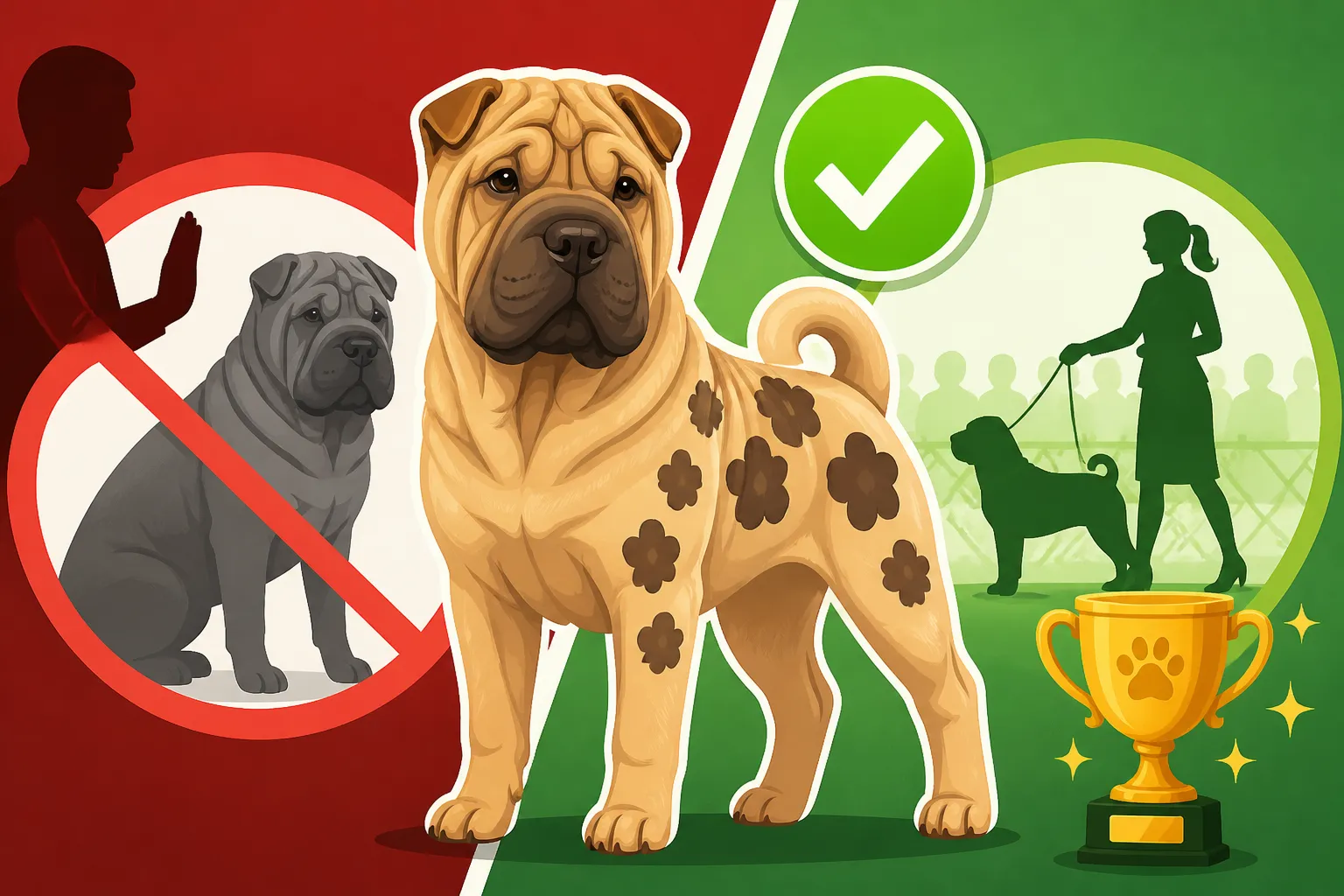
Whether a Flowered Shar Pei Can Be Shown
A flowered Shar Pei can be registered or welcomed at some events, yet that does not automatically make the dog eligible for conformation showing. The key is what “flowered” means, which kennel club is running the show, and whether its breed standard accepts the coat pattern. Here’s how to check the rules before entering—and what your dog can still enjoy if the pattern is not accepted.
What “flowered” means on a Shar Pei
A pattern, not simply a coat color
“Flowered” is commonly used for a Shar Pei with patches of white or another color across the coat. The precise appearance can vary: a dog may have larger, clearly defined patches, or a more scattered pattern. The label describes how the coat looks; it does not, by itself, tell you which registry rules apply or whether the dog is eligible for a particular class.
That distinction matters because show standards often list permitted colors and patterns specifically. A patterned dog may be registered with a kennel club but still fall outside the accepted colors for conformation. Registration and show eligibility are separate questions, and people understandably mix them up.
It is also easy to confuse a flowered pattern with a dilute coat color. A dilute Shar Pei may have a solid coat in a lighter or softened shade, while a flowered dog has a pattern. If you are trying to identify what you see, compare the coat with the recognized colors and patterns described in Which Colors a Shar Pei Comes In and What a Dilute Shar Pei Is.
Why a pattern may matter in the show ring
Conformation shows judge dogs against a breed standard. That standard describes the qualities judges are expected to assess, which can include structure, movement, coat, color, and overall type. If a breed standard excludes a particular pattern, a flowered dog may not qualify for regular conformation classes, even if the dog is healthy, well trained, and otherwise closely resembles the breed.
This is not a judgment about the dog’s temperament or worth. It is a rule about which dogs can compete in a specific type of event. A dog that is ineligible for conformation may still be able to participate in other activities, depending on the event organizer’s requirements.
The Shar Pei standard also addresses more than appearance. Coat color is just one part of the picture; judges assess the dog as a whole. For context, Whether a Shar Pei's Wrinkles Are in the Standard explains how a recognizable feature can be described in the standard without being the only thing that matters in the ring.
Can a flowered Shar Pei compete in conformation?
Check the registry and the exact standard
There is no safe one-size-fits-all answer for every country, registry, or event. Kennel clubs can use different standards, and event rules may also differ. Some breed standards specify solid colors and do not accept a flowered or patched pattern for conformation. If that applies to the organization you plan to enter with, the dog may be excluded from conformation competition on coat-pattern grounds.
Before making plans, look up the current Shar Pei breed standard and show regulations from the organization running the event. Pay attention to the wording about color and markings, including whether a pattern is explicitly disallowed, listed as a fault, or handled under a separate rule. The distinction can affect whether the dog is barred from entry or simply disadvantaged in judging.
This is particularly important if you live near a national border, travel to shows, or have paperwork from a different registry. Whether the Shar Pei Standard Differs Between Countries is useful background, but the final answer should come from the specific organization and event you intend to enter.
Registration does not guarantee eligibility
A registration certificate confirms that a dog is recorded under a registry’s procedures. It does not necessarily mean that the dog meets every requirement for every competition. A registered dog may be ineligible for a particular conformation class because of color, age, coat, or another rule.
Likewise, a breeder’s description of a puppy as “show quality” is not a substitute for checking the rules. Ask what the breeder means by that phrase: Are they talking about registration, general appearance, or eligibility for conformation? Those are different claims, and a clear answer can prevent disappointment later.
If your dog already has registration papers, contact the registry or show secretary with a clear description of the coat pattern. If possible, provide a photograph and ask whether the dog may enter the specific class you have in mind. Written clarification is more useful than relying on a casual answer from someone who may not be familiar with the rules.
| Question | Why it matters | What to check |
|---|---|---|
| Is the dog registered? | Registration records the dog but does not guarantee show eligibility. | The registry’s paperwork and rules |
| Does the standard accept the pattern? | A flowered coat may be excluded from conformation. | The current Shar Pei breed standard |
| Which event are you entering? | Conformation, sports, and companion events can have different requirements. | The event’s entry rules |
| Are you crossing into another jurisdiction? | Standards and procedures may differ between organizations. | The local kennel club or event secretary |
Ask before paying an entry fee
If the wording in a standard is unclear, ask the event secretary or kennel club to interpret it for the particular class. Use a direct question: “My Shar Pei has a flowered coat with these markings. Is the dog eligible for this conformation class under your rules?” Include the dog’s age, registration details, and a clear photo if requested.
Avoid relying only on social media comments or another owner’s experience. They may be describing a different country, registry, event type, or coat pattern. Even a well-meaning breeder may not know how a particular show organization interprets its rules.
If the answer is no, ask whether the event offers other activities that suit your dog. Rules can vary between conformation and non-conformation events, so it is worth checking rather than assuming the dog is barred from the entire show venue.
What a flowered Shar Pei can do instead
Explore events beyond conformation
Conformation is only one way to take part in the dog world. Depending on local rules and your dog’s interests, a flowered Shar Pei may be able to enjoy activities such as obedience, scent work, rally, or other companion events. These activities focus on trained skills or teamwork rather than judging whether a dog matches a breed’s appearance standard.
Eligibility is still event-specific. Some organizations impose registration, age, health, or equipment requirements, so check those before entering. If your dog is new to busy settings, start with a quiet class or a low-pressure training session rather than expecting them to cope immediately with a crowded show environment.
Training can also be rewarding even if you never compete. Short sessions, clear rewards, and practice around everyday distractions can build useful skills and give you and your dog a shared routine. A flowered coat does not limit a dog’s ability to learn, work, or enjoy time with you.
Prepare for events at your dog’s pace
Shar Pei can be reserved, and a showground may bring unfamiliar dogs, people, noises, and handling. Give your dog room to settle. Bring water, plan breaks, and avoid forcing greetings with strangers or other dogs. If your dog shows signs of stress, stepping away is a sensible choice—not a failure.
Practice handling gradually at home if the event requires your dog to be examined or touched. Pair brief, gentle handling with something your dog enjoys, and stop if they become uncomfortable. For advice on breed-specific behavior in unfamiliar situations, see How a Shar Pei Greets a Visitor and How a Shar Pei Responds to Harsh Handling.
For basic event preparation, keep grooming gentle and practical. Use products appropriate for your dog’s skin and coat, and ask your veterinarian for guidance if the skin is irritated or uncomfortable. If you are shopping for routine grooming supplies, retailers such as Chewy may offer a convenient way to browse options; check product suitability and ingredients rather than assuming a product is right for every Shar Pei.
Coat pattern, health, and responsible ownership
Do not treat “flowered” as a health diagnosis
A coat pattern alone does not tell you whether a Shar Pei is healthy or unhealthy. It is not a substitute for veterinary care, and it cannot confirm a dog’s genetic status. If you are concerned about a patch of skin, a new change in coat, itching, odor, or discomfort, focus on the actual symptom and speak with your veterinarian.
The same goes for a puppy whose coat changes as it grows. Colors and markings may look different as the coat develops or sheds, so photographs from different ages can help you describe the change. For more on coat development, see Whether a Shar Pei's Color Changes.
If a breeder makes health claims based only on the dog’s color or pattern, ask what evidence supports the claim. Health screening, medical history, and veterinary assessment are more meaningful than appearance alone. You can also read Whether the Shar Pei Is Bred for Health Now for broader context when evaluating breeding practices.
Groom for comfort, not for a different pattern
A bath or grooming routine will not make a flowered pattern acceptable under a conformation standard if the rules exclude it. Avoid attempts to alter the coat’s appearance to get around show requirements. Instead, keep grooming focused on cleanliness, comfort, and the needs of your individual dog.
Choose gentle brushes and skin-care products, and introduce grooming slowly if your dog dislikes being handled. Online retailers such as Chewy can be one place to look for routine supplies, but ask your veterinarian before using medicated products or treating a skin problem yourself. If you are considering a show or sport, confirm that any grooming or equipment choices also meet the event’s rules.
A practical checklist before entering
- Identify the pattern. Take clear photographs in natural light and describe the markings accurately.
- Find the event’s governing organization. Do not assume that rules from another country or registry apply.
- Read the breed standard and entry rules. Look specifically for wording about solid colors, patches, and disqualifications.
- Ask the event secretary if anything is unclear. Share the dog’s registration information and photos, and ask about the exact class.
- Separate conformation from other activities. If conformation is not available, check whether companion events or training activities are suitable.
- Make the experience comfortable for your dog. Plan for water, rest, gradual handling, and space from stressful interactions.
A flowered Shar Pei may be excluded from conformation where the applicable standard does not accept the pattern, but the answer depends on the organization and event. Confirm the rule directly before entering. Whatever the result, a coat pattern does not define a dog’s health, character, or ability to be a valued companion.
Disclaimer
This article is for general informational purposes only and does not constitute professional advice. Laws, prices and regulations vary by location and change over time. Consult a qualified professional for guidance on your specific situation.