How a Shar Pei Behaves Toward Other Dogs
One of the most common worries I hear from new Shar Pei parents, and even seasoned ones, is how their wrinkled wonder gets along with other dogs. It’s a genuine concern, and frankly, a characteristic of the breed that many people aren't fully prepared for. Unlike some breeds that seem to greet every canine with tail wags and boundless enthusiasm, a Shar Pei often approaches other dogs with caution, indifference, or sometimes, outright challenge. This guide will help you understand the deep-seated reasons behind your Shar Pei's unique approach to dog-to-dog interactions and provide practical strategies for managing these encounters, ensuring both your dog's safety and the peace of mind of other pet owners.
Understanding the Shar Pei's Historical Roots and Instincts
To truly grasp why a Shar Pei might not be the life of the dog park, we have to travel back in time and understand what these incredible dogs were originally bred to do. Their past roles have imprinted behaviors that are still very much present in the modern Shar Pei, shaping their interactions with the world, including other canines. It’s not about them being "mean" or "bad"; it’s about their inherent nature.
The Shar Pei's Original Purpose and Its Impact on Socialization
Imagine ancient China, where the Shar Pei first emerged. These weren't lapdogs or casual companions. They were utility dogs, bred for a variety of demanding tasks that required immense independence, courage, and a protective instinct. They guarded homes and livestock, hunted wild boar, and even, in some historical accounts, participated in dog fighting. Think about what kind of temperament these jobs would forge: a dog that needed to be self-sufficient, wary of strangers (both human and animal), and utterly devoted to its own family and territory.
This deep-rooted history means that a Shar Pei was never developed with the idea of making friends with every dog it met on a leisurely stroll. Their historical roles taught them that other dogs might be competitors for resources, threats to their territory, or prey during a hunt. This isn't a flaw in their character; it's a testament to their enduring loyalty to their original purpose. When your Shar Pei eyes another dog suspiciously, it’s not necessarily a sign of aggression, but often a manifestation of this deeply ingrained cautiousness. They are assessing, weighing the potential threat or challenge, and their initial reaction might be to create distance or to stand their ground rather than to invite interaction.
Why Natural Dog Aggression Isn't a Flaw, But a Trait
It’s easy for us, with our modern understanding of dog behavior, to label any unfriendly canine interaction as "aggression" and view it as a problem to be eradicated. However, for a Shar Pei, some level of dog-to-dog intolerance, particularly with unknown dogs or those perceived as rivals, is less a flaw and more a breed-specific trait. It's crucial to differentiate between natural, inherited tendencies and overt, dangerous aggression. A Shar Pei's natural inclination might be to guard its space and its people, and this can sometimes manifest as a strong aversion to other dogs infringing on what it considers "its" bubble.
This isn't to say we should encourage or ignore truly dangerous behavior, but rather to acknowledge that their genetic makeup predisposes them to be more selective in their canine friendships. They weren't bred to run with a pack of neighborhood dogs. Instead, they were often solitary workers or lived in small family units, where a clear hierarchy would have been established. Understanding this helps us manage their expectations and ours. When you encounter another dog on a walk, your Shar Pei isn't necessarily thinking, "Oh, a new friend!" but rather, "Who is this, and what do they want?" This instinctual wariness means that managing their environment and interactions is paramount, rather than trying to force them into a social mold that goes against their very nature.
The Nuances of Shar Pei-to-Dog Interactions
Navigating the world of dog-to-dog interactions with a Shar Pei can feel like trying to solve a puzzle with a few missing pieces. Their unique physical characteristics and inherent temperament make their communication style, and thus their reactions, quite distinct. What might be an obvious signal from a Labrador could be completely invisible or misinterpreted when coming from a Shar Pei.
Reading a Shar Pei's Body Language with Other Dogs
One of the biggest challenges in understanding a Shar Pei's interactions with other dogs is their unique physiology. Those wonderful, distinctive wrinkles and small, often flat-lying ears, combined with a tightly curled tail, can obscure many of the traditional canine communication cues that other dogs (and humans) rely on. A dog approaching a Shar Pei might not see the subtle ear flick, the slight widening of the eye, or the tentative tail wag that signals intent or emotion in other breeds. This can lead to misunderstandings, where another dog might push past a Shar Pei's warning signs, leading to a quicker, more intense reaction.
For an owner, this means becoming a master interpreter. You need to look for more subtle cues. Is their weight shifting? Are they freezing for a split second? Is their gaze direct and unblinking, or are they averting their eyes slightly? Does their mouth tighten? The famous "Shar Pei scowl," which is a natural set of their facial wrinkles, can also be misinterpreted by other dogs as a snarl or a challenge, even when the Shar Pei is simply observing. Being acutely aware of these nuanced signals is critical. Remember, a Shar Pei will often try to communicate its discomfort before escalating, but if those signals are missed, either by the approaching dog or by you, the situation can quickly deteriorate. It's a reminder that their physical traits, while charming, do pose a communication challenge in the wider dog world, as discussed in How a Shar Pei's Wrinkles Hide Its Expression.
Different Reactions to Different Dogs
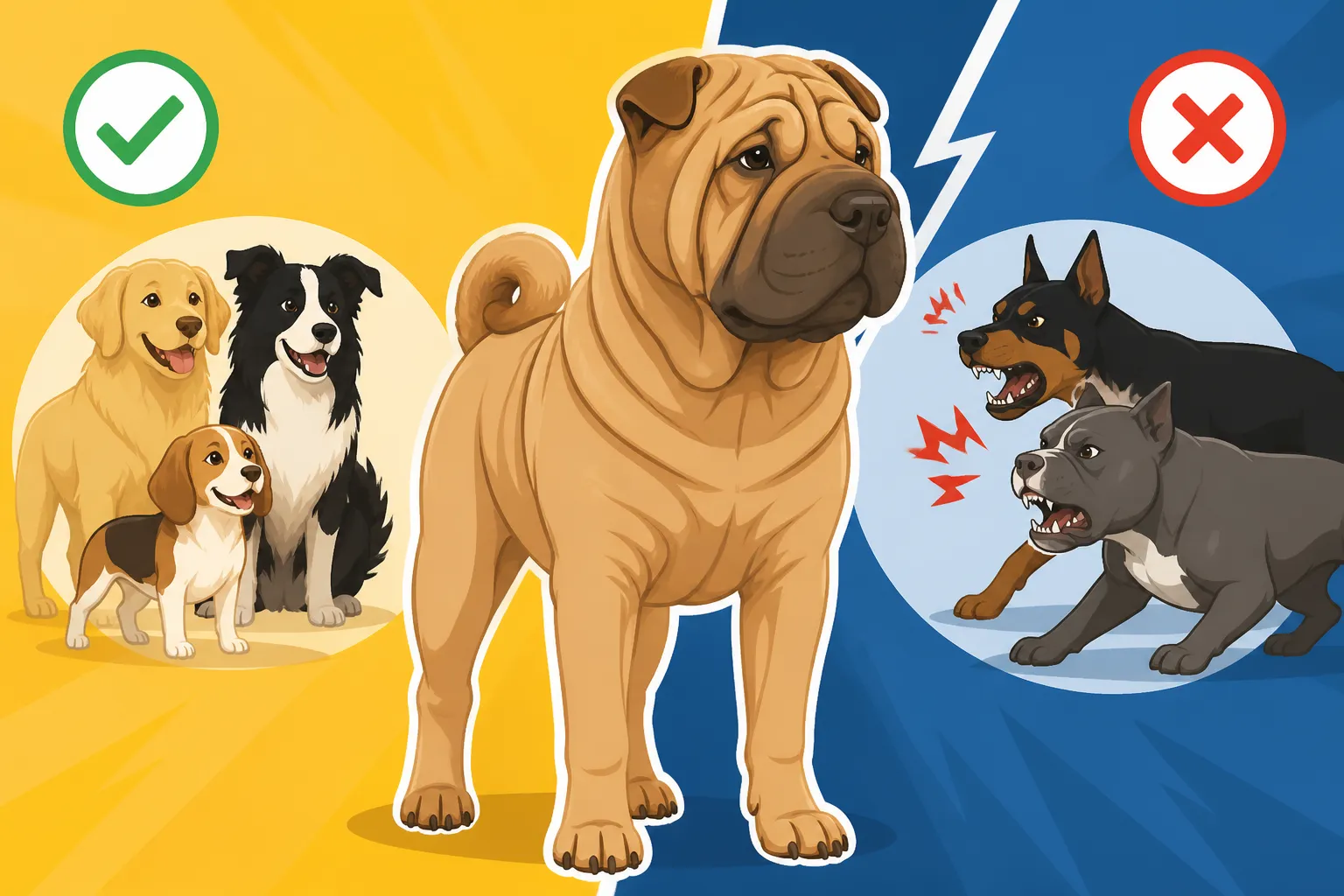
It's a common misconception that if a Shar Pei is "dog aggressive," it will be aggressive with every dog. This isn't always the case. Their reactions can be highly varied, often depending on the size, sex, energy level, and even the "vibe" of the other dog.
For instance, a Shar Pei might tolerate, or even ignore, a calm, submissive small dog, viewing it as non-threatening. However, a boisterous, pushy large dog might instantly trigger a defensive or challenging response. There's also a known tendency for same-sex aggression, particularly between intact males. Two male Shar Pei living together or encountering each other in a neutral space can often lead to heightened tension and potential conflict, as detailed in How Two Male Shar Pei Live Together. This isn't unique to Shar Pei, but it's a characteristic that is often more pronounced in guardian breeds with strong territorial instincts.
Age also plays a role. While some Shar Pei might tolerate puppies with a degree of patience, others may find their boundless energy and lack of social graces irritating, leading to a quick snap or growl to tell them off. Conversely, an older, slower Shar Pei might find a high-energy younger dog overwhelming and become reactive out of stress. The key is to recognize that your Shar Pei isn't a monolith in its reactions. Every dog encounter needs to be assessed individually, and you should always err on the side of caution, managing interactions closely to prevent negative experiences.
| Shar Pei Reaction Type | Triggering Dog Characteristic | Typical Shar Pei Response | Owner Management Strategy |
|---|---|---|---|
| Indifference/Tolerance | Calm, Submissive, Known Dog | May ignore, sniff briefly, or allow parallel walking. | Supervise lightly, reward calm behavior. |
| Defensive/Wary | Bold, Direct, Unknown Dog | Stiff body, direct stare, low growl, attempts to create distance. | Increase distance, block visual, use calming verbal cues. |
| Challenging/Aggressive | Pushy, Intact Same-Sex Dog | Lunging, barking, snarl, raised hackles, attempts to engage. | Immediate separation, avoid eye contact, professional help. |
| Irritation/Correction | Overly Energetic Puppy | Quick snap, growl, stiff body to assert boundaries. | Intervene before escalation, teach puppy appropriate behavior. |
| Fear/Avoidance | Loud, Unpredictable, Large Dog | Tries to hide, pulls away, subtle shaking, low posture. | Remove from situation immediately, build confidence in safe spaces. |
Strategies for Managing Dog-to-Dog Encounters
Given the Shar Pei's unique predispositions, a proactive and thoughtful approach to dog-to-dog encounters is not just helpful, it's absolutely essential. You can't just hope for the best; you have to plan for success, or at least for avoidance of conflict. This isn't about changing your Shar Pei's core personality, but about giving them the tools and boundaries they need to navigate a world full of other canines safely and calmly.
Early, Controlled Socialization is Key
The absolute best thing you can do for a Shar Pei, especially when they are a puppy, is to expose them to a wide variety of sights, sounds, people, and, yes, other appropriate dogs. The keyword here is "controlled." This isn't about letting your eight-week-old puppy loose in a dog park (please, please don't do that!). It's about carefully curated, positive experiences during their critical socialization window, which typically closes around 12-16 weeks of age. Missing this window can have lasting consequences, leading to an undersocialized adult dog that is fearful or reactive. Socialize a Shar Pei Before Twelve Weeks or Pay for It Later truly highlights the urgency here.
Think about it: a puppy's brain is like a sponge during this period. Every positive interaction builds a foundation of confidence and neutrality. Enroll your puppy in a well-run puppy class that emphasizes positive reinforcement and safe, supervised play with other puppies. Look for classes where the trainers understand breed-specific behaviors and can guide appropriate interactions. You can also arrange playdates with calm, vaccinated, adult dogs that you know are good with puppies. The goal is to create positive associations: other dogs mean good things, or at least neutral things, not scary or threatening things.
Online resources, like those offered by BAXTER & Bella, can be incredibly helpful here. They provide structured, step-by-step guidance that can help you understand the nuances of socialization from the comfort of your home, and then apply those lessons in controlled real-world scenarios. This kind of systematic approach allows you to build confidence in both you and your Shar Pei without overwhelming either of you. Remember, it's about quality over quantity; a few positive, short interactions are far more beneficial than one overwhelming, negative one.
Leash Etiquette and Avoiding Confrontation
Once your Shar Pei is past puppyhood, or if you've adopted an adult, the focus shifts to careful management and clear communication on leash. For many Shar Pei, random, off-leash greetings with unfamiliar dogs are a recipe for disaster. This is why dog parks are generally unsuitable for the breed, as explained in Whether a Shar Pei Belongs at a Dog Park. The unpredictable nature of a dog park, with its myriad of dog personalities and energy levels, is simply too much for most Shar Pei to handle gracefully.
Instead, prioritize calm, structured walks where you are in control. Invest in a sturdy, comfortable leash and harness. Brands found on platforms like Amazon offer a wide range of reliable options, allowing you to find gear that fits your Shar Pei's unique build without rubbing their folds. Practice walking past other dogs at a distance, gradually decreasing that distance as your dog shows signs of comfort. Reward calm behavior profusely. If your Shar Pei stiffens, stares, or shows any signs of discomfort, create more space. Cross the street, turn around, or step behind a parked car – whatever it takes to avoid a direct confrontation.
Learn to "read" the environment ahead of you. See a dog off-leash? Change direction. Spot a dog whose owner isn't paying attention? Be ready to pivot. Your job is to be your Shar Pei's advocate and protector. They rely on you to keep them safe and to manage interactions that they might find stressful or challenging. This consistent, careful management prevents negative experiences from accumulating, which can otherwise lead to a more deeply ingrained reactivity.
Living with a Shar Pei in a Multi-Dog Household
Bringing a Shar Pei into a home with existing dogs, or adding another dog to a home with a Shar Pei, requires a delicate hand and a clear understanding of canine social dynamics. It's certainly possible for Shar Pei to live harmoniously with other dogs, but it rarely happens without thoughtful planning and ongoing management. Their independent nature and tendency to guard resources means you need to be strategic.
Introducing a New Dog to Your Shar Pei
If you're thinking of adding another dog to your Shar Pei's life, or if your Shar Pei is joining a home with other canines, the introduction process is absolutely critical. You cannot simply throw them together and hope for the best. A successful introduction is a slow, methodical process designed to minimize stress and maximize positive associations.
Start on neutral territory. This means a place where neither dog feels possessive or territorial, like a park or a quiet walking trail neither has been to before. Keep both dogs on leash, with separate handlers, and walk them parallel to each other at a comfortable distance. The goal is for them to acknowledge each other's presence without direct interaction, allowing them to decompress and get used to the idea of the other's existence. Over several sessions, gradually decrease the distance, allowing brief, controlled sniffs. Avoid direct face-to-face greetings initially, as these can be confrontational for some dogs.
Once they seem comfortable on neutral ground, move the introduction to your home, but keep things structured. Use baby gates or crates to create safe spaces where each dog can have alone time and eat undisturbed. Supervise all interactions closely. Feed them separately, ensuring no resource guarding issues arise around food bowls. Provide separate, high-value chew toys or beds to prevent conflict. This slow, steady approach allows both dogs to acclimate to each other's presence, building a foundation of acceptance rather than forcing a rushed, potentially negative interaction.
Managing Resource Guarding and Hierarchy
Shar Pei, by nature, can be prone to resource guarding. This means they might become possessive over food, toys, beds, their humans, or even specific locations in the house like a doorway. This is a common issue that must be addressed proactively in a multi-dog household to prevent conflicts. Whether a Shar Pei Guards Its Food is a prime example of a behavior that needs careful handling.
The most effective way to manage resource guarding is through prevention and consistent training. Always feed dogs separately, perhaps in different rooms or crates, to eliminate any competition. Don't leave high-value toys or chews lying around unsupervised. If one dog is particularly attached to a specific spot, like a favorite bed, ensure they have exclusive access to it when needed, or provide multiple attractive options.
Training plays a huge role here. Teach a strong "leave it" cue to all dogs. Practice trading exercises where you offer a higher-value treat for a guarded item, teaching your Shar Pei that giving things up results in something better. This builds trust and reduces their need to "guard." Establish clear boundaries and routines. A well-managed household, where resources are clearly defined and conflicts are prevented before they start, is a much happier household for all its occupants, especially a Shar Pei who thrives on predictability and structure. Consistency and vigilance are your best friends in fostering a peaceful coexistence.
When Professional Intervention is Needed
There are times when even the most dedicated Shar Pei owner might feel overwhelmed by their dog's reactions to other canines. This is not a sign of failure, but rather an acknowledgment that some behavioral issues require expert guidance. Knowing when to call in a professional can make all the difference in preventing escalation and ensuring the safety and well-being of everyone involved.
Recognizing Signs that You Need Help
It can be hard to admit when you need help, especially when you love your dog fiercely. However, ignoring escalating dog-to-dog reactivity can have serious consequences. There are clear indicators that it's time to seek professional assistance. If your Shar Pei's reactions are becoming more intense, more frequent, or harder to predict, it's a red flag. This includes lunging, barking excessively, growling, snapping, or trying to bite other dogs, even when you're attempting to manage the situation.
Another significant sign is if you feel unsafe or out of control during encounters. If you're constantly worried about walks, or if your Shar Pei's behavior is impacting your ability to enjoy normal activities, that's a signal. Similarly, if there's any instance of injury to another dog, even a minor one, or if you live in a multi-dog household and internal conflicts are becoming a regular occurrence, it's definitely time to get help. Early intervention is always better than waiting until the problem is severe. Remember, When a Shar Pei Needs a Behaviorist isn't a question of if, but when, for some Shar Pei. It's about getting the right tools to live a calmer, safer life together.
Choosing the Right Professional
Once you've decided to seek help, the next step is finding the right professional. This is crucial, as not all trainers or behaviorists are created equal, and some methods can actually worsen a Shar Pei's reactivity. Look for a Certified Professional Dog Trainer (CPDT-KA), a Certified Applied Animal Behaviorist (CAAB), or a Veterinary Behaviorist (DACVB). These individuals have extensive education, experience, and ethical guidelines.
It’s vital to seek out professionals who use positive reinforcement, force-free, and fear-free training methods. Avoid anyone who suggests using harsh corrections, prong collars, shock collars, or other intimidation tactics. Not only can these methods be damaging to your Shar Pei's trust in you, but they often suppress outward signs of aggression without addressing the underlying fear or anxiety, potentially leading to more dangerous "unpredictable" bites in the future. As emphasized in Why a Prong Collar Is Wrong for a Shar Pei, such tools are counterproductive and can exacerbate issues in a sensitive, headstrong breed. A good behaviorist will work with you to understand the root cause of your Shar Pei's behavior, develop a comprehensive management and training plan, and empower you with the skills to help your dog thrive. They should prioritize safety, effective communication, and building a stronger bond between you and your Shar Pei.
Preventing and Mitigating Dog Aggression
Proactive measures and a consistent approach are truly the cornerstones of successfully managing a Shar Pei's dog-to-dog interactions. It’s a marathon, not a sprint, and it requires dedication, understanding, and a willingness to be your dog's best advocate. By establishing clear boundaries and providing appropriate outlets, you can help your Shar Pei navigate the world more calmly.
Consistent Training and Leadership
A Shar Pei, like many intelligent, independent breeds, thrives on clear leadership and consistent expectations. This doesn't mean being harsh or dominant; it means being a reliable, fair, and predictable guide for your dog. Your Shar Pei needs to know that you are in charge of their safety and that you will manage potentially stressful situations. This understanding reduces their need to take matters into their own paws.
Consistent training from a young age is paramount. Focus on foundational obedience cues like "sit," "stay," "come," and especially a rock-solid "leave it" and "watch me." These commands become your tools for managing encounters. For instance, a strong "watch me" can redirect your Shar Pei's attention from an approaching dog to you, allowing you to move them away calmly. Consistent practice builds a strong communication channel between you and your dog. Remember, a Shar Pei has a headstrong streak that nobody truly trains out of them, as explored in The Headstrong Streak Nobody Trains Out of a Shar Pei, so patience and positive reinforcement are far more effective than force. They respond best to a leader they respect, not one they fear. Regular, short training sessions, integrated into your daily routine, will reinforce good habits and build your Shar Pei's confidence in your guidance.
Environmental Management and Enrichment
Beyond direct training, creating an optimal environment and providing adequate enrichment are crucial for preventing and mitigating dog-to-dog reactivity. A bored, under-exercised, or stressed Shar Pei is far more likely to react negatively to other dogs. Mental and physical stimulation are just as important as structured training.
Ensure your Shar Pei gets appropriate exercise. This often means regular, leashed walks in areas where you can control encounters, or secured, private off-leash areas if available. Mental enrichment is also vital. Puzzle toys, snuffle mats, and training sessions (even short ones) that challenge their minds can tire them out just as much as a physical walk. A tired dog is generally a well-behaved dog.
Environmental management at home is also key. If you have a multi-dog household, ensure each dog has their own space – a crate, a bed, or a room – where they can retreat and be undisturbed. This reduces competition and stress. Manage access to doorways, windows, and other "high-traffic" areas where your Shar Pei might feel the need to guard. By proactively managing their environment, anticipating triggers, and providing plenty of appropriate outlets for their energy and intelligence, you can significantly reduce the likelihood of negative dog-to-dog interactions. This holistic approach supports your Shar Pei's overall well-being, making them a calmer, more confident companion.
Disclaimer
This article is for general informational purposes only and does not constitute professional advice. Laws, prices and regulations vary by location and change over time. Consult a qualified professional for guidance on your specific situation.