Why a Shar Pei Ignores a Cue It Knows
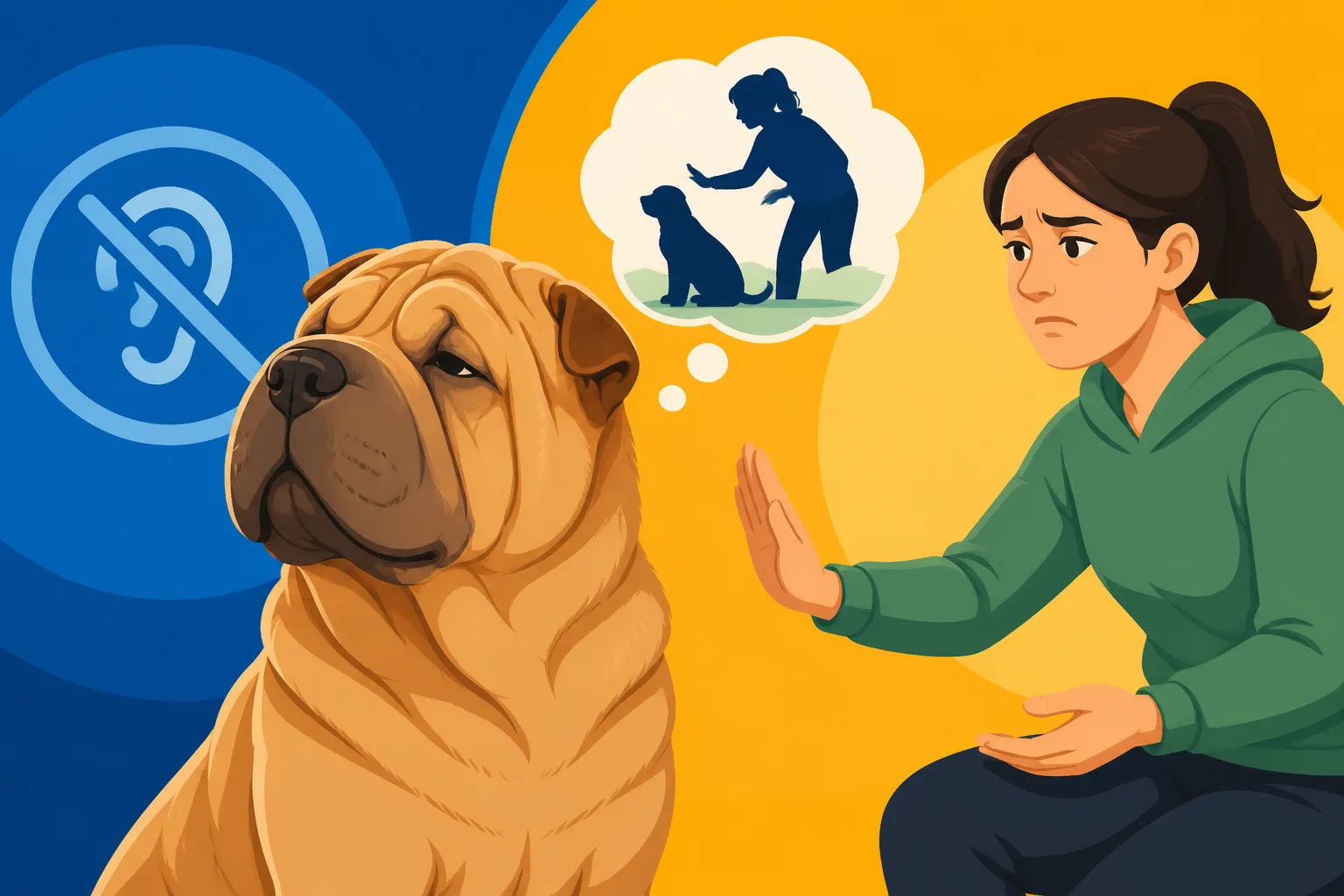
It's incredibly frustrating when your Shar Pei, a dog you know is smart and capable, suddenly acts like they've never heard a command before. You've taught them 'sit' a hundred times, and now they're just staring at you, ears swiveled towards a distant squirrel. This guide dives deep into why your Shar Pei might be ignoring cues they clearly know, offering insights and practical advice to get back on track.
The Shar Pei's Independent Nature and Why It Matters for Training
One of the most common frustrations for Shar Pei owners is the perception that their dog is "stubborn." While it's easy to label them as such, it's more accurate to understand their inherent independence and selective hearing, which is deeply rooted in their breed history. They were not bred to be eager-to-please, highly biddable working dogs in the traditional sense, but rather independent guardians and hunters. This means their motivation system works a little differently than, say, a Labrador Retriever.
The 'Stubborn' Label: Understanding a Shar Pei's Will
Calling a Shar Pei stubborn often misses the point entirely. They're not being deliberately disobedient just to spite you; they're simply weighing their options. A Shar Pei's mind often works on a "what's in it for me?" basis. If the perceived reward for performing a known cue isn't high enough, or if something else in the environment is more compelling, they'll often choose the path of most interest to them. This isn't stubbornness as much as it is a strong sense of self-preservation and independent decision-making. You'll often find yourself having to convince them that your idea is, in fact, the best idea for them.
This inherent trait means that rote repetition without meaningful engagement can quickly lead to disinterest. They're not dogs that thrive on endless drilling. Instead, they need intelligent engagement and a clear understanding of the value of their compliance. If you've been relying on the same old kibble as a reward for every single command, your Shar Pei might have decided that the payout isn't worth the effort when there's a fascinating smell under that bush. It's crucial to acknowledge The Headstrong Streak Nobody Trains Out of a Shar Pei early in their training journey.
For many Shar Pei, their strong-willed nature can even translate into a deep-seated suspicion of anything they perceive as an attempt to control them without reason. This isn't malicious; it's just how their ancient instincts guide them. They are intelligent and capable of learning complex commands, but they will always prioritize their own assessment of a situation. Understanding this fundamental aspect of their personality is the first step in addressing why they might ignore a cue they've learned perfectly well.
Motivation is Key: What Actually Works
Given their independent streak, understanding What Motivates a Shar Pei is paramount. For many, food is a powerful motivator, but not just any food. We're talking about high-value, irresistible treats that they don't get at any other time. Think small pieces of cooked chicken, cheese, or even specific soft training treats. These aren't everyday snacks; they're the gold standard, reserved for when you absolutely need their attention and compliance, especially in distracting environments. Many owners find success experimenting with different brands of high-value treats available on sites like Amazon to see what their individual dog truly goes wild for.
Beyond food, some Shar Pei are highly toy-motivated, especially with squeaky toys or tug ropes. If your Shar Pei values a specific toy above all else, using it as a reward immediately after a successful cue can be incredibly effective. The key is to make the reward immediate and truly exciting for them, not just what you think is exciting. The moment they perform the cue, that treat or toy needs to appear, reinforcing the positive association instantly.
Another often-overlooked motivator is praise and genuine affection. While some Shar Pei might seem aloof, many cherish quiet praise and a gentle ear scratch from their chosen person. This isn't always enough on its own, but combined with other high-value rewards, it can significantly boost their willingness to engage. Remember, your relationship with your Shar Pei is built on trust and mutual respect, and positive reinforcement strengthens that bond, making them more inclined to respond to your requests rather than simply ignoring them.
Environmental Factors and Distractions
A common reason a Shar Pei might ignore a known cue isn't deliberate defiance, but rather an overwhelming environment. Their senses are constantly processing information, and sometimes, the world outside your training bubble is simply too fascinating or overwhelming to tune out. This is a challenge common to all breeds, but with a Shar Pei's often limited peripheral vision and intense focus, external stimuli can be particularly distracting.
The World is More Interesting Than Your Voice
Imagine you're trying to concentrate on a task, but there's a siren wailing, a delicious smell wafting from the kitchen, and a compelling conversation happening nearby. That's often what your Shar Pei experiences. Their world is rich with scents, sounds, and sights that can easily override your voice, especially if your cue isn't accompanied by a strong, consistent reward history in that specific environment. A distant dog barking, a squirrel darting across the yard, or the smell of another animal can become the singular focus for your Shar Pei, making your commands fade into the background.
This is particularly true for Shar Pei, who can be quite discerning about their surroundings and often have a strong prey drive or territorial instinct. If a cue is given when they're locked onto something, whether it's another dog in the distance or a leaf blowing past, their attention is already elsewhere. It's not that they don't know the cue; it's that they literally aren't hearing it in a way that registers over the competing stimuli. This is why practicing known cues in progressively more distracting environments is so critical. Start in a quiet room, then move to the backyard, then a quiet park, gradually building up their ability to focus on you no matter what's going on around them.
The problem often arises when we assume a cue is "learned" just because they perform it perfectly in the living room. The real test comes when you're out and about, facing real-world scenarios. A new park, a busy street, or even just guests arriving at your home can present a totally different challenge. For this reason, many owners find structured online programs, like those offered by BAXTER & Bella, helpful in providing guidance for slowly introducing distractions while maintaining consistency in training.
When Routine Changes Everything
Shar Pei are creatures of habit, and while they can adapt, significant changes in their routine or environment can lead to stress, confusion, and a temporary breakdown in learned behaviors. Moving to a new home, a new person joining the household, or even a different walking route can subtly impact their ability to focus and respond to cues. They thrive on predictability, and when that's disrupted, their confidence can waver, manifesting as a reluctance or inability to perform commands.
Consider a Shar Pei who always performs a "stay" perfectly in the park where they've trained for months. Now, take them to a new, unfamiliar park with different smells, sounds, and an altered visual landscape. That same "stay" might suddenly become an exercise in futility. The change itself can be a distraction, forcing them to process a flood of new information before they can even consider your request. This is not defiance; it's a dog trying to make sense of its world.
It's important during these periods of change to revert to basics, reduce distractions, and build confidence again. Use higher-value rewards and more frequent, shorter training sessions. Be patient and understanding. Acknowledge that they might be feeling overwhelmed, and focus on rebuilding their reliability by setting them up for success. This might mean temporarily simplifying your expectations and gradually reintroducing complexity as they adjust to the new normal.
Health, Comfort, and Communication Gaps
Sometimes, a Shar Pei's refusal to respond isn't about stubbornness or distraction, but something deeper related to their physical or emotional state. They might be uncomfortable, in pain, or simply not understanding what you're asking in the way you intend. Given their unique physical characteristics and stoic nature, these factors can be easily overlooked.
Is Your Shar Pei Uncomfortable or in Pain?
Shar Pei are renowned for being stoic, often Whether a Shar Pei Hides Pain incredibly well. This means a subtle limp, an ache, or even an internal discomfort might not be obvious to you but could be severely impacting their willingness or ability to perform a cue. For instance, a Shar Pei with developing hip discomfort might refuse to 'sit' or 'down' because it causes them pain. Similarly, if they have an ear infection – a common ailment for the breed given A Shar Pei Has the Narrowest Ear Canals of Any Breed – the discomfort could be so distracting that they simply cannot focus on your voice.
Any sudden change in behavior, particularly an abrupt refusal to do something they once loved, should trigger a check-in with your veterinarian. It’s not uncommon for health issues like joint pain, dental problems, or even mild gastrointestinal upset to manifest as a reluctance to engage in training or a perceived act of ignoring commands. A full physical examination can rule out underlying medical causes that might be influencing their behavior. Never assume it's just "being stubborn" when your dog’s comfort might be compromised.
Even seemingly minor issues, like an irritated skin fold or a dull ache, can make a significant difference. Imagine trying to concentrate or follow instructions when you have a nagging headache or a sore back; your Shar Pei experiences something similar. Their overall well-being directly impacts their cognitive function and willingness to participate. Addressing any potential health concerns is foundational to effective training and a happy, responsive dog.
Are You Speaking 'Shar Pei'?
Sometimes, the disconnect isn't that your Shar Pei is ignoring you, but that you're not communicating effectively. Dogs read our body language, tone, and energy just as much, if not more, than the verbal cue itself. If your body language is inconsistent with your verbal command, or if you're feeling frustrated, your Shar Pei might be receiving mixed signals or simply reacting to your emotional state rather than the specific cue. Given that How a Shar Pei's Wrinkles Hide Its Expression can make them hard for us to read, it's just as important for us to be clear and readable to them.
Your tone of voice plays a huge role. A sharp, frustrated tone can make a Shar Pei shut down or become wary, especially if they've had any past negative experiences or if you're naturally prone to How a Shar Pei Responds to Harsh Handling. Conversely, a cheerful, inviting tone can make a simple "come" sound much more appealing. It’s also important to remember their unique vision; Why a Shar Pei Cannot See to the Side means they might miss hand signals if you're not directly in their field of vision, which is often very narrow. Make sure your physical cues are clear, consistent, and delivered where they can actually see them.
Furthermore, consider the context of your commands. Are you asking them to do something they've only practiced indoors in a bustling park for the first time? Are you using too many words when a simple, single-word cue would suffice? Simplifying your communication, ensuring consistency, and understanding how your Shar Pei perceives the world around them can bridge these communication gaps. Sometimes, a quiet reset, a clear, calm voice, and direct eye contact (without being confrontational) are all that's needed to get their attention back.
Training Gaps and Inconsistency
Even with a Shar Pei's independent spirit, solid training forms the bedrock of good behavior. When a trained cue suddenly goes unheard, it often points back to inconsistencies or gaps in the training process itself. It’s rarely the dog being malicious; more often, it’s a reflection of how the cue has been reinforced (or not) over time and across different situations.
The "Sometimes I Do, Sometimes I Don't" Problem
One of the biggest culprits behind a Shar Pei ignoring a known cue is inconsistency in reinforcement. If you sometimes reward a "sit" and sometimes don't, or if you only enforce it when it's convenient, your Shar Pei quickly learns that the cue is optional. They're smart, and they'll quickly figure out that they don't always have to perform the action, especially if the reward isn't guaranteed or high-value. This creates a "sometimes I do, sometimes I don't" mentality, making their response unreliable.
To combat this, every time you give a cue, your expectation should be that your Shar Pei performs it, and you should be prepared to follow through with appropriate reinforcement. This doesn't mean you need to carry a treat bag everywhere for the rest of their life, but it means that in the early stages of proofing, and whenever you notice a decline in responsiveness, you need to go back to consistent, positive reinforcement. Think of it like a slot machine: if the payout is random, they'll keep trying. If it's never there, they'll stop. If it's always there, they'll always deliver.
This consistency also applies to everyone in the household. If one person uses a cue reliably with rewards, but another lets the dog get away with ignoring it, the Shar Pei will quickly learn who they can "ignore" and who they need to respect. Programs like BAXTER & Bella can be fantastic resources for families seeking to ensure everyone is on the same page with training methods and expectations, fostering a unified approach that helps the Shar Pei understand what's expected of them, regardless of who is giving the command.
Proofing Behaviors in Real-World Scenarios
A cue isn't truly "learned" until it can be performed reliably in various environments, with different distractions, and by different people. This process is called "proofing," and it's where many training efforts fall short with Shar Pei. It's not enough that your Shar Pei sits perfectly in your quiet living room; they need to be able to do it at the busy pet store, the local park, or when friends come over. Without this proofing, your Shar Pei learns the cue only applies in specific, low-distraction contexts. The Shar Pei in Puppy Class might do great, but that doesn't always translate to the real world.
The trick to successful proofing is gradual progression. Start with minimal distractions and gradually increase them. If your Shar Pei struggles, reduce the distraction level again. For example, if you're working on "stay," start with a short duration in a quiet room, then move to a slightly busier room, then add a mild sound, then a visual distraction, and so on. Always ensure the reward matches the difficulty of the task. If you're asking for a complex behavior in a highly distracting environment, the reward needs to be exceptional.
| Reason for Ignoring Cue | Description | Potential Solutions |
|---|---|---|
| Independent Nature | Shar Pei weigh options; perceived value of reward is low. | Use high-value, novel rewards. Make it worth their while. |
| Distraction | Environmental stimuli (sights, sounds, smells) override your voice. | Proof cues in varied environments. Start low-distraction, gradually increase. |
| Discomfort/Pain | Underlying medical issue making the action painful or uncomfortable. | Vet check-up for any sudden changes in behavior. |
| Communication Gap | Inconsistent body language, tone, or unclear cues. | Be clear, calm, and consistent. Ensure eye contact (within their vision). |
| Inconsistent Training | Cue is sometimes rewarded, sometimes ignored, making it optional. | Every cue gets a response; every response (or attempt) gets reinforcement. |
| Boredom/Repetition | Shar Pei can get bored easily with repetitive, unengaging drills. | Keep sessions short, fun, varied. Introduce new challenges. How Fast a Shar Pei Gets Bored of Repetition. |
Remember, a Shar Pei that ignores a cue isn't usually being "bad." They're often being a Shar Pei – assessing, prioritizing, or simply communicating a need. By understanding these nuances and adjusting your approach, you can strengthen your bond and improve their responsiveness, making training a much more rewarding experience for both of you.
Disclaimer
This article is for general informational purposes only and does not constitute professional advice. Laws, prices and regulations vary by location and change over time. Consult a qualified professional for guidance on your specific situation.


