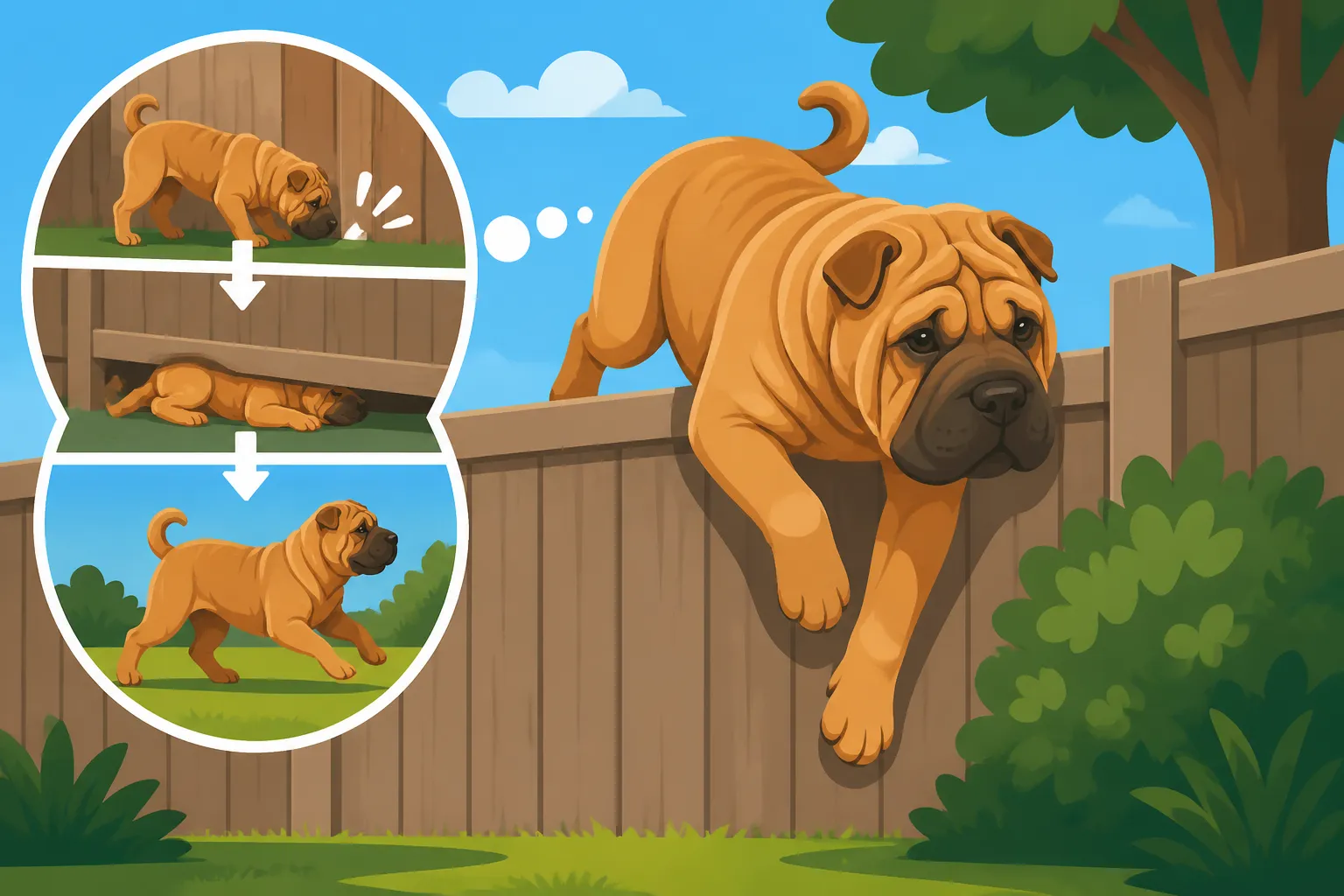
How a Shar Pei Escapes a Yard
Oh, the sheer panic of looking out into your supposedly secure yard only to find… nothing. Just an empty space where your beloved Shar Pei should be, often with a tell-tale hole under the fence or a suspiciously unlatched gate. It’s a gut-wrenching feeling that far too many Shar Pei owners experience, leaving you wondering if your dog is part Houdini. This guide is all about understanding why your Shar Pei might become an escape artist and, more importantly, how to outsmart them to keep them safely in their own domain.
The Shar Pei Mindset: Why They Escape
Understanding why your Shar Pei feels the need to make a break for it is the first step in preventing future escapades. It's rarely about them not loving you or wanting to run away; it's often deeply rooted in their breed characteristics and individual needs.
The Independent Thinker
Shar Pei are notoriously independent. They weren't bred to be constantly looking to their human for direction or to stick close by like some retrieving breeds. Their historical roles as guard dogs, hunters, and farm dogs meant they often had to make decisions on their own, surveying their territory and acting on instinct. This strong sense of self-reliance means that if they see an opportunity or feel a strong pull to investigate something beyond their current boundaries, they're quite likely to follow through. They don't always check in with you before embarking on a solo adventure.
This inherent independence can be both a blessing and a curse. While it makes them incredibly loyal and self-assured companions inside the home, it also means they have a strong internal compass that might point them towards the neighbor's interesting smells or the distant sounds of another dog. They might decide that their current environment isn't providing enough stimulation, or that there's a more interesting "job" to be done just outside the gate. It's not defiance, but rather their nature expressing itself in a way that can be alarming for owners. Remember, their world is full of intriguing scents, sounds, and sights, and their independent spirit often encourages exploration.
Many owners find this aspect of their personality charming until it leads to a missing dog scare. It highlights the importance of truly understanding what a Shar Pei was originally bred to do, which was not to be a docile, always-on-leash companion. Their independence is a feature, not a bug, of the breed, and it needs to be respected and managed with secure boundaries. A Shar Pei Was Bred to Guard, Not to Greet also touches on their inherent traits that drive their actions.
Boredom and Lack of Mental Stimulation
A bored Shar Pei is a destructive Shar Pei, and destructive often includes finding ways out of confinement. These dogs are intelligent, and if they aren't given enough engaging activities, their minds will seek out their own entertainment. This often manifests as chewing, digging, or trying to scale fences. Imagine being stuck in a room with nothing to do; eventually, you'd start looking for a way out, right? Your Shar Pei is no different. A lack of daily walks, interactive toys, or even just quality time with you can quickly lead to an escape attempt.
Mental stimulation is just as crucial as physical exercise for a Shar Pei. Puzzle toys, scent games, and even short, consistent training sessions can burn off a surprising amount of mental energy. If your dog spends long hours alone in the yard with nothing but the grass to look at, the appeal of what lies beyond the fence becomes exponentially greater. This is especially true for younger, more energetic Shar Pei who haven't quite settled into their adult routine yet. They have energy to burn and curiosity to satisfy.
Consider how much time your Shar Pei spends actively engaged versus passively waiting. If the balance is heavily weighted towards waiting, you might be setting the stage for an escape. Integrating more play, training, and exploration into their daily lives can significantly reduce their desire to seek adventure outside the yard. For more on this, you might find What a Bored Shar Pei Does particularly insightful.
The Drive to Patrol and Protect
Another core instinct in the Shar Pei is their strong territorial drive. They were historically guardians of property and family. This means they naturally feel a need to patrol the perimeter of what they perceive as their domain. If that domain feels open or vulnerable, or if they see perceived threats or intruders (like a squirrel, a delivery driver, or another dog walking by), their instinct to investigate or deter can override their training to stay put.
This guarding instinct can be a powerful motivator for escaping. They might feel compelled to "chase off" a perceived threat from the fence line, or to expand their patrol route if they feel their current boundaries are insufficient. It’s not necessarily aggression, but a deep-seated desire to ensure the safety of their home and family. This can be particularly pronounced in situations where they have a clear line of sight to the outside world, making the temptation to "secure" that outer perimeter even stronger.
Understanding this drive is crucial for prevention. It means that simply having a fence isn't enough; the fence needs to be robust, high, and secure enough to contain their patrolling instincts. They need to know that you are in charge of security, and that their job is inside the home, not outside the fence. Providing them with a secure, view-obscured perimeter can sometimes lessen the urge to breach the boundary.
Common Shar Pei Escape Tactics
Once a Shar Pei decides to make a break for it, they often employ a surprisingly clever and persistent array of tactics. They are problem-solvers, and a flimsy fence or an insecure gate latch is just another puzzle for them to crack.
The Diggers
This is perhaps the most classic Shar Pei escape method. Their powerful forelegs and strong prey drive make them excellent diggers. They'll methodically work their way under a fence, especially if they catch a scent on the other side or if the ground is soft from rain. A determined Shar Pei can tunnel out in what seems like minutes, leaving a surprisingly large crater behind. They don't just scratch at the surface; they excavate.
Digging often starts in areas where the fence meets the ground with a gap, or where the soil is easiest to move. They might also gravitate towards spots where they've repeatedly seen or smelled something interesting, turning a casual sniff into a determined digging project over time. It’s their way of extending their sensory exploration, or simply finding a cooler spot in summer, but it quickly becomes an exit strategy. This is a behavior deeply ingrained in many working breeds, and the Shar Pei is no exception.
Preventing digging escapes requires fortifying the fence line. Burying chicken wire or a similar mesh horizontally along the bottom of the fence, extending inward at least a foot, can deter them. Another method is to lay large rocks or concrete pavers along the fence base. For a particularly persistent digger, even a "L-footer" made of wire mesh attached to the bottom of the fence and extending outwards can create a barrier they can't get past. Consider how much yard a Shar Pei uses and where their patrol routes might lead them to dig.
The Jumpers and Climbers
While not always the most athletic dogs, Shar Pei can surprise you with their vertical capabilities when motivated. A standard 4-foot fence might not be enough for a determined jumper, especially if there's something exciting on the other side, or a convenient object nearby to assist them. And forget about chain link fences – their clever paws and thick skin make them surprisingly good climbers, using the mesh as a ladder.
A Shar Pei won't necessarily try to clear a fence in one graceful leap. More often, they'll test the fence, look for weaknesses, and then use any available leverage. This might mean climbing up a stack of firewood, a storage bin, or even a sturdy bush positioned too close to the fence. Their compact, muscular build gives them a low center of gravity that can be surprisingly effective for climbing, and their stoic nature means they might tolerate a little discomfort to achieve their goal.
To combat jumpers, a 6-foot solid fence is often recommended. For climbers, consider "coyote rollers" on top of the fence or angling the top section inwards to make it impossible to get a purchase. Make sure there’s nothing near the fence line that they can use as a launching pad or stepping stone. Even a seemingly innocuous garden planter can be the difference between a secure yard and an open road.
The Houdini of the Gate Latches
This is where the Shar Pei's intelligence truly shines, or perhaps frustrates, its owners. Many standard gate latches are simply not secure enough for a smart dog. Dogs can learn to push, pull, or even mouth a lever-style handle until it gives way. Simple hook-and-eye latches or gravity latches are practically an open invitation for a curious and persistent Shar Pei.
They watch, they learn, and they experiment. If they see you operate a latch enough times, some Shar Pei will absolutely figure out the mechanics. It might start with nudging the gate, realizing it's a weak point, and then progressively working at the latch until they succeed. This isn't just a physical challenge for them; it's a mental one. They observe the cause and effect, and if the effect is "freedom," they'll repeat the cause.
The solution here is multi-layered security. Use heavy-duty, locking gate latches that require a human hand and perhaps two distinct actions to open. Carabiners, padlocks, or double-sided slide bolts (top and bottom) are much more effective. Always check that the gate swings freely and doesn't stick, as a stuck gate can make it easier for them to jostle the latch open. And remember to check all gates, including seldom-used side gates or utility access points, as they often become overlooked weak spots.
Fortifying Your Yard Against a Shar Pei Escape
Now that we understand the 'why' and the 'how,' let's talk about turning your yard into a Shar Pei-proof fortress. It's about combining physical barriers with mental engagement.
Securing the Perimeter: Fences and Barriers
Your fence is the frontline defense against escape. A basic picket fence or chain link might be fine for some breeds, but for a Shar Pei, you generally need something more robust. Aim for a solid fence, at least 6 feet high, that your dog cannot see through. This helps reduce the visual stimuli that might trigger their patrol instincts or prey drive, lessening their motivation to get to the other side. The Yard a Shar Pei Needs is a great resource here.
Beyond height, focus on the base of the fence. As noted with the diggers, burying a footer (chicken wire, hardware cloth, or a concrete curb) 12-18 inches deep and curving inwards is highly effective. You can also pour a concrete runner along the entire fence line. For chain link, consider adding privacy slats to reduce visibility and attach the fence more securely to the ground with additional rebar or heavy-duty stakes. Regularly inspect your fence for loose boards, weakened posts, or new gaps, especially after storms or changes in ground moisture.
Don't forget about your gates. They are often the weakest point. Install double latches, preferably ones that require lifting and pulling, or even a bolt lock. Position gates to open inwards, making them harder to push open. Consider adding a self-closing spring and a "dog-proof" secondary latch, even if you typically use the main one. Regular maintenance is key – a loose hinge or a warped gate can quickly become an escape route. On Amazon, you can find a huge variety of robust gate latches and reinforcing materials.
Mental and Physical Enrichment
A tired Shar Pei is a good Shar Pei, and a mentally stimulated Shar Pei is even better. Don't underestimate the power of regular exercise and engaging activities to curb escape attempts. An hour a day of walking, sniffing, and exploring in a safe environment is a great baseline. This allows them to expend physical energy and satisfy their natural curiosity in a controlled way. An Hour a Day Suits a Shar Pei, and Heat Cuts It Short is a must-read for managing their exercise needs.
Beyond physical walks, integrate mental enrichment. This could be daily training sessions, even short 10-minute bursts, working on obedience cues or teaching new tricks. Puzzle toys that dispense treats, snuffle mats for scent work, or even just rotating their toy selection can keep their minds engaged when you can't actively supervise. Interactive feeders, available on Amazon, can also turn mealtime into a stimulating activity rather than a quick gobble. If they're busy solving a puzzle, they're less likely to be plotting an escape.
Consider structured playtime in the yard with you. Playing fetch, hide-and-seek, or even just working on recall in a secure space reinforces your bond and their connection to their "home" territory. If your Shar Pei spends a lot of time alone, think about how to make that time more fulfilling. Chews, long-lasting treats, or even background noise like a radio can help prevent boredom from creeping in and sparking an escape plan.
Training for Recall and Boundary Awareness
Even with the most secure yard, a strong recall is your ultimate backup plan. If, despite your best efforts, your Shar Pei does manage to get out, a reliable "come" command can be the difference between a brief scare and a tragic loss. Start practicing recall in a low-distraction environment and gradually increase the challenges. Use high-value treats and praise to make coming to you the most rewarding choice.
Boundary training, while challenging for an independent breed like the Shar Pei, can also be beneficial. This involves teaching your dog the invisible boundaries within your yard, even if there's a physical fence. Techniques like "place" commands, where they learn to stay in a designated spot, can be useful. Some owners even explore invisible fence systems as a secondary layer of deterrent, though these should never be relied upon as the sole barrier for a Shar Pei, given their pain tolerance and determination.
Online training platforms, such as those offered by BAXTER & Bella, often have modules on recall and boundary training that can be incredibly helpful for a breed like the Shar Pei. Their methods focus on positive reinforcement and building a strong relationship, which is essential for working with independent dogs. Consistent, patient training from puppyhood sets the foundation for a well-behaved adult, reducing the likelihood they'll feel the need to roam. Remember, The Headstrong Streak Nobody Trains Out of a Shar Pei means consistency is key, and harsh methods will only make them more resistant.
When Your Shar Pei Does Get Out: What to Do
The best defense is a good offense, but sometimes, despite all your precautions, your Shar Pei might still manage an escape. Having a plan in place can significantly reduce the stress and increase the chances of a swift, safe reunion.
Immediate Action Steps
If you discover your Shar Pei is missing, act quickly but calmly. First, do a thorough sweep of your property and immediate vicinity. They often don't go far, especially if startled. Call their name loudly and clearly, using the same tone you would for recall. Have high-value treats or a favorite squeaky toy on hand. Many Shar Pei, despite their independence, will respond to the sound of your voice or the promise of a delicious snack.
Next, alert your immediate neighbors. Provide them with a clear photo of your dog and any distinguishing features. Check with local shelters, animal control, and veterinary clinics in your area immediately. Many lost dogs are found and brought to these places within hours. Post on local social media groups (Facebook, Nextdoor, etc.) with a clear photo, last known location, and your contact information. The power of community can be immense in these situations.
Avoid chasing your Shar Pei if you spot them in the distance. This can often make them bolt further away, perceiving it as a game or feeling threatened. Instead, try to entice them to come to you by calling their name, kneeling down, and sounding excited and happy, rather than panicked. If you have another dog they are bonded with, sometimes bringing that dog along can help lure them back.
Microchipping and ID Tags
This is non-negotiable for any dog owner, but especially for Shar Pei given their escape artist tendencies. A microchip is a permanent form of identification that can be scanned by any vet or shelter, linking your dog back to your contact information. Make sure your microchip registration is always up-to-date with your current phone number and address. It's easy to forget to update this information after a move or a new phone.
In addition to a microchip, your Shar Pei should always wear a collar with current ID tags. This includes a tag with their name and your phone number. Some owners also add a tag with a microchip number or a "reward if found" message. While a collar can slip off, it's often the first thing a good Samaritan will look for if they find a lost dog. It's immediate identification, often preventing a trip to the shelter altogether.
These measures are often the quickest way to get your beloved Shar Pei back home. Imagine someone finding your dog: an ID tag means they can call you right away. A microchip means even if the collar is lost, your dog still has a way to be identified. Don't rely on just one method; layer your security with both. Having clear, visible identification dramatically increases the chances of a happy reunion, turning a potential disaster into a manageable situation.
Disclaimer
This article is for general informational purposes only and does not constitute professional advice. Laws, prices and regulations vary by location and change over time. Consult a qualified professional for guidance on your specific situation.


