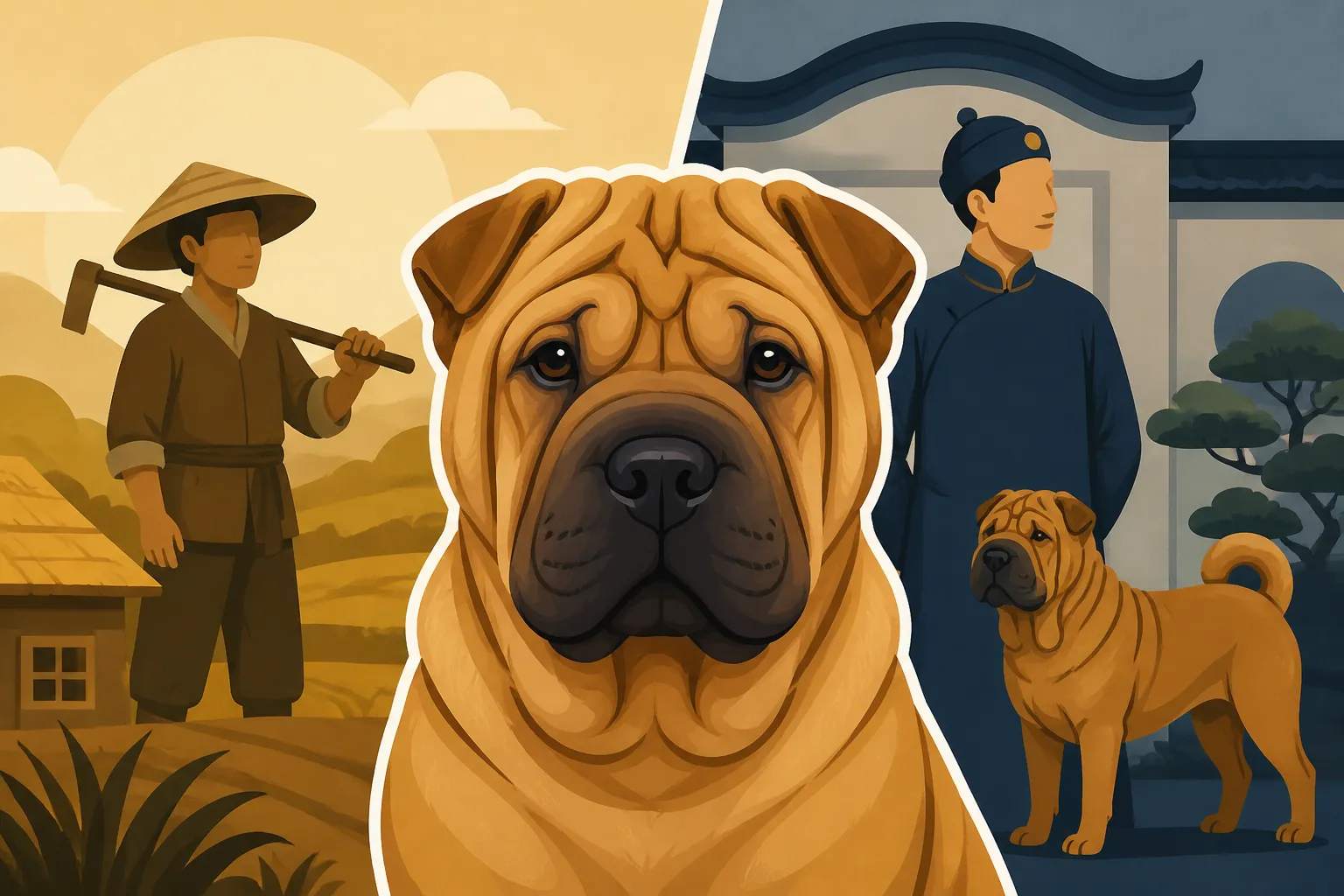
Whether the Shar Pei Was a Peasant’s Dog
The Shar Pei is often described as a Chinese farm dog, but “peasant’s dog” can sound more precise than the evidence allows. This guide explains what that label means, what working roles the breed may have filled in rural China, and why its history is best understood as practical and locally rooted rather than neatly documented.
What “peasant’s dog” means in the Shar Pei’s history
A useful description, not a formal breed category
Calling the Shar Pei a peasant’s dog generally means it was kept by ordinary rural households rather than developed exclusively as a palace, aristocratic, or specialist sporting dog. In that broad sense, the description fits the picture often associated with the breed: a hardy, useful dog living close to people and working around homes, farms, and villages in southern China.
But “peasant’s dog” was not a formal job title or a carefully recorded breed classification. Historical accounts of everyday dogs are often incomplete, and the surviving descriptions do not give us a tidy record of every role the Shar Pei performed. It is more accurate to think of the label as shorthand for a working, locally kept dog than as proof that every Shar Pei had one specific task.
That distinction matters because breed histories can become overconfident. A modern description might say the Shar Pei was “the farmer’s guard dog” or “the village hunting dog,” as if all dogs in the breed lived and worked the same way. Rural life varied from household to household. A dog might help guard a home, accompany a person outdoors, or simply be a useful companion around a farmstead.
Where the traditional Shar Pei is associated
The Shar Pei is commonly associated with southern China, particularly Guangdong province and the area around Dali. That regional connection helps explain why accounts of the breed often describe practical work suited to village and farm life. The climate, landscape, and everyday demands of a household shaped what people needed from their dogs.
The breed’s name is commonly translated as “sand skin,” referring to its rough coat. That name points to a distinctive physical feature, but it does not tell us exactly what the dog did for a living. For a broader look at the name and its interpretation, see What Shar Pei Means in Chinese. For the larger question of how far back the breed’s history can be traced, Whether the Shar Pei Is an Ancient Breed is useful context.
It is also worth separating a breed’s traditional regional roots from the modern image many people recognize. The heavily wrinkled Shar Pei familiar from photographs and advertisements reflects later breeding choices and changing breed fashions. The history of those changes is explored in Whether Western Breeders Made the Shar Pei Wrinklier. A dog’s modern appearance should not be treated as a perfect record of what every rural Chinese Shar Pei looked like.
What work a rural Shar Pei may have done
Guarding homes and property
Guarding is one of the most plausible and frequently described roles for the Shar Pei. A household dog did not need to be trained as a specialized security animal to be useful. Its presence, awareness of unfamiliar people, and willingness to alert its family could help protect a home, yard, or livestock area.
That kind of guarding often looks less dramatic than popular stories suggest. A dog might bark when someone approached, remain watchful around the household, or be wary of strangers. Those traits can be valuable in a rural setting, where homes may be spread apart and a dog’s alertness can help a family notice activity nearby. They do not automatically mean the dog was expected to attack intruders.
The breed’s reputation for independence and reserve is sometimes connected to this working background. A dog expected to assess its surroundings may not greet every unfamiliar person with enthusiasm. Still, temperament is shaped by breeding, socialization, individual experience, and the home environment—not history alone. Modern owners can learn more about the breed’s relationship with visitors in Why a Shar Pei Is Aloof With Strangers.
Hunting, herding, and general farm work
The Shar Pei is also described in historical accounts as a hunting or farm dog. Hunting may have involved helping people locate or pursue game, while general farm work could include moving around livestock or staying alert near the property. The available picture is broad: the breed may have served as an adaptable household worker rather than a narrowly specialized dog.
It is important not to turn “may have helped with herding” into a certainty that every Shar Pei was a dedicated livestock herder. Likewise, a hunting role does not mean the breed was a modern gundog trained for a particular style of field work. Rural dogs were often expected to be useful in several ways, and their duties could change with the needs of the household. For more on those possible roles, see What the Shar Pei Was Used for in China, Whether the Shar Pei Hunted, and Whether the Shar Pei Herded.
| Common historical description | What it may mean in practice | What it does not prove |
|---|---|---|
| Farm or village dog | Lived around a household and may have had several useful duties | That every dog had the same job |
| Guard dog | Alerted to unfamiliar people or activity and stayed watchful | That it was trained to attack |
| Hunting dog | May have accompanied people or helped with hunting tasks | That it belonged to a specialized modern hunting line |
| Herding or livestock dog | May have helped around animals or farm property | That herding was its sole or universal role |
| Peasant’s dog | A practical dog associated with ordinary rural life | A formal historical breed category |
The fighting-dog story needs care
Some descriptions of the Shar Pei’s past include dog fighting. That claim is often repeated alongside accounts of the breed’s loose skin and supposed ability to turn within an opponent’s grip. These stories are not always presented with clear evidence, and they can make a complex rural history sound more certain—and more sensational—than it is.
A dog’s body shape cannot, on its own, establish the work it was bred to do. Loose skin may have practical interpretations, but it does not prove that fighting was the breed’s primary purpose. The historical record is not strong enough to confidently reduce the Shar Pei to a fighting dog, or to assume that every traditional Shar Pei was used that way. For a closer look at this debate, read Whether the Shar Pei Was a Pit Dog and Whether the Shar Pei's Skin Helped It Fight.
It is also helpful to distinguish an old working role from a modern dog’s behavior. A Shar Pei living in a family home today is not automatically dangerous because of stories about its past. Individual behavior depends on many factors, including early experiences, health, training, and the way people manage introductions to other dogs.
How its working background relates to the modern Shar Pei
A working history does not dictate a dog’s personality
People sometimes hear that the Shar Pei was a farm or guard dog and assume it will naturally know how to protect a home—or that it will be unfriendly to everyone outside the family. Neither assumption is reliable. A breed’s history can offer clues about tendencies, but it cannot predict exactly how an individual dog will behave.
A Shar Pei may be reserved with strangers, strongly attached to its household, or more interested in observing than greeting. Another may be sociable and relaxed in familiar situations. Thoughtful early socialization, gentle handling, and consistent training all matter. So does learning to read the dog’s signals rather than expecting it to behave like a universally outgoing companion.
Practical routines help more than romantic ideas about the breed’s past. Short, positive introductions and reward-based training can teach a dog what to expect when visitors arrive. If a family is preparing for a Shar Pei puppy, When a Shar Pei Puppy Should Meet New People offers a useful next step. The goal is not to erase a dog’s character; it is to help it feel safe and make good choices in modern settings.
Traditional usefulness is not the same as low-maintenance care
A rural working dog may have had a practical role, but that does not mean the modern Shar Pei is maintenance-free. Today’s owners need to pay attention to skin, ears, eyes, exercise, and heat. The amount of care required varies by individual, and a dog’s wrinkles or coat type do not tell the whole story about its health.
For example, a Shar Pei can develop skin irritation where moisture and debris collect, and its narrow ear canals may make ear problems harder to manage. Owners should watch for persistent itching, odor, redness, discharge, or changes in comfort and ask a veterinarian about concerning symptoms. The Shar Pei Ear You Cannot Reach Into and Every Fold on a Shar Pei Is a Place Something Grows explain why routine observation is useful.
Basic supplies can make care easier, but they should not replace veterinary guidance. A soft brush, a well-fitted harness, washable bedding, and gentle cleaning products may be part of an owner’s routine; retailers such as Chewy carry many everyday pet-care items. The right choice depends on the dog’s coat, skin, and comfort, so avoid assuming that a product is suitable just because it is marketed for dogs.
Why modern owners should avoid buying into a simple origin story
A neat origin story is appealing: one breed, one region, one job, one explanation for every trait. But the Shar Pei’s history is better understood as a combination of regional roots, practical household roles, changing breeding, and gaps in historical documentation. “Peasant’s dog” can be a helpful way to picture a working village companion, as long as it is not treated as a definitive label.
This caution also matters when choosing a dog. A breeder’s description of a puppy as “traditional,” “rare,” or “born to guard” does not tell you enough about its health, temperament, or likely needs. Ask about the parents’ behavior, health history, early handling, and the support available after the puppy goes home. The broader questions in Whether the Shar Pei Is Bred for Health Now can help put claims about modern breeding into perspective.
If you already live with a Shar Pei, you do not need to recreate a historical farm routine to meet its needs. Provide suitable exercise, mental engagement, a comfortable home, careful introductions, and consistent health care. For everyday coat and skin routines, a retailer such as Chewy may be one place to find basic supplies, but a veterinarian should guide decisions about medicated products or persistent skin problems.
How to understand the “peasant’s dog” label today
A practical summary of what is known
The label is most useful when it describes the Shar Pei as a dog associated with ordinary rural life, rather than as a breed created solely for display or a single specialized sport. The breed is linked to southern China and is commonly described as having worked around homes and farms. Guarding is a recurring part of that picture, while hunting and livestock-related work are also discussed.
The limits are just as important. The historical evidence does not support a single, universal job description for every Shar Pei. Nor does the label prove that the breed was primarily a fighting dog, that all Shar Pei had identical temperaments, or that today’s dogs will behave in a particular way. When a source presents one dramatic explanation as settled fact, it is sensible to look for careful wording and supporting context.
Modern ownership brings its own practical concerns. If you are assembling a care kit, Chewy and other pet retailers can be convenient places to browse routine items, while your veterinarian can help determine what is appropriate for your dog. That combination—ordinary household preparation and individualized professional advice—is more useful than trying to judge a modern Shar Pei solely by a simplified account of its past.
The clearest answer
Was the Shar Pei a peasant’s dog? In a broad, everyday sense, it is reasonable to describe the breed as a practical rural dog associated with ordinary households in southern China. The phrase captures a likely social setting and working context, but it should not be mistaken for a precise historical classification.
A careful account leaves room for uncertainty: Shar Pei may have guarded homes, accompanied people in hunting, and helped around farms, but roles likely varied. Their past can inform how we think about the breed, yet it does not define the needs or character of every dog living with a family now. For a fuller picture, compare the rural-working account with What the Shar Pei Was Used for in China and the breed’s modern care considerations in The Shar Pei Against the Other Wrinkled Breeds.
Disclaimer
This article is for general informational purposes only and does not constitute professional advice. Laws, prices and regulations vary by location and change over time. Consult a qualified professional for guidance on your specific situation.