Whether the Two Types Are Bred Together
A bone-mouth Shar Pei and a meat-mouth Shar Pei can be bred together because these labels describe different looks within the breed, not two separate breeds. But a pairing does not guarantee a particular muzzle, wrinkle pattern, or health outcome. Here’s what the terms mean, what mixed-type litters may look like, and what to ask a breeder before choosing a puppy.
What bone mouth and meat mouth mean
The terms describe appearance, not separate breeds
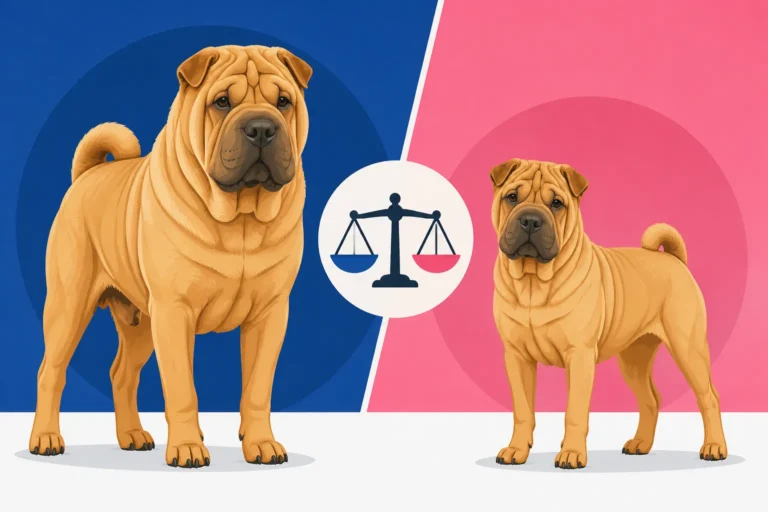
“Bone mouth” and “meat mouth” are informal terms used to describe variations in Shar Pei appearance. A bone-mouth dog is generally described as having a less padded muzzle and a more traditional, less exaggerated outline. A meat-mouth dog usually has fuller tissue around the muzzle, giving the face a broader, more padded look. The labels can be useful shorthand, but they are not precise measurements, and people may use them differently.
These terms don’t mean that one dog is a purebred Shar Pei and the other is not. Nor do they mean that the dogs belong to separate breeds with a formal reproductive barrier between them. The Shar Pei is the breed; bone mouth and meat mouth refer to types or styles within it. For a closer look at the distinction, see What a Bone Mouth Shar Pei Is and What a Meat Mouth Shar Pei Is.
It’s also worth remembering that a dog’s overall appearance comes from more than one feature. A less padded muzzle doesn’t necessarily mean a dog has a leaner body, fewer wrinkles everywhere, or a particular temperament. Individual dogs can sit between the commonly described types, and even littermates can look noticeably different.
Why the labels can be confusing
The terms are not a universal classification system with an agreed-upon checklist. One breeder may call a dog bone mouth because its muzzle is less padded than that of other dogs in their line; another may reserve the term for a more specific traditional look. Photos, pedigree descriptions, and sales listings can therefore use the labels inconsistently.
The type names also shouldn’t be confused with official breed recognition. Breed standards describe the expected Shar Pei, but they do not necessarily treat bone mouth and meat mouth as two separate varieties. For example, a standard’s description of the muzzle may help explain why a breeder uses one label, but it doesn’t make that label a separate breed category. Which Type the AKC Standard Describes provides more context on how a breed standard relates to these descriptions.
When comparing dogs, look beyond the label. Ask what the breeder means by “bone mouth” or “meat mouth,” and ask whether they can show you the parent dogs and explain the traits they expect to see in the litter. A clear, specific answer is more helpful than a type name by itself.
Can bone-mouth and meat-mouth Shar Pei be bred together
Yes, breeders can pair dogs of different types
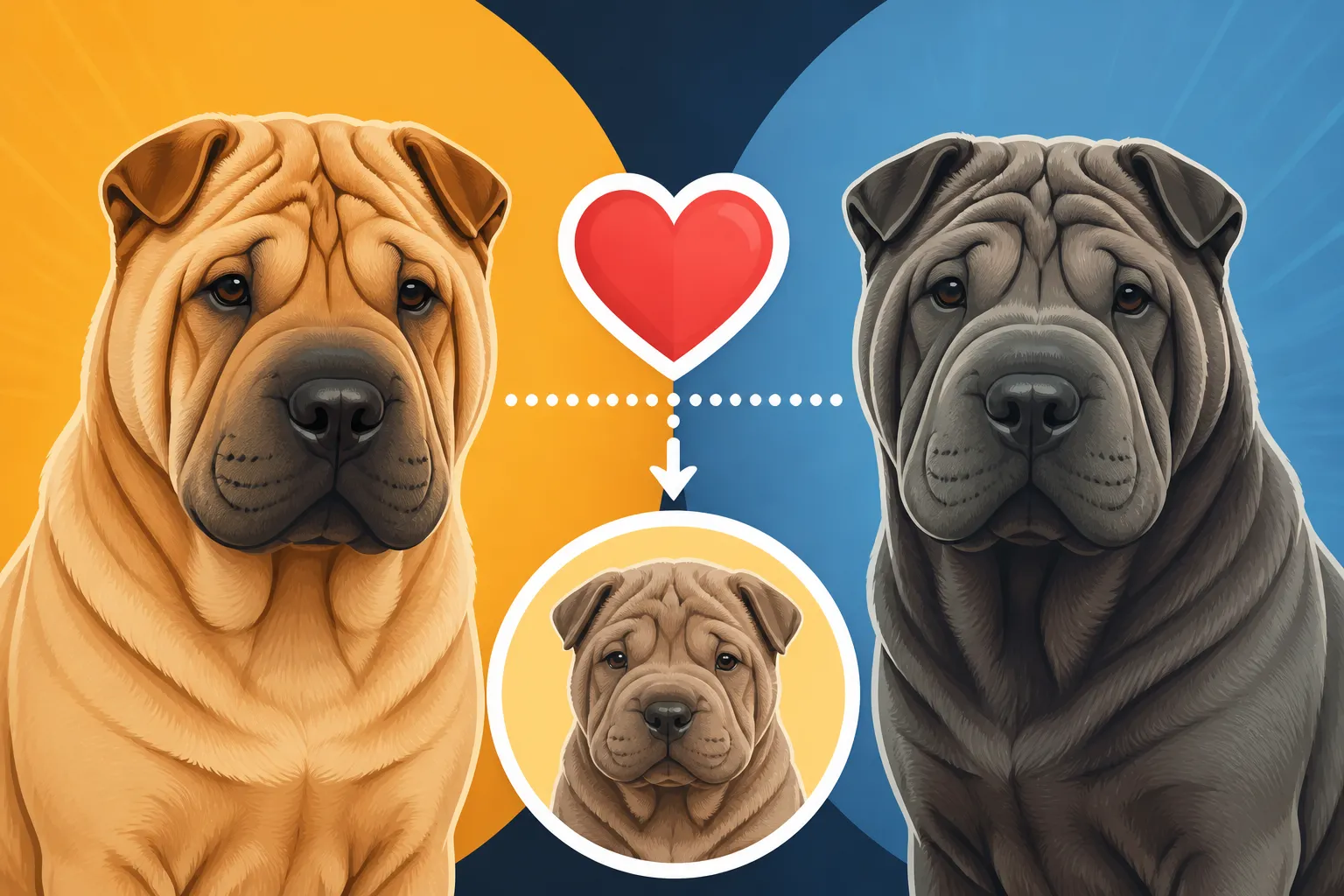
A bone-mouth Shar Pei can be paired with a meat-mouth Shar Pei. Since the labels describe appearance rather than separate breeds, a breeder who has two suitable dogs may choose a cross-type pairing. This is sometimes done to bring together different physical characteristics or to support a particular breeding goal.
However, a pairing doesn’t work like mixing two fixed ingredients. Puppies inherit many traits from both parents and from earlier generations in their pedigrees. A litter may include puppies whose faces resemble one parent more strongly, puppies with intermediate features, and puppies that don’t fit neatly into either label. Coat, build, skin, and degree of facial padding can vary as well.
That’s why “bone mouth crossed with meat mouth” isn’t a reliable promise of a specific-looking puppy. A breeder may have a reasonable expectation based on the family lines, but they can’t guarantee that every puppy will have a particular muzzle or amount of wrinkling. The same caution applies to claims about what the breed looked like historically; Whether the Bone Mouth Is the Original Shar Pei explores why the history is not always as straightforward as the labels suggest.
A cross between types is not the same as a cross between breeds
The word “cross” can create confusion. Pairing a bone-mouth Shar Pei with a meat-mouth Shar Pei is not necessarily a crossbreed mating. If both dogs are Shar Pei, the pairing is within the breed, even if they have different appearances or come from lines described by different type labels.
That distinction matters when reading a litter advertisement or talking with a breeder. Ask whether both parents are Shar Pei and what their registered breed and pedigree information show. Then ask what the breeder means by the type descriptions. A label on its own does not tell you the dogs’ ancestry, the quality of the pairing, or whether the breeder has made thoughtful health decisions.
A useful way to compare the terms is to separate the appearance claim from what it can actually tell you:
| Claim or description | What it may tell you | What it does not establish |
|---|---|---|
| “Bone mouth” | The breeder sees a less padded muzzle or a more traditional-looking outline | That the dog is a separate breed or is automatically healthier |
| “Meat mouth” | The breeder sees a fuller, more padded muzzle | That the dog will pass the same features to every puppy |
| “Bone-mouth and meat-mouth pairing” | The parents are described as having different types | That puppies will be evenly split between those looks |
| “Traditional type” | The breeder is describing a preferred look or line | A guaranteed history, health profile, or temperament |
| “Type bred for health” | The breeder says health is a goal | That health testing, records, and sound breeding decisions have been completed |
What a mixed-type litter may look like
Puppies can fall between the two descriptions
When parents have noticeably different muzzles, a litter may show a range of facial shapes. Some puppies may have a more padded muzzle, some may have less, and others may look intermediate. The amount and placement of loose skin can differ too. Even when a breeder has produced similar pairings before, each litter is its own combination of inherited traits.
The labels don’t predict every other physical feature. A bone-mouth parent does not guarantee that puppies will have fewer wrinkles across the body, and a meat-mouth parent does not guarantee that every puppy will have a heavily padded face. Appearance is influenced by multiple inherited factors, so one visible trait cannot stand in for the whole dog.
If you’re choosing a puppy because you prefer a certain look, ask to see adult relatives as well as the parents. Puppy features change as a Shar Pei grows, and a young dog’s loose skin may not be a reliable guide to its adult appearance. The question Whether a Shar Pei Puppy's Tongue Is Blue at Birth is one example of how puppy appearance can change or be misunderstood; for wrinkles specifically, Whether Breeders Are Reducing Shar Pei Wrinkles discusses the broader conversation about selecting for less exaggerated features.
Looks are not a shortcut to predicting health
It’s understandable to wonder whether a less padded muzzle or fewer wrinkles means a healthier dog. But a type label is not a health test, and a visible feature cannot tell you everything about a dog’s inherited risks. Health depends on many factors, including the parents’ health, family history, the breeder’s choices, and the puppy’s care over time.
Wrinkle level is also not a simple stand-in for genetic risk. Shar Pei fever and SPAID-related concerns involve more than the amount of loose skin you can see on a particular puppy. Claims that bone-mouth dogs are automatically free of those risks, or that meat-mouth dogs are inevitably unhealthy, oversimplify a complex issue. For a more careful discussion, see Whether a Bone Mouth Shar Pei Is Healthier and How Copy Number Changes a Shar Pei's Risk.
A responsible breeder should be willing to discuss health concerns in the family lines without using appearance as proof that a puppy is safe. Ask what conditions have occurred among close relatives, how the breeder evaluates the parents, and what veterinary records they can share. If a breeder presents one type as a guaranteed health fix, ask for a clear explanation of the evidence behind that claim.
How to assess a breeder’s pairing
Ask about the actual parents and their family histories
Start with the dogs in front of you. Ask the breeder to describe each parent’s appearance in ordinary, specific terms: muzzle shape, skin and wrinkle distribution, overall build, and any features they are trying to retain or moderate. That makes it easier to understand what “bone mouth” or “meat mouth” means in that particular kennel.
Then ask about health and temperament across the family, not just the parents. A breeder may know about the parents’ medical histories but should also be prepared to talk about close relatives where information is available. No breeder can promise that a puppy will never develop a health problem, but openness about known issues gives you a more useful picture than a broad statement such as “our line is healthy.”
You can also ask why the breeder chose this particular pair. A thoughtful answer might explain how the dogs complement each other, what traits the breeder hopes to preserve, and what risks they considered. Be cautious if the explanation focuses only on producing a rare look, unusually heavy wrinkles, or a guaranteed type without discussing health and temperament.
Questions worth asking before reserving a puppy
A straightforward conversation can help you separate a considered breeding program from a sales pitch. You don’t need to know every technical detail before speaking with a breeder. You do deserve clear answers about the parents, the litter, and the limits of what appearance labels can promise.
Consider asking:
- What do you mean by bone mouth and meat mouth when describing these two parents?
- What traits do you expect puppies from this pairing might inherit, and which traits can’t you predict?
- Can I meet the mother and see records or information about the father?
- What health conditions have appeared in the parents’ close relatives?
- What veterinary evaluations or health screening have been completed for the parents?
- How do you assess temperament, and what do you know about the parents’ behavior?
- What care or veterinary follow-up might a puppy need as it grows?
- Will you share the puppy’s veterinary records and explain what support you offer after placement?
Look for answers that are specific without pretending to offer certainty. A responsible breeder may say that puppies could vary, that a particular trait is hard to predict, or that a health concern needs discussion with a veterinarian. That kind of honesty is more reassuring than a promise that every puppy will have a certain look or avoid every breed-related issue.
Finally, consider whether the breeder’s goals make sense for the dog’s long-term welfare. Breeding two types together can be a normal within-breed pairing, but the label alone does not make it a good one. The dogs’ health, temperament, and family histories matter more than whether the puppies can be marketed as bone mouth, meat mouth, or a blend of the two.
What the two-type pairing means for a puppy buyer
If you’re drawn to a Shar Pei because of a particular face or outline, it’s fine to have preferences. Just treat type as one part of the conversation, not as a guarantee. Ask to meet adult dogs from the breeder’s lines, learn how their appearance developed, and be prepared for the puppy to grow into a look that is not an exact copy of either parent.
If you’re more concerned about health, focus your questions there rather than relying on a label. Ask about the breeder’s health practices, the family’s medical history, and how the breeder will help you make informed choices as the dog grows. A less exaggerated appearance may be a reasonable breeding goal, but it doesn’t erase the need to evaluate each dog and family line individually.
The practical answer is simple: bone-mouth and meat-mouth Shar Pei can be bred together, and their puppies may show a range of features. These are descriptive types within the breed, not separate breeds. The quality of the pairing depends on the dogs and the breeder’s decisions—not on the label alone.
Disclaimer
This article is for general informational purposes only and does not constitute professional advice. Laws, prices and regulations vary by location and change over time. Consult a qualified professional for guidance on your specific situation.