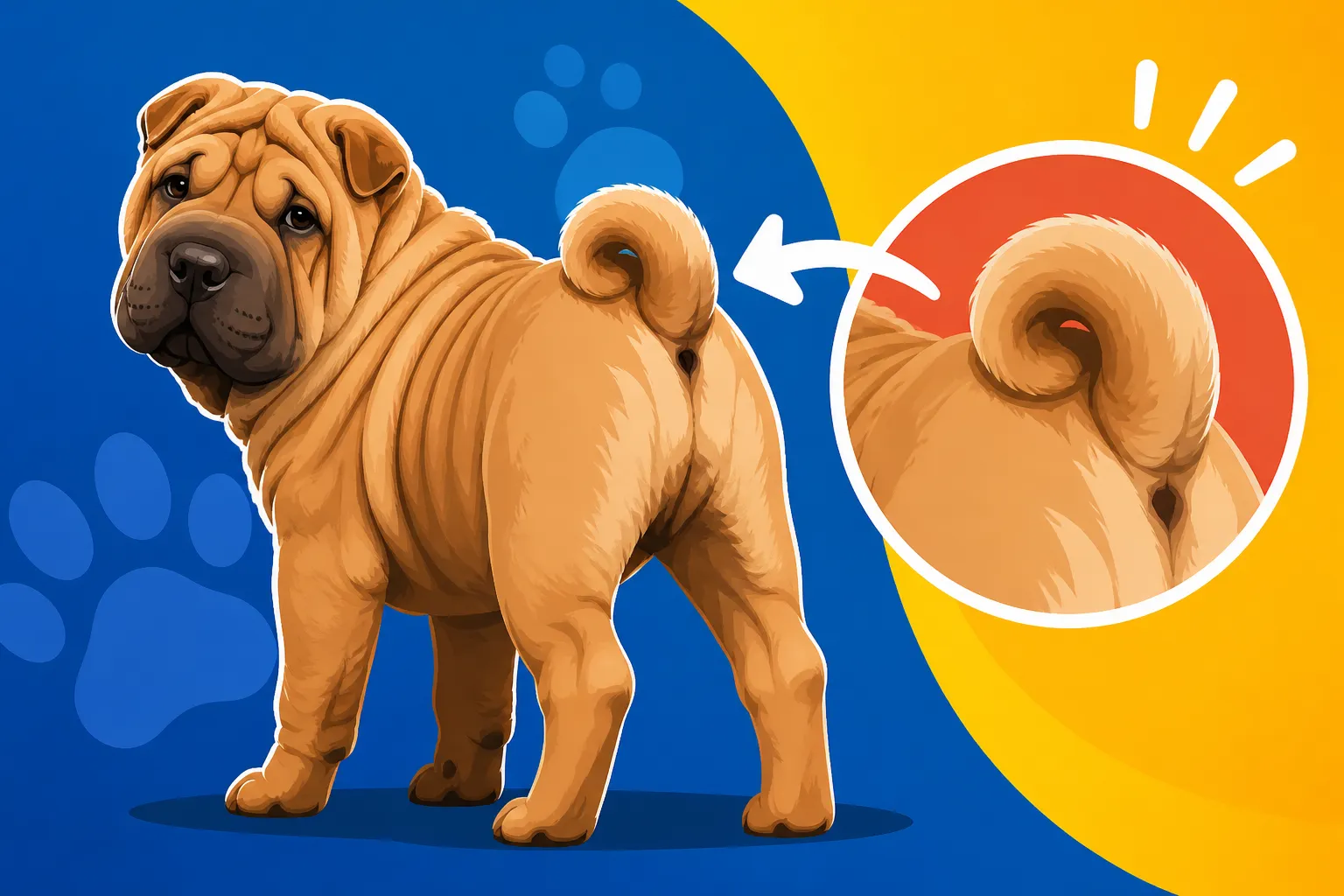
Whether the Shar Pei’s Tail Curls for a Reason
A Shar Pei’s curled tail is part of its natural shape, not a sign that it is trying to communicate one particular mood. The curl comes from the tail’s structure and inherited breed traits, while the tail still helps the dog balance and express itself. This guide explains why the shape is common, what normal tail carriage can look like, and when a change deserves attention.
Why a Shar Pei's Tail Curls
The curl is a natural breed trait
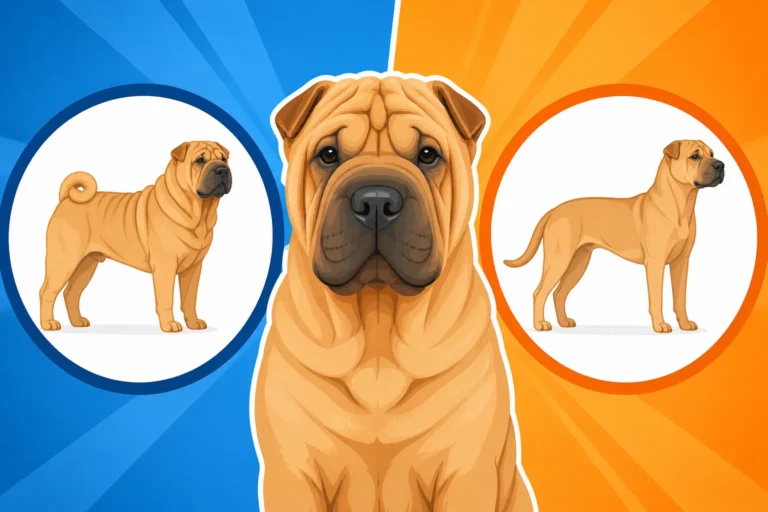
Shar Pei tails are usually thick at the base and taper toward the tip. Many curve upward over the back or fall to one side, but the exact shape varies from dog to dog. One Shar Pei may have a loose, sweeping curve; another may carry its tail in a tighter curl. Neither shape, on its own, tells you whether the dog is healthy or happy.
The tail’s position is related to its underlying structure and inherited traits. It is not a posture a dog consciously holds to create a certain impression. A Shar Pei may raise, lower, or move its tail, but its resting curve is largely a matter of anatomy.
People sometimes assume a curled tail must have evolved for a single practical purpose. There is no clear reason to treat the Shar Pei’s particular curl as a specialized tool for a specific job. Like many breed features, it is better understood as a characteristic shape that has been passed down, rather than as proof of one definitive historical function.
For a broader look at the breed’s background, see What a Shar Pei Was Used for in China and Whether the Shar Pei Is an Ancient Breed. The history of a breed can provide context, but it does not always give us a simple explanation for every physical feature.
Tail shape and tail carriage are not the same thing
A tail’s shape is its natural curve and structure. Carriage is how the dog holds it at a particular moment. A Shar Pei’s tail can retain its usual curl while being held higher during alertness or lowered when the dog is relaxed, uncertain, or uncomfortable.
That distinction matters because people often try to read a dog’s mood from the curl alone. A curled tail is not a permanent “I’m confident” signal, any more than a straight tail automatically means a dog is upset. Look at the whole dog: posture, facial tension, movement, ears, approach or avoidance, and what is happening around them.
A dog lying quietly at home might have a loose tail position, while the same dog lifts it when someone approaches the door. That moment-to-moment change is different from the tail’s underlying curve. If you are learning to read your dog’s body language, How a Shar Pei Uses Its Tail offers a useful related discussion.
Does the curl help with balance or communication?
A dog’s tail can contribute to balance during movement and can provide social signals to people and other dogs. Those functions apply broadly to dogs; they do not prove that the Shar Pei’s distinctive curl developed specifically for balance or communication. The shape and the tail’s everyday use are related, but they are not interchangeable explanations.
Tail movement can add context to a dog’s behavior. A relaxed, loose wag is different from a rigid, high-held tail with a stiff body. Yet a Shar Pei’s curl can make the tail look prominent even when the dog is simply standing still. That is one reason not to treat a curled tail as a complete mood report.
If you are comparing tail shapes across breeds, The Shar Pei Against the Other Wrinkled Breeds can help put the breed’s appearance in perspective. For practical purposes, it is more useful to learn what is normal for your individual dog than to expect every Shar Pei to carry its tail in exactly the same way.
What a Normal Shar Pei Tail Looks Like
Expect variation between individual dogs
There is no single curl that every healthy Shar Pei must have. The tail may sit over the back, curve to one side, form a looser loop, or appear less tightly curled. Age, posture, excitement, and the individual dog’s anatomy can all affect how it looks at a glance.
Breed descriptions generally value a high-set tail that curves or curls, but a standard describes a desired breed appearance, not a medical test. A tail that looks different from a show photograph does not automatically mean something is wrong. Nor does a particularly tight curl prove that a dog is healthier, more typical, or better bred.
| What you notice | What it may mean | What to do |
|---|---|---|
| A familiar curve that stays consistent | Likely your dog’s normal tail structure | Observe it during relaxed and active moments |
| Tail held lower temporarily | Could reflect rest, uncertainty, or discomfort | Check the whole body and the situation |
| Tail suddenly droops or becomes stiff | Possible pain or injury, especially if new | Contact your veterinarian for guidance |
| Swelling, a wound, heat, or pain at the tail base | May indicate an injury or skin problem | Arrange veterinary care |
| Trouble wagging along with weakness or difficulty walking | Could involve more than the tail | Seek prompt veterinary assessment |
A useful baseline is to watch your dog when they are calm, walking, greeting a familiar person, and resting. Note what the tail usually does in those situations. A short phone video can help you compare later, especially if you notice a change but are unsure whether it is new.
If you are choosing a harness, collar, or bedding, the tail curl usually does not require special equipment. A well-fitting harness should be selected for the dog’s chest and body, not for the tail’s shape. Chewy can be one place to look at general dog-care supplies, but check measurements and product guidance carefully rather than relying on a breed label alone.
Tail carriage can shift with mood and activity
A Shar Pei may raise its tail when alert, lower it when resting, or move it when greeting someone. These changes are normal if they fit the dog’s usual behavior and are not accompanied by signs of distress. Look for combinations of signals: a loose body and easy movement differ from a rigid stance, pinned ears, or attempts to move away.
Because Shar Pei facial folds can make expressions harder for some people to interpret, it is especially helpful to observe the whole body. How a Shar Pei's Wrinkles Hide Its Expression discusses that challenge. The tail is one clue, not a verdict about what the dog feels.
A tail that is carried lower for a brief period after a long nap may not be cause for alarm if the dog is otherwise moving comfortably and acting normally. A tail that suddenly hangs limp, stays clamped down, or causes the dog to react when touched is a different situation. The change from your dog’s normal pattern is often more informative than the exact angle.
Why the breed standard is not a health checklist
A breed standard describes appearance and proportions expected in the show ring. It can help explain why people associate Shar Peis with curled tails, but it cannot tell you whether a particular dog is comfortable. A dog can have a textbook-looking curl and still develop an injury, while a dog with a looser curve can be perfectly well.
This distinction is useful when evaluating puppies, adult dogs, or online photographs. One dramatic pose can make a tail look tighter or higher than it usually is. Ask what the dog’s tail looks like when relaxed, and consider the entire dog’s health and behavior rather than placing too much weight on a single feature.
For related context on how standards shape the breed’s appearance, see Whether a Shar Pei's Tail Must Curl Over Its Back and Whether the Shar Pei Standard Should Change. Both topics help separate a preferred look from the practical needs of an individual dog.
When a Tail Change Needs Attention
Know the signs of pain or injury
A curled tail should not suddenly become painful or immobile without a reason. Contact a veterinarian if your Shar Pei’s tail has abruptly dropped, appears swollen, looks injured, or is held rigidly in a way that is unusual for that dog. Also watch for yelping, flinching, persistent licking, reluctance to sit, or guarding the tail area.
Tail discomfort can follow rough play, a fall, a collision, or an accidental pull. Sometimes the cause is not obvious, and a dog may hide pain until the change in movement becomes noticeable. Avoid repeatedly lifting, bending, or squeezing the tail to test it; that can worsen discomfort and is unlikely to reveal the cause.
If the dog also seems weak, has difficulty walking, cannot control normal movements, or develops problems urinating or defecating, treat the situation as more urgent. Those symptoms may point to a problem beyond the visible tail. A veterinary professional can examine the dog and decide whether testing or treatment is needed.
Watch the skin beneath and around the tail
Shar Pei owners are familiar with skin folds, but the tail base and nearby skin still deserve routine attention. Check for redness, moisture, a strong new odor, discharge, scabs, or persistent scratching. A dog may have irritation around the tail even when the curl itself looks unchanged.
Keep any skin-care routine gentle and appropriate for the area. If the skin is sore, raw, or repeatedly irritated, ask your veterinarian before applying a product or trying home remedies. A change in odor or skin color can have several causes, so guessing at treatment may delay the right care.
For general fold-care questions, see Every Fold on a Shar Pei Is a Place Something Grows and Whether a Shar Pei's Tail Fold Needs Attention. If you need supplies for routine cleaning, Chewy may carry general pet-care items, but follow veterinary instructions about which products are suitable for your dog’s skin. A product marketed for dogs is not automatically appropriate for every irritated area.
A simple way to monitor what is normal
You do not need to measure the curl or check it obsessively. Instead, make a habit of noticing your dog’s ordinary movement during grooming, walks, and calm time at home. That gives you a baseline and makes a genuine change easier to spot.
A practical check can be as simple as this:
- Observe the tail when your dog is relaxed and standing naturally.
- Notice whether your dog can move it comfortably while walking or greeting you.
- Look around the tail base during ordinary grooming for visible irritation or injury.
- Record a brief video if the tail looks different, so you can show the change to your veterinarian.
- Seek veterinary advice if the change is sudden, painful, persistent, or paired with other symptoms.
You can keep a small care kit with basic grooming supplies, waste bags, and any items your veterinarian has specifically recommended. Chewy is one possible source for everyday supplies, though the important part is choosing products appropriate for your dog rather than buying a particular brand. If your Shar Pei has a known skin condition or a history of sensitivity, ask before adding new cleaners or topical products.
Understanding the Curl Without Overreading It
The tail is one piece of the dog’s story
A Shar Pei’s curled tail is a recognizable feature, but it does not explain the dog’s personality or health by itself. Tail structure is largely inherited; tail carriage changes with posture, activity, and context. Communication, balance, and movement are functions of the tail in dogs generally, but they should not be mistaken for a proven, single-purpose explanation for this breed’s curl.
That balanced view prevents two common worries: assuming every curl has a hidden medical meaning, and dismissing a sudden change because “Shar Peis have curly tails.” A familiar curve is simply part of your dog’s normal appearance. A new droop, stiffness, swelling, pain, or inability to move comfortably deserves attention.
Focus on your dog’s usual pattern
There is no need for every Shar Pei to have an identical tail. Learn what is usual for yours, look at the whole body when interpreting behavior, and seek veterinary guidance when a change seems sudden or painful. That approach is more useful than trying to decode the curl as if it were a fixed signal.
For more breed context, explore How a Shar Pei Behaves Toward Other Dogs and What a Shar Pei Weighs and How Tall It Stands. Understanding the dog as a whole—not just one striking feature—makes everyday care and communication easier.
Disclaimer
This article is for general informational purposes only and does not constitute professional advice. Laws, prices and regulations vary by location and change over time. Consult a qualified professional for guidance on your specific situation.