Whether Han Dynasty Statues Show a Shar Pei
Han Dynasty dog statues can look Shar Pei-like at first glance: some have compact bodies, small ears, and curled tails. But a sculpture’s resemblance is not proof of breed identity. This guide explains what the figures can tell us, why identifying an ancient dog from a statue is difficult, and how carefully to connect them to the modern Shar Pei.
What Han Dynasty dog statues can show
A resemblance is not a breed identification
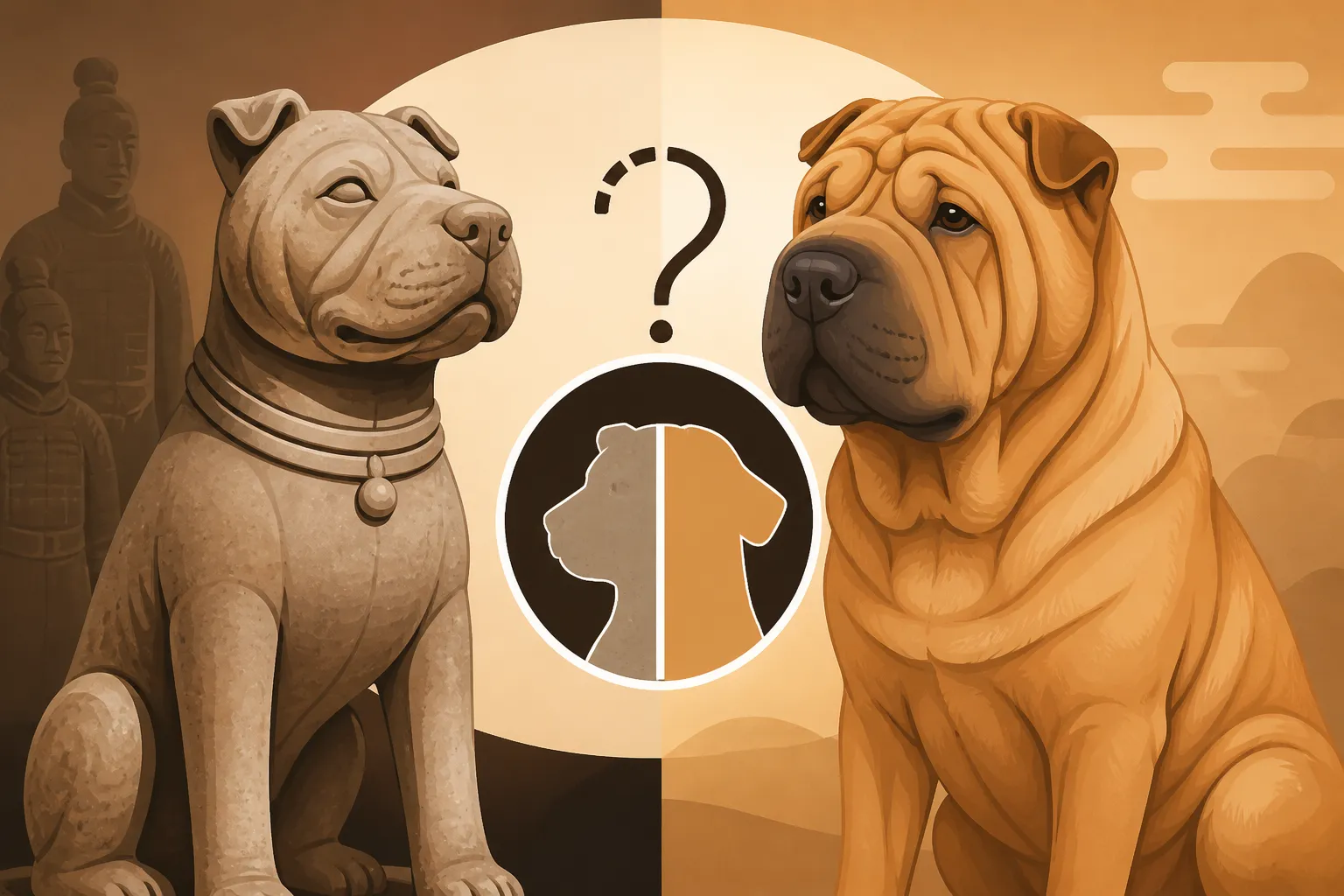
The Han dynasty lasted from 206 BCE to 220 CE, and objects from that period include depictions of dogs. Some figures may share features people now associate with Shar Pei, such as a sturdy build, a broad head, or small folded-looking ears. Those similarities can make the connection tempting, especially when a statue is photographed from an angle that emphasizes its face.
But resemblance is a starting point for a question, not evidence that settles it. A sculptor might simplify a dog’s features, exaggerate a characteristic, or follow artistic conventions rather than portray one particular animal with precision. A small ear on a clay figure, for example, does not necessarily mean the dog had the distinctive ear shape of a modern Shar Pei. Nor does a broad muzzle establish a direct link.
A statue can tell us that people represented dogs and may give clues about how dogs were imagined or valued. On its own, it usually cannot tell us a precise breed name, a dog’s ancestry, or whether its descendants include a modern breed. The question Whether Han Dynasty Statues Show a Shar Pei is therefore best answered with caution: some statues may look Shar Pei-like, but their appearance cannot confirm that they depict Shar Pei.
Why a single statue leaves so much uncertain
Ancient sculptures are not photographs. Their makers worked in particular materials and artistic styles, and practical details could be omitted. A carved or molded dog may have a simplified coat, a stylized face, or proportions chosen to make the figure recognizable as a dog rather than to document an individual animal accurately.
The object’s condition also matters. Features may have been damaged, smoothed, or altered over time. A missing ear tip or worn muzzle can change how a viewer reads the figure. Modern reproductions and cropped photographs can make the problem harder: an image may leave out the sculpture’s scale, surface, or surrounding context, all of which help specialists assess what they are looking at.
Even a more detailed figure may represent an idealized type rather than one specific dog. To make a confident breed claim, researchers would need more than a visual match. They would look for reliable information about the object’s age and origin, compare it with a wider set of evidence, and avoid treating modern breed standards as if they applied unchanged in antiquity.
Why identifying an ancient breed is difficult
Modern breeds are not fixed across thousands of years
A modern breed is usually understood through a combination of ancestry, selection, and recognizable traits. Those traits can be shaped by generations of breeding, and the appearance of a breed can change over time. That makes it risky to look at a dog figure from two thousand years ago and label it using a breed category familiar today.
The Shar Pei’s history is itself complex. The breed is associated with southern China, but the details of its early development are not established simply by finding an old image of a dog with a broad head or a curled tail. Its modern appearance reflects a history that cannot be read directly from one sculpture. For a broader look at the timeline and the limits of what can be known, see How Old the Shar Pei Breed Really Is and Whether the Shar Pei Is an Ancient Breed.
This distinction does not mean a modern Shar Pei has no historical roots. It means that claims about those roots need to be made at the right level of confidence. A dog in an ancient image might belong to a general local dog population, or it might share some traits with later dogs. Those possibilities are different from proving that it belongs to the same defined breed recognized today.
The evidence has to be considered together
A careful historical argument draws on multiple kinds of evidence rather than one striking resemblance. Relevant material might include securely dated objects, written descriptions, regional history, and, where available, biological evidence. Each type has limits, and none automatically answers every question about breed ancestry.
For example, a written reference to dogs in a region could help establish that dogs were present or valued there, but it may not describe their appearance in enough detail to identify a breed. A sculpture might show body shape or posture but leave coat texture unclear. A modern dog’s resemblance to a figure may be interesting, yet resemblance can arise without direct descent.
That is why discussions of the Shar Pei’s background benefit from separating what is documented from what is plausible. The history of the breed’s roles in China is a related topic, but it should not be used as proof that a particular statue depicts one. See What the Shar Pei Was Used for in China for that separate question.
| Evidence | What it may help establish | What it cannot establish by itself |
|---|---|---|
| A dated dog sculpture | That dogs were represented in a particular period and artistic context | The exact breed or lineage of the dog |
| A written description | How people discussed or used dogs | A modern breed identity without distinctive detail |
| Similarity to a modern Shar Pei | A possible visual parallel worth examining | Direct descent or an unchanged breed across centuries |
| Several independent forms of evidence | A stronger historical interpretation | Certainty where the evidence remains incomplete |
What the statues do and do not say about Shar Pei history
A possible resemblance does not prove the breed was unchanged
It is easy to imagine a straight line from an ancient dog figure to a modern Shar Pei: the statue looks similar, so the breed must have existed in the same form. That story is appealing, but it skips the hardest questions. Which traits are genuinely distinctive? How accurately did the sculptor represent them? Were similar-looking dogs common in the region? And how did dog populations change over the centuries?
The Shar Pei’s loose skin and wrinkles are often central to conversations about its appearance. Yet those traits should not be projected onto ancient figures unless the sculpture clearly depicts them. A smooth or simplified surface might reflect the sculptor’s style rather than the dog’s coat and skin. Conversely, folds in a statue might be decorative details, not a deliberate record of a Shar Pei-like body.
The question Whether the Original Shar Pei Was Wrinkly at All highlights why visual history deserves care. An ancient image may contribute to discussion, but it cannot alone tell us how much wrinkling early dogs had or whether their appearance matched today’s Shar Pei. Likewise, Whether Photos of Early Shar Pei Show Fewer Folds explores a different kind of historical evidence: photographs can offer useful comparisons, but they still represent particular dogs at particular moments, not every dog in the breed’s past.
Ancient dog figures may reflect a broader relationship with dogs
Even when a sculpture cannot be assigned to a specific breed, it can still be meaningful. Dog figures may reflect the place dogs held in people’s daily lives, beliefs, or artistic traditions. Their context—where they were found, what they were made from, and what else was buried or displayed nearby—can matter as much as their resemblance to a modern animal.
A dog represented in an ancient setting might have been a working animal, a companion, a symbolic figure, or an artistic motif. The sculpture alone may not tell us which. It is reasonable to ask whether dogs in a region helped guard homes, hunt, or perform other tasks, but those claims need supporting context rather than being inferred from the dog’s shape.
The phrase “ancient Shar Pei” can therefore blur two separate ideas: that dogs existed in China long ago, and that a modern breed with a specific appearance existed in a recognizable form at that time. The first is not the same as the second. A statue can help people picture ancient dogs without proving a continuous Shar Pei lineage.
How to evaluate claims about Han statues and Shar Pei
Look for the claim behind the caption
When an image is labeled “ancient Shar Pei,” pause and ask what the label is based on. Does the description provide the object’s location, date, and collection history? Does it explain which features supposedly identify the breed? Is the claim attributed to a specialist, or is it simply repeated from one image caption to another?
A caption may be written to attract attention, and a visually memorable comparison can spread quickly online. That does not make it false, but it does mean the wording deserves scrutiny. “Resembles a Shar Pei” is a much narrower and more defensible statement than “is a Shar Pei” or “proves the breed existed in the Han dynasty.”
It also helps to check whether the image shows the full object and whether the date is supported by its archaeological context. If the caption offers no details beyond “ancient Chinese dog,” treat the breed identification as interpretation, not established fact. The same caution applies when comparing Shar Pei with other dogs from China. For example, Whether the Shar Pei and the Chow Chow Are Related is a distinct ancestry question; a shared geographic association or an old-looking image does not settle it.
Use a careful conclusion rather than an all-or-nothing answer
A useful answer does not have to choose between “definitely a Shar Pei” and “completely unrelated.” The evidence may support a more measured conclusion: some Han-era dog statues have features that viewers find reminiscent of the Shar Pei, but the figures do not establish that the dogs were members of the modern breed or direct ancestors of it.
That wording protects the interesting part of the question—the visual comparison—without turning resemblance into proof. It also leaves room for new evidence or more detailed study of particular objects. If a specific statue is under discussion, the strongest assessment depends on that object’s provenance, date, physical details, and scholarly interpretation rather than on a general claim about every Han dynasty dog sculpture.
For a wider historical picture, it is also useful to distinguish the Shar Pei’s possible early roots from later changes in its appearance and breeding. Topics such as Whether the Shar Pei Was a Peasant's Dog add context about historical roles, but even that context should not be treated as a shortcut to identifying a sculpture. The most responsible takeaway is simple: Han dynasty statues may invite comparison with Shar Pei, but resemblance alone cannot prove breed identity or an unbroken lineage.
Disclaimer
This article is for general informational purposes only and does not constitute professional advice. Laws, prices and regulations vary by location and change over time. Consult a qualified professional for guidance on your specific situation.