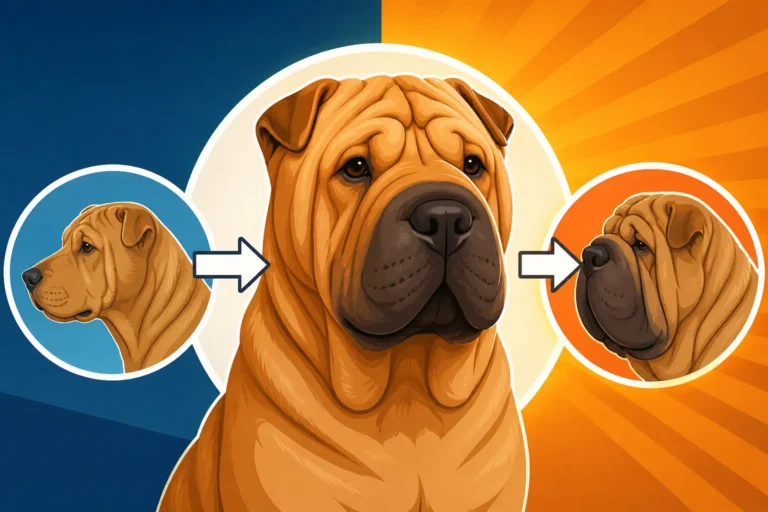
Whether an Adult Shar Pei Should Have Head Wrinkles Only
An adult Shar Pei can look dramatically different from the deeply folded puppy people remember, leaving owners wondering whether those wrinkles have disappeared too quickly—or whether folds across the body are a health concern. Most adults carry their most noticeable wrinkles on the head and withers, but “head wrinkles only” is an imperfect rule. This guide explains what is typical, what deserves attention, and how to care for the skin.
What adult Shar Pei wrinkles usually look like
The head and withers are the usual places for folds
Shar Pei puppies often have loose, folded skin across much of the body. As they mature, their skin and body grow into a more adult shape, and many of those puppy folds become less obvious. In an adult, wrinkles are commonly most visible around the forehead and head, with some looseness at the neck and withers—the area over the shoulders.
That pattern is why people often say an adult Shar Pei should have wrinkles “only on the head.” It’s a useful shorthand, but not a strict description of every healthy dog. The breed standard commonly describes loose, wrinkled skin around the head, neck, and withers, while heavy wrinkling over the mature body is generally not the desired look. Standards can vary between kennel organizations, and individual dogs vary too.
If you are comparing your dog with a photograph, keep in mind that pose, coat, age, weight, and the way the skin is sitting can change how wrinkled a Shar Pei appears. A relaxed dog lying down may have folds that look deeper than they do when standing. A thick neck roll can also make the transition between head and shoulders look more folded than it really is.
For the breed-standard context, see Whether a Shar Pei's Wrinkles Are in the Standard and How Many Wrinkles an Adult Shar Pei Should Have. The practical point is that the pattern matters more than a precise wrinkle count: adults tend to have the strongest folds around the head and shoulder area, not a deeply folded body from nose to tail.
“Head only” does not mean every other fold is abnormal
A few folds elsewhere do not automatically mean a dog is unhealthy or outside a reasonable range of normal variation. Some Shar Pei have loose skin around the neck, shoulders, or rump, and a fold may become more visible when the dog bends, sits, or turns. Body shape also affects how loose skin lies. A dog carrying extra weight may develop deeper-looking creases, while a lean dog may have a smoother outline.
What is more concerning is extensive, deep, persistent folding across the trunk, especially if the skin is difficult to see or keep dry. The breed standard’s preference for less excessive body skin is not just about appearance: close, poorly ventilated folds can hold moisture, warmth, and debris. That can make irritation or infection more likely in some dogs.
A helpful distinction is whether the fold is simply part of your dog’s normal skin shape or whether it is creating a recurring skin problem. If a crease stays damp, becomes red, smells unpleasant, or seems sore, it deserves attention even if it is in a place where you expect a fold. See Whether Body Wrinkles Are a Fault in an Adult Shar Pei for more on appearance versus health, and Whether a Shar Pei's Neck Roll Traps Moisture for a closer look at a common trouble spot.
Why adult wrinkles vary from dog to dog
Puppy skin changes as the dog matures
A Shar Pei puppy’s folds can look strikingly abundant, especially around the neck and shoulders. As the puppy grows, the body lengthens and fills out, so the same amount of loose skin may appear less dramatic. This does not mean the skin literally vanishes in a predictable, identical way for every dog. The pace and degree of change vary, and a puppy’s appearance is not a reliable way to forecast the exact wrinkle pattern of the adult.
Age is only one part of the picture. A dog’s build, family traits, body condition, and the amount of loose skin it inherited can all influence the adult outline. Some adults retain more visible folds than others without having an obvious skin problem. Others have a relatively smooth body and prominent facial wrinkles. There is no simple visual test that tells you whether a particular dog’s skin is healthy in every other respect.
If you are looking at a puppy and trying to predict its adult appearance, avoid relying on one photo or a breeder’s promise that a certain wrinkle pattern will remain. The article Whether a Shar Pei Puppy's Skin Predicts the Adult explores that question in more detail. Likewise, Why a Shar Pei Puppy Has More Wrinkles Than an Adult explains why puppy folds often become less prominent with maturity.
Family traits and breeding choices influence the outline
Shar Pei vary in how much loose skin they carry. Breeding choices can influence the look of a line over time, but a dog’s visible wrinkles are not a complete health assessment. A less wrinkled adult may have fewer skin-care challenges in some areas, yet appearance alone cannot tell you whether that dog is free of allergies, ear disease, fever episodes, or other breed-related health concerns.
It is also worth separating a healthy, moderate amount of skin from an extreme appearance. More folds are not automatically better or more authentic, and fewer folds do not guarantee a problem-free dog. If you are considering a puppy, ask about the health and skin history of close relatives, and look for a breeder who can discuss health concerns plainly rather than treating heavy wrinkling as the only mark of quality.
For a fuller discussion of appearance and health, see Whether a Less Wrinkled Shar Pei Is Healthier and Whether Breeders Are Reducing Shar Pei Wrinkles. Both questions matter because the goal is not simply to maximize or minimize wrinkles; it is to prioritize a dog that can move comfortably and maintain healthy skin.
How to tell normal folds from a skin problem
Watch for changes in the skin, not just the number of wrinkles
A fold that has always been present and stays clean, dry, and comfortable is different from a fold that suddenly becomes red, damp, tender, or smelly. Pay attention to changes such as persistent scratching, rubbing the face or body on furniture, frequent licking, hair loss, scabs, swelling, or discharge. These signs can point to irritation, infection, allergy, or another issue that needs veterinary assessment.
A mild doggy smell after a walk or a bath is not the same as a strong, sour, yeasty, or worsening odor coming from a crease. Nor should a normal fold look raw or feel painful to touch. If your dog flinches when you gently check the area, or the skin looks inflamed, do not scrub it hard or try several products at once. A veterinary team can help identify whether the problem is moisture, infection, allergy, or a combination.
Skin-fold dermatitis can occur where skin rubs together and stays moist. The location may be on the face, neck, tail area, or elsewhere; the pattern is not limited to the folds that look deepest. Read Skin Fold Dermatitis on a Shar Pei for more detail on what that condition can look like and why repeated flare-ups should not be dismissed as ordinary “Shar Pei smell.”
Check folds gently and keep the skin dry
A quick visual check during normal handling is often more useful than repeatedly wiping every fold. Look for trapped debris, redness, dampness, or a change in odor. If the skin is clean and comfortable, there is usually no need to aggressively clean it just because a crease exists. Over-cleaning, harsh products, and vigorous rubbing can irritate sensitive skin and make a small problem harder to settle.
If a fold needs cleaning, use a soft, damp cloth or a product your veterinarian recommends, then gently dry the area. Avoid leaving moisture tucked into a crease. Do not use household disinfectants, scented wipes, or medicated products without veterinary direction. If a fold is persistently dirty or inflamed despite gentle care, the underlying reason may need treatment rather than more frequent wiping.
For supplies, keep the routine simple: clean cloths, a gentle dog-safe option if your veterinarian approves one, and a way to dry the fold carefully. If you shop at Chewy, read the product label rather than assuming that a product marketed for pets is suitable for every skin condition. The same applies at a neighborhood pet shop or veterinary clinic; ask your vet before using an antiseptic or medicated cleanser. Guidance on routine fold care is available in Every Fold on a Shar Pei Is a Place Something Grows.
A practical routine for caring for adult folds
Build a calm, repeatable skin check
Choose a moment when your dog is settled, such as after a quiet walk or while relaxing at home. Lift or separate the skin gently enough to see the crease, without pulling or forcing your dog into an uncomfortable position. Check the forehead, around the muzzle, under the neck roll, and any other places where your individual dog has folds. You do not need to turn a quick check into a long grooming session.
Make a note if a particular area repeatedly becomes damp, smells different, or looks red. A simple record can help you notice whether a problem is linked with bathing, rain, exercise, a new product, or a particular season. If something changes, a clear description and a few well-lit photos can help your veterinarian understand how the skin has progressed—but photos are not a substitute for an examination when the area is painful or worsening.
Routine care should be based on your dog’s skin, not on a rigid schedule copied from another owner. One Shar Pei may need a little attention after getting wet, while another may have folds that stay dry with minimal intervention. If you buy basic cloths or dog skin-care products through Chewy, keep the packaging and ingredient information available so you can show your veterinary team what you have used.
Know when to contact the veterinarian
Contact your veterinary clinic if a fold becomes painful, swollen, raw, persistently damp, or strongly odorous, or if you see discharge, bleeding, or spreading redness. It is also worth asking for advice when a skin issue keeps returning even after you have followed a care plan. Recurrence can mean that the original trigger has not been addressed, or that a different condition is involved.
Seek prompt guidance if your dog seems unwell as well as having a skin change—for example, if there is marked lethargy, reduced appetite, or a fever. A wrinkle pattern itself does not diagnose a disease, and not every skin flare is caused by the folds. Allergies, parasites, yeast, bacteria, and other causes can produce overlapping signs, so treatment should match the cause rather than the appearance alone.
When you speak with the clinic, describe where the problem is, when you first noticed it, whether it has happened before, and what you have applied. If you have been comparing products on Chewy or elsewhere, mention the exact product and how often it was used. That detail can help the veterinarian decide whether to examine the skin, test a sample, or adjust your dog’s care plan.
| What you notice | What it may mean | Sensible next step |
|---|---|---|
| A stable fold that is clean, dry, and comfortable | Often a normal feature of your dog’s skin | Check it during ordinary handling |
| Mild debris after eating or walking | Material may have collected in the crease | Wipe gently if needed and dry the area |
| Persistent dampness or a new strong odor | Irritation or infection may be developing | Contact your veterinary clinic for advice |
| Redness, soreness, scabs, or hair loss | The skin may be inflamed or damaged | Arrange a veterinary assessment |
| Repeated flare-ups in the same fold | An underlying trigger may need attention | Review the history and care plan with your vet |
An adult Shar Pei does not have to match a single wrinkle map to be normal. The head and withers are commonly the most visibly folded areas, while a heavily wrinkled body may raise questions about both breed type and skin care. Pay attention to comfort and skin condition rather than counting creases, and seek veterinary advice when a fold becomes sore, smelly, or persistently irritated.
Disclaimer
This article is for general informational purposes only and does not constitute professional advice. Laws, prices and regulations vary by location and change over time. Consult a qualified professional for guidance on your specific situation.