Whether the Shar Pei’s Skin Helped It Fight
A Shar Pei’s loose skin can look like natural armor, which makes it tempting to assume the breed’s wrinkles evolved for fighting. The history is less tidy: Shar Pei were working dogs with several roles, and some accounts connect them with dog fighting, but appearance alone cannot prove why a trait developed. This guide separates plausible function from popular legend.
What the Shar Pei’s skin might have done
Loose skin can move without stopping the body
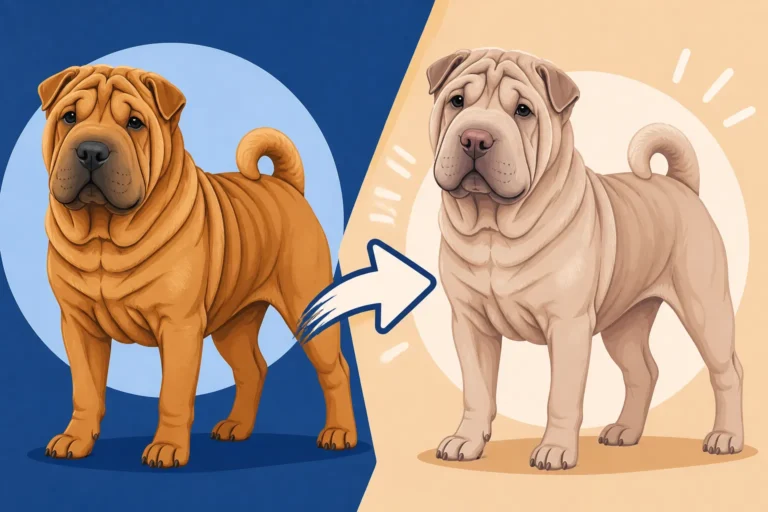
The Shar Pei’s wrinkles are most obvious in puppies. As a dog grows, many body folds become less pronounced, although folds often remain around the head and neck. That changing pattern matters when considering function: the skin is not a fixed suit of armor, and an adult dog is not necessarily covered in deep folds from nose to tail.
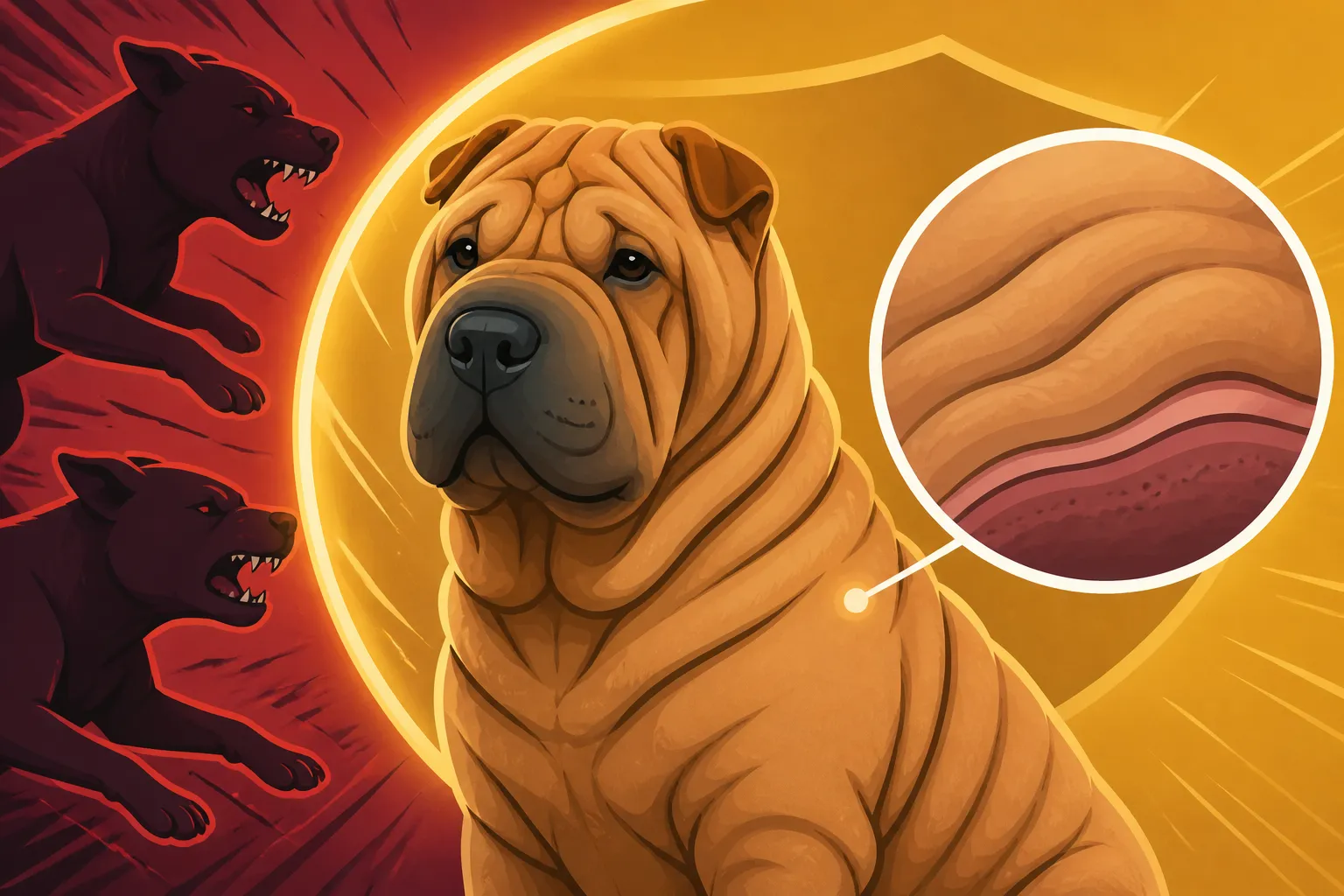
Loose skin can shift over the tissues beneath it. If an animal is grabbed, the skin may move somewhat independently of the body, potentially allowing the dog to turn or pull away more easily than if the skin were taut. This is a reasonable mechanical possibility, but it is not proof that Shar Pei skin evolved specifically for fighting. A feature can be useful in one situation without having originated for that purpose.
It is also easy to overstate the protection this might provide. Wrinkled skin is not equivalent to protective padding, and it would not prevent serious bites or injuries. The idea that a Shar Pei could simply “turn inside its skin” and escape unharmed is a dramatic version of the theory, not a safe or reliable description of what the anatomy can do.
Wrinkles do not tell us a breed’s entire history
A dog’s shape can suggest how it might have been used, but shape alone cannot identify its original job. The Shar Pei’s history is usually described in terms of practical work in southern China, including guarding and hunting. Accounts also connect the breed with fighting, though surviving descriptions do not establish that every Shar Pei—or even every historical line—was bred for that role.
For a broader look at those traditional jobs, see What the Shar Pei Was Used for in China. The question of whether the breed was specifically developed as a pit dog is more complicated than a simple yes or no; Whether the Shar Pei Was a Pit Dog explores that distinction.
One reason the fighting story persists is that loose skin seems to offer an obvious advantage in a physical struggle. But a plausible explanation is not the same as a documented breeding purpose. Historical claims need to be weighed against what is known about the breed’s other work, the limits of written records, and the fact that physical traits can arise and spread for more than one reason.
| Claim | What can reasonably be said | What the claim does not prove |
|---|---|---|
| Loose skin may shift when the dog moves | It could allow some movement of skin over the body | That the trait evolved specifically to resist bites |
| Shar Pei were associated with fighting | Some historical accounts connect the breed with that activity | That fighting was the breed’s only or primary purpose |
| Puppies have more visible folds | Wrinkles often become less pronounced as the dog grows | That adult dogs were originally bred to keep extensive body folds |
| A wrinkled appearance seems useful in combat | It invites a functional explanation | That appearance alone establishes historical intent |
The cautious answer to the title question is therefore: the skin may have offered some practical flexibility, but there is not enough evidence to state confidently that it helped the Shar Pei fight or that it was bred for that purpose.
How to separate historical evidence from breed lore
A trait can be useful without being created for that use
When people see a distinctive feature, they often work backward and assign it a purpose. A broad chest becomes “built for strength”; a curled tail becomes “designed for signaling”; loose skin becomes “made for fighting.” Sometimes those explanations are plausible. Sometimes they are stories that grew more certain with repetition.
A more careful question is whether there is evidence that people selected dogs for the trait because of a particular function. That is different from asking whether the trait could have helped in that function. The skin might have moved freely, for example, without being deliberately selected as a fighting adaptation.
This distinction is useful well beyond the Shar Pei. A feature can be inherited, become common through breeding choices, or be favored for appearance, while also having incidental effects on how a dog moves or handles contact. For related background on early breed shape, see Whether the Original Shar Pei Was Wrinkly at All and Whether Photos of Early Shar Pei Show Fewer Folds.
Modern appearance is not a perfect record of the past
The Shar Pei seen in photographs, show rings, and family homes today is not a frozen snapshot of an ancient dog. Breed populations change. Human preferences influence which dogs are bred, and a feature that is admired may become more pronounced over generations. The modern wrinkled look therefore cannot, by itself, tell us exactly what an earlier Shar Pei looked like or why its skin developed as it did.
This does not mean every modern wrinkle was deliberately exaggerated, or that all breeders have pursued the same appearance. It does mean that claims about historical function should account for changes in breeding and standards. Whether Western Breeders Made the Shar Pei Wrinklier looks at that question, while What Being Saved Did to the Shar Pei's Health offers context about the breed’s more recent population history.
There is also a difference between a breed’s long history and the reliable documentation available for that history. The label “ancient” can sound like a detailed record exists, even when written evidence is limited or interpretations differ. Whether the Shar Pei Is an Ancient Breed is a useful companion topic if you are trying to distinguish tradition from well-supported historical claims.
What the skin means for a Shar Pei today
Folds are living skin, not protective equipment
Whatever role loose skin may or may not have played in the past, today it needs ordinary, careful attention. Folds can hold moisture and debris, especially where the skin stays warm or rubs together. That does not mean every Shar Pei will develop a skin problem, but persistent redness, odor, discharge, soreness, or repeated scratching deserves attention rather than being dismissed as part of the breed’s normal appearance.
Owners often worry that cleaning too much will irritate the skin, while cleaning too little may allow moisture to linger. A practical approach is to follow veterinary guidance, use products intended for the dog’s skin, and dry any folds that become damp after bathing or getting wet. Avoid assuming that a wrinkle needs a special treatment simply because it is a wrinkle. The right routine depends on the dog’s skin and any diagnosed condition.
For everyday supplies, some owners use retailers such as Chewy to find basic grooming items, but a product listing is not a substitute for veterinary advice. If a dog has an active rash or recurring irritation, ask a veterinarian what is appropriate before trying medicated products. Chewy may be convenient for replacing routine items once you know what your dog tolerates, but the label and your vet’s instructions should guide the choice.
Fighting history is not a reason to test a dog’s limits
It is neither fair nor safe to treat a Shar Pei as a fighting dog because of a story about its past. Individual temperament is shaped by genetics, early experience, health, training, and the situation the dog is in. A dog that dislikes rough handling or is uncomfortable around unfamiliar dogs should be managed respectfully, not pushed into confrontations to see what its skin can withstand.
That matters at home as well. Teach children not to grab wrinkles, pull skin, or climb on the dog. Supervise interactions, give the dog a place to retreat, and use calm handling during grooming and veterinary care. A historical theory about skin flexibility does not make grabbing or rough play harmless.
If a Shar Pei’s body language is hard to read, pay attention to the whole dog rather than relying on its facial expression alone. Stiffness, turning away, freezing, repeated lip licking, or trying to leave can signal discomfort. For more on the question of whether loose skin was selected for combat, see Whether a Shar Pei's Loose Skin Was Bred for Fighting. If the practical concern is caring for folds rather than their history, Every Fold on a Shar Pei Is a Place Something Grows covers the everyday side of that distinctive skin.
When shopping for routine care supplies, Chewy can be one place owners look for wipes, towels, or grooming basics, but choose products based on your veterinarian’s recommendations and your dog’s response. A new smell, persistent dampness, or inflamed skin is a reason to reassess the routine—not simply add another product. Chewy listings can help with product descriptions, while a clinician can help determine whether the problem is irritation, infection, allergy, or something else.
The most accurate answer
The Shar Pei’s loose skin may have allowed some extra movement when the body was grabbed, so it is possible that it offered a limited practical advantage in a struggle. But the evidence does not justify presenting that possibility as an established reason the breed developed wrinkles. The Shar Pei had multiple working roles, and accounts of fighting do not erase the uncertainty around how particular traits arose.
A balanced explanation keeps three ideas separate: the breed’s historical association with fighting, the possible mechanical effect of movable skin, and the stronger claim that people deliberately bred the skin as combat protection. The first appears in historical accounts, the second is plausible, and the third is not something appearance alone can confirm.
For today’s owners, the most useful takeaway is much less dramatic: skin folds are part of the dog’s anatomy and need sensible care, but they are not armor. Handle them gently, keep damp areas from staying wet, and ask a veterinarian about persistent skin changes. Chewy may help owners source routine supplies after they know what is suitable, but no product can turn a historical theory into a medical or behavioral fact.
Disclaimer
This article is for general informational purposes only and does not constitute professional advice. Laws, prices and regulations vary by location and change over time. Consult a qualified professional for guidance on your specific situation.