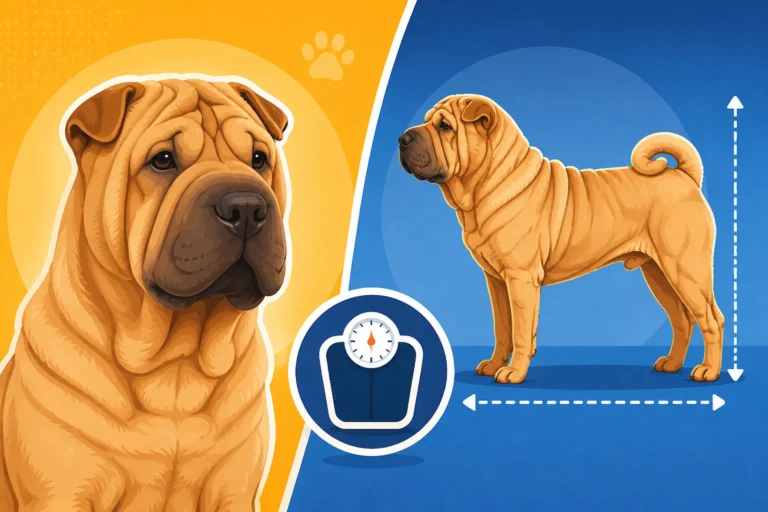
How a Bone Mouth Shar Pei Looks Different
A bone-mouth Shar Pei can look noticeably leaner in the face than the heavier, more padded meat-mouth type, but the difference is not always obvious in a puppy or in a dog from a mixed breeding line. This guide explains the visual clues to look for, what the labels mean, and why appearance alone cannot tell you a dog’s health or ancestry.
What bone mouth means in a Shar Pei
A traditional-looking type, not a separate breed
“Bone mouth” is a commonly used description for a Shar Pei with a less padded muzzle and a more moderate overall appearance. It is often contrasted with “meat mouth,” a type associated with a fuller muzzle and more pronounced facial folds. These labels can help people describe what they see, but they are not universal, tightly defined categories. Dogs may show a mix of features, and people may use the terms differently.
If you are new to the distinction, What a Bone Mouth Shar Pei Is and What a Meat Mouth Shar Pei Is explain the terms in more detail. In everyday conversation, “bone mouth” usually points to a leaner, less exaggerated face, not a different breed or a guarantee of particular ancestry.
The labels can be especially confusing when you are looking at photos online. Lighting, camera angle, a dog’s age, and even how its skin sits while it is standing can change how broad or wrinkled its face appears. A front-facing close-up may make the muzzle seem much heavier than it looks in a side view.
How the type relates to breed standards
People sometimes assume that one type is the “official” Shar Pei and the other is not. In practice, the breed standard used by a kennel organization describes the desired appearance for dogs shown under that organization’s rules. It does not turn every common descriptive label into a separate registered variety. Which Type the AKC Standard Describes is useful context if you are trying to understand how a show standard relates to bone-mouth and meat-mouth descriptions.
A dog’s registration status also depends on its pedigree and the rules of the relevant registry, not simply on whether its face looks more traditional or more heavily padded. If you are considering a puppy, ask the breeder how the litter is registered and what documentation is available. For related background, see Whether a Bone Mouth Shar Pei Can Be Registered.
It is also worth separating visual tradition from proof of origin. A leaner-looking dog may remind someone of older images of Shar Pei, but appearance alone cannot establish a dog’s lineage or demonstrate exactly how its ancestors looked. The historical question is more complicated than a face-type label suggests; Whether the Bone Mouth Is the Original Shar Pei explores that distinction.
The visible differences between bone-mouth and meat-mouth Shar Pei
Muzzle shape and facial padding
The muzzle is usually the first feature people notice. A bone-mouth Shar Pei often has a narrower, less padded-looking muzzle that tapers more clearly toward the nose. The face may look cleaner in outline, with less loose tissue around the lips and cheeks. From the side, the transition from forehead to muzzle may appear less bulky.
A meat-mouth Shar Pei is more likely to have a broad, fleshy-looking muzzle, with heavier padding around the lips and cheeks. That fuller shape can make the face appear wider or more substantial, especially in a close-up photo. The muzzle may seem to blend into the cheek area rather than narrowing as distinctly.
These are tendencies, not rules. A bone-mouth dog can still have a broad muzzle, and a meat-mouth dog may have a more moderate face than you expect. When comparing dogs, look at several angles rather than deciding from one portrait. A side view shows muzzle length and profile; a front view helps you compare width and facial padding.
Wrinkles and loose skin
Bone-mouth Shar Pei are often described as having fewer or less pronounced facial folds, particularly around the muzzle. Their skin may look more fitted to the face, so the outline can appear less crumpled. This does not mean the dog has no wrinkles: forehead folds and loose skin can still be present, and individual dogs vary considerably.
Meat-mouth dogs commonly have more visible folds and heavier-looking facial skin. The extra padding can create deeper creases around the muzzle and cheeks, making the head look rounder or more heavily wrinkled. But wrinkles are not a reliable measuring tool for classifying a dog by themselves. A puppy, for example, may have more loose skin than it retains as an adult.
You may also see variation across the rest of the body. Some dogs have a moderate outline with fewer visible folds, while others have more loose skin at the neck and shoulders. A single wrinkle pattern does not define the whole dog. For broader context on the breed’s appearance, Whether a Shar Pei's Wrinkles Are in the Standard and How Many Wrinkles an Adult Shar Pei Should Have address what wrinkles can and cannot tell you.
Overall build and expression
A bone-mouth Shar Pei may give a more athletic or less exaggerated impression. The head can look more balanced with the body because the muzzle and facial tissue do not dominate the outline as much. Some people describe the expression as sharper or more alert, although expression is subjective and changes with posture, mood, and eye shape.
A meat-mouth Shar Pei may look heavier in the head, with a broader face and more obvious padding around the muzzle. That can create a softer or more imposing appearance, depending on the dog. The body itself does not necessarily follow the same pattern: a fuller face does not prove that a dog has a heavier build, and a leaner face does not guarantee a lighter frame.
| Feature | Bone-mouth tendency | Meat-mouth tendency | What to keep in mind |
|---|---|---|---|
| Muzzle | More tapered and less padded-looking | Broader and more fleshy-looking | Individual dogs vary |
| Facial folds | Often less pronounced around the muzzle | Often more visible around the muzzle and cheeks | Wrinkles alone do not identify the type |
| Head outline | May appear more moderate or defined | May appear fuller or heavier | Camera angle can change the impression |
| Body shape | Not determined by the face label | Not determined by the face label | Assess the whole dog separately |
| Health | Cannot be judged from the label | Cannot be judged from the label | Seek veterinary assessment and health history |
Why appearance can be misleading
Puppies change as they grow
A Shar Pei puppy can look much more wrinkled than the same dog will look as an adult. As the puppy grows into its skin, the folds and proportions may change, and the muzzle can appear different as the head matures. That makes it risky to assign a firm type based on a very young puppy’s appearance.
Photos can add to the confusion. A puppy photographed with its head lowered may appear to have deeper facial folds; a close lens can make the muzzle look broader. If you are comparing a puppy with adult dogs, try to look at clear, natural-light photos from several ages and angles. Ask whether you can meet the puppy and, where possible, see the parents.
A breeder’s description is only one piece of information. Ask what the breeder means by “bone mouth” or “meat mouth,” and request specific examples of the features they are describing. If the answer is mostly about a fashionable label, rather than the dog’s health, temperament, and care, keep asking questions. Whether the Two Types Are Bred Together offers further context on how these looks may occur within breeding.
Labels cannot confirm health or genetics
It is tempting to assume that a less wrinkled dog must be healthier, or that a particular face type guarantees fewer breed-related concerns. That conclusion goes beyond what appearance can show. A dog’s face does not reveal its full medical history, inherited risks, or future health. For a closer look at that question, see Whether a Bone Mouth Shar Pei Is Healthier.
The same caution applies to genetic claims. Visible differences do not let you reliably count copies of a genetic change or determine an individual dog’s genetic result. If a breeder makes a specific claim about a dog’s genetic status, ask what test was used and request documentation rather than relying on photographs or a label. Whether a Bone Mouth Shar Pei Has Fewer Copies discusses why appearance is not a substitute for genetic evidence.
When assessing a puppy or adult, focus on the whole picture: veterinary records, the health of close relatives where known, the dog’s breathing and movement, and how its skin, eyes, and ears are cared for. A responsible conversation about health should be more detailed than “this type is healthier.”
How to assess a Shar Pei in person
Compare the dog from more than one angle
If you are trying to decide whether a dog looks bone-mouth or meat-mouth, view it standing naturally from the front and side. Notice the width and taper of the muzzle, the amount of visible padding around the lips, and how the facial folds sit when the dog is relaxed. Avoid stretching the dog’s skin or pulling its lips back to make a comparison.
Then take a step back and look at the full head and body together. A very close photo can exaggerate muzzle width, while a high camera angle can make the face look shorter. A short video of the dog walking and turning its head can offer a more useful sense of proportions than a single posed image.
If you are meeting a litter, compare puppies calmly and ask the breeder to explain the differences they see. You do not need to choose a puppy based on a label. Temperament, health information, and whether the breeder provides clear, thoughtful answers matter at least as much as whether the muzzle looks more traditional or more padded.
Ask focused questions before choosing a puppy
Ask what the breeder means when they describe a puppy as bone-mouth or meat-mouth, and whether the description reflects their own terminology or a particular breeding line. Ask to see the parents, learn about relevant health history, and review veterinary records. If a breeder presents a type name as proof that a dog will not develop health issues, treat that as a reason to ask for more evidence.
It is also reasonable to ask how the breeder expects the puppy’s face and coat to change as it matures. No one can promise exactly how an individual puppy will look as an adult, but a knowledgeable breeder should be able to discuss the range of appearances in their lines without guaranteeing a specific outcome.
Once you bring a Shar Pei home, practical care should be based on the dog in front of you rather than its label. For example, choose a harness using your dog’s actual measurements, not a guess based on its head type; retailers such as Chewy can be one place to compare sizing guidance, but check the manufacturer’s fit instructions and adjust as your dog grows. If you are buying grooming or skin-care supplies through Chewy or another retailer, read product labels and follow your veterinarian’s advice, especially if your dog has irritation. Appearance can help you describe a dog, but it should not replace individual assessment or good everyday care.
Disclaimer
This article is for general informational purposes only and does not constitute professional advice. Laws, prices and regulations vary by location and change over time. Consult a qualified professional for guidance on your specific situation.